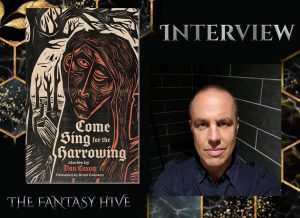
Interview with Dan Coxon (COME SING FOR THE HARROWING)
Dan Coxon has won a World Fantasy Award (Heartwood: A Mythago Wood Anthology), a Saboteur Award (Being Dad) and two British Fantasy Awards (Writing the Uncanny and Writing the Future, both co-edited with Richard V. Hirst). He has been shortlisted for the British Fantasy Awards a total of eight times, and was a finalist for the Shirley Jackson Awards. In October 2025 his anthology of haunted house stories, Unquiet Guests, was published by Dead Ink Books. His second short story collection, Come Sing for the Harrowing, will be reissued by CLASH Books in April 2026.
Your new short story collection Come Sing for the Harrowing is out now from Clash Books. Can you tell us a bit about it, and its journey to publication?
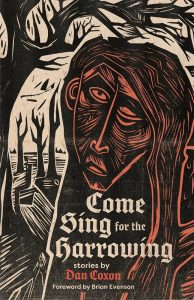
It’s a long story, so I might have to give the short version. In essence, the collection was with a small press publisher in the US called Weird Little Worlds back in 2024 – but then they decided to close their doors and shut down, almost as soon as it came out, so it was suddenly orphaned after a matter of weeks. I always felt that it deserved a bigger audience, and thankfully Christoph at CLASH Books felt the same. This edition has a brand new cover, plus some extra stories – so even if you were one of the handful of people who grabbed a copy of the original print run, this is something new.
As for the book itself, it’s a collection of folk-horror-adjacent stories, tinkering around with the idea of what folk horror is, and smashing it together with things like the Weird and the Uncanny.
You’ve described the stories in this book as “not-quite-folk-horror tales”. What is your work’s relationship to folk horror, and how do you go about approaching it from an oblique angle?
Each of these stories tries to do something different with folk horror. Most of the time it was a case of ‘what if…’ What if we set folk horror in a very contemporary setting and idiom? What if the ancient god isn’t the bad guy? I also play around with form quite a lot, and try to push myself in some slightly new directions (for me). I’ll admit I’ve never been a devoted folk-horror acolyte, but I do like it when it’s done well, and when it plays around with your expectations as a reader.
 A lot of the stories involve the motif of human sacrifice, or at least the idea of some kind of Faustian exchange. What is it about this idea that we find so compelling?
I’ve been asked before about religion in my stories, and I hadn’t really noticed it until that point. Now I can’t stop seeing it. In terms of sacrifice, I always find it interesting to look at just how far some people will go to get what they want – the morality we’re willing to set aside for a cause. I also find the idea of religious or spiritual ecstasy interesting too, I suspect because it nudges up against what I like about the Uncanny (specifically the idea that the mundane world is not as mundane as we think, and is in fact stranger and more wonderful).
Robert Aickman and M.R. James seem like important touchstones to your approach to the Weird. What other authors are you inspired by?
I wouldn’t consider myself an expert on either, and I’m certainly no academic, but as a writer I find many of the effects they achieve both interesting and inspiring. I love Arthur Machen too (he does that ‘religious ecstasy’ thing particularly well) – in fact, I have a Machen-inspired story coming in Nepenthe Press’s The Green Book anthology later this year. When it comes to contemporary fiction, I’m constantly reading new and different writers, always looking for authors I can invite to my anthology projects.
The Aickman thing seems central to me because in a lot of your work the uncanniness comes initially from human behaviour, from people behaving in ways that don’t match our understanding of how social situations ought to work, which is of course a big hallmark of Aickman’s approach to the Weird. Can you talk a bit about how this manifests in your writing?
I have a (possibly unhealthy) interest in atypical responses to situations. All too often, modern reviewers will point to a character and say, ‘oh, but they wouldn’t react like that’ – but if COVID and the lockdowns taught us anything, it’s that people don’t always behave rationally, especially in high-stakes situations. I find it so much more interesting to have a character behave in an atypical way, and then explore why their reaction is so different to what we’d expect. ‘Clockwork’ (in the collection) is an example of that. We’d expect someone to be sad at their father’s funeral, but when they’re not, and they’re angry instead, that sets up a really interesting dynamic to explore.
You also have a number of stories, like ‘Bodies on the Dancefloor’ which takes place in a club, or ‘Beyond the Beach, the Trees’ which takes place in a tropical resort, neither of which are venues we traditionally associate with horror. Was it challenging bringing a sense of uncanny to these settings?
I just love setting stories all over the place. Location is a big part of writing for me, and I’m constantly thinking of new places I can set stories. Again, I think it makes the stories more intriguing, and by setting myself challenges as a writer it pushes me to try something new. Incidentally, the tropical resort in ‘Beyond the Beach, the Trees’ is a real place. I went there about twenty years ago, and it’s obviously been sitting on a mental shelf since then, just waiting for the right story. As for bringing a sense of the Uncanny, in some ways it’s easiest when the main character is out of their depth, or embedded in a culture that they don’t understand. Travel can be deeply unsettling at times.
A lot of the stories feature deeply weird and dysfunctional family relationships. This seems to tie in with Freud’s original conception of the uncanny as the unheimlich, the unfamiliar becoming all that more powerful because it’s found in the familiar and in the home. Is this something that you find particularly resonant?
I think that sometimes the translation of unheimlich as ‘unhomely’ is misleading and rather unhelpful. There can be a focus on the home, yes, but the unheimlich can absolutely occur anywhere. What’s more important is that it’s the familiar made strange, and I think families are a really good example of this – they can feel both familiar but also deeply odd, especially when viewing someone else’s family from the outside. I actually believe that one of the reasons horror (as a genre) is enjoying such a renaissance at the moment is because it often looks at what should be safe spaces, but which are instead unsettling or threatening in some way. It’s allowing the genre to go to some really interesting places in terms of gender and race – and it also lends itself to an intriguing examination of family dynamics.
What’s next for Dan Coxon?
Anyone who’s talked to me over the past few months will tell you that I’m incredibly busy right now! 2026 has kind of ballooned out of proportion. Obviously Come Sing for the Harrowing has just come out, but in May I have a new novella, Where Once He Stood, being published by Black Shuck Books, and a chapbook, Never Land, with Salo Press.
After the summer I have two big anthologies coming: Unearthed, co-edited with Philip Fracassi and published by Titan Books, featuring stories of evil uncovered beneath ancient ruins; and then Unhallowed Gifts with Dead Ink Books, a follow-up of sorts to Unquiet Guests, focusing on cursed objects. There’s also a surprise release that hasn’t been announced yet, and Collective, which I’ve co-edited with Peter Sutton for Luna Press – an essay collection on how we edit anthologies, including pieces by Ellen Datlow, Ann VanderMeer, Mark Morris, Paul Kane & Marie O’Regan, and many more. Busy times!
Come Sing the Harrowing is available now from Clash Books – you can order your copy on Bookshop.org