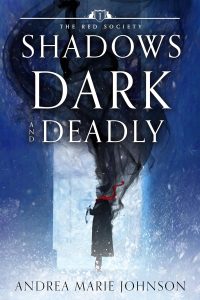
SPFBO 11 Third Semi-Finalist Review: SHADOWS DARK AND DEADLY by Andrea Marie Johnson
Here at the fantasy-hive we don’t like numbers, or stars, or quantifiable ratings – although we do admit we have to give out numerical scores for all of the eventual finalists.
However, rather than put a score on each semifinalist each of our judges is going to rank them as we go through our reviews – inspired by the process used in the SPFBO Champion of Champions contest.
The winning book and chosen finalist will be the one with the best average ranking once all the reviews are done and the judges have ranked all six books. (If there should be a tie on average ranking then the winner will be the one with the most 1st places, if still tied then it will be the one with the most 2nd places and so on.)
This will make for a more dynamic leader table as books can shuffle up or down the list all the way to the sixth and final semi-finalist review.
So on to our third semi-finalist review of SHADOWS DARK AND DEADLY where the judges will comment under the headings of worldbuilding, Prose, Character and Plot, before giving their pithy one line conclusions and fitting this week’s semifinalist into our overall ranking table.
Worldbuilding
Cat: As with The Sea Prince, this is something that drew me in from the first. A London-esque city with its rich and poor areas, interesting Victorian-style social setup, plus magic. That sounds good to me! Unfortunately as the book goes on, it doesn’t really expand much on this. We’re told the heroine would be killed due to her looks based on current enmity between this land and another, but never really why (she’s just really pale with green eyes?). There’s some time given to the hierarchy of those in charge but it flew past so quickly that neither I nor Cerise really understood it. The elemental magic system was fun, but I would’ve appreciated more use of it rather than just being told how powerful some magic-users were over others. One point I really liked was how ‘those of us who are queer, have taken up Isyn, the divinity of rainbows, as our unofficial deity.’ Nicely done.
Theo: The book paints an interesting kind of Victorian era world with elaborate dresses, issues of nobility, etiquette and profound inequality. The different kinds of magic people are able to deploy are nicely alluded to without me ever feeling subjected to a lot of Sanderson style detailed magic systems. As a reader I like to be immersed in the magic without being taught it – yet while also being confident there is a structure and logic behind it – a bit like learning a foreign language.
There’s some nice incidental worldbuilding – with inworld phrases for the protagonist’s near death experience. like “I barely outran Ynes and her soul chalice.” And in this reference to linguistic imperialism
“A little but not too bad.” A small smile touches my lips as I chew on Keir’s little gift.
“Perhaps Lierunese has changed more because of the growing empire bringing in other languages.”
There’s also a nice dose of political intrigue, colonial imperialism and religious fanaticism at work – but I did worry a bit about the centrality of the assassin’s league that the hero works for. I mean these assassins have uniforms and wear an identifying red pin, undergo rigorous training and apprenticeship, do jobs that they get paid for, yet also follow a moral purpose but do so with extreme brutality and torture. Is this a kind of Robin Hood’s merry men band, or a kind of self-appointed secret police? I feel that could have been more coherent.
Vinay: There is a nice sense of a Victorian world here but at the same time there is also a sense of seediness and grittiness in play through the various brothels that seem to exist in this world. There is also a greater sense of worldbuilding through the society of assassins and in an almost John Wick style, there are people who provide those services for them. There is also the larger intrigue regarding the Emperor and Empress especially as it relates to our lead but it’s just very briefly mentioned. The worldbuilding is an element more of a supporting member to the book than being a main character
Prose
Cat: Another well-written book here, with text that flowed nicely so I was rarely lost. The sheer sense of honesty portrayed in the main relationship was appreciated too, with trauma acknowledged and overcome without being trivialised, and toxic masculinity noted and rebuffed.
‘This isn’t an amorous hug full of desire. It’s a desperate need for human contact and comfort.’
My main gripe is that certain words and phrases repeat quite often – Cerise often speaks ‘dryly’ and some of the intimate and action scenes felt a little rushed or clunky. Also we never really get an idea of what some characters look like; descriptions are very basic, and I felt that Keir especially acted very differently to how he looks to Cerise as narrator. I had to go back and check, as he’s never described after the initial shadowy glimpse in a dark alley!
Theo: The prose is effective and, being delivered through Cerise’s first person point of view, manages to convey an air of youthful mischief, painful yearning and a kind of adolescent frustration with the constraints the situation imposes on her. As Cat has noted there are some turns of phrase and themes that seem to get repeated, the maid Adette interrupting Cerise and Keir in a clinch with the announcement of some message or visitor, or Keir waking a sleeping Cerise. Given Cerise’s status as not-yet-acknowledged-apprentice of Keir’s, a lot of action and dialogue based plot development takes place beyond her point of view. This does limit what Cerise can do and talk about. However, I liked this line about Keir giving Cerise a dagger to help with her bad dreams.
Gods regular people would think this is depraved. Oh, you have nightmares? Let’s get you a weapon to cradle in your sleep like a dolly. I’ll never have a normal life.
Vinay: The prose has a nice easy pace to it and it never feels forced or simple. It is a rather well-written book but there are instances where it feels a bit rote and repetitive. There is a great degree of spice in the book and the writing conveys it pretty eloquently and sometimes in great detail. The action sequences, especially with the powers displayed are brief but skillfully executed.
Characters
Cat: Overall, I enjoyed the character portrayals, from the main pair to the NPCs (albeit the latter walk a fine line between existing as individuals and purely serving plot purposes). Cerise is fun and I appreciated her almost Dickensian street survivalist attitude clashing with her past trauma. Keir did seem to flit between Handsome Hero to Real Human Male depending on what he was doing, but given the book as a whole, I could live with that. Also I found myself wishing for more of genderfluid steampunk technician Damara and the below-stairs cast!
Theo: Yup, I agree, Damara was certainly a fun side character and the servants managed to convey an air of depth and enigma beneath the brief appearances they made in the narrative. Possibly those small glimpses left space for the reader to project an imagined depth onto them. I struggled a bit with Keir, possibly because the perspective gives us less insight into his character than we get through riding in Cerise’s head. I felt at times I was being told about his competence (as a brilliant assassin), his humanity (as a killer who hates killing) and his tortured grief (over his previous apprentice’s death) rather than having these things shown to me.
Vinay: It does seem to be the season in our batch of SPFBO to have many 1 to 1 relationships. Cerise and Keir are well fleshed and have their own pasts and mysteries to hide and reveal and those are the characters we spend a lot of time with. Cerise does come across as street-smart in a lot of her interactions but also painfully naive in other aspects and the author does a believable job of conveying that. Keir on the other hand has that mysterious air around him that gets revealed as his inhibitions crumble around Cerise. The only aspect of Keir that I struggled with was inconsistency in his actions and behaviour and for someone who is supposedly the best at what he does, it doesn’t really come across in the actions – I felt that there needed to be a degree of competence that Keir showed.
Plot
Cat: Here’s where things stuck for me. After a good start, the book spends the majority of its pages trapped in a posh townhouse, with Cerise falling asleep virtually every chapter as she spends over half the book trying to overcome her weakness and malnutrition. Keir goes out to do ‘Assassin Things’ and there’s some reference to training (including eating breakfast and then going for a run, which would result in abdominal pain and a potentially messy floor!). Everything takes so very long to move forward, and while I liked the foundational worldbuilding, I reached the ⅔ point wishing that we’d had more action. The main plot is more a romance than a fantasy, which is fine if that’s what the book is intended to be, but if you’re building up a battle between Assassin Guilds, we need more Assassining! (Assissining definitely needs to be a word so to hell with that wiggly red underlining! Theo)
Theo: Yup. It felt like the focus of the book was very much on the romance between Keir and Cerise and the actual plot – a strange fanatic and his sidekick burning down brothels – felt more peripheral than integrated. Partly this is because – with Cerise confined to quarters for so long – she lacks agency in driving the plot forward for much of the book so she has to get her (and the reader’s) significant information second hand. There is a point in the plot where her being locked up for so long, wan and magic-less in the house turns out to have been an advantage for the good guys, but – to my mind – not to a sufficiently great extent to justify the lengthy confinement.
I like Cat’s summary of this as a ‘semi-cosy’ romantasy because – outside the confined to barracks/townhouse moment – there is a lot of bloodshed and torture. Back at home, with Cerise in magical and physical convalescence, the romance gets quite steamy with a lot of rummaging in each other’s underclothes and general levels of heavily breathed hardness and dampness of the straight and sapphic varieties. In Keir’s social mentoring of Cerise and in the long shadow cast by his now dead previous apprentice there are shades of Pygmalion (filmed as My Fair Lady) and Rebecca underpinning the central love story.
Vinay: Honestly, I would have liked to have significantly more meat in the bones of the plot. In between all the sex & sexual tension (yes, there is a lot), sleeping (again a whole lot) and bacon (the breakfast of champions (Hard agree! Theo)), there is very little space for the plot. The opening 10% is quite electric and intriguing but then the book takes a detour to the bed and breakfast of the above mentioned trio of delicacies and the pace slows down. I admit a lot of the attention does go to building the relationship between the leads but relatively very little happens otherwise.There are brief sojourns where things happen but we are back to the confines of the house, back to the same cycle. For a book about Assassins, very little assassination does happen.
Conclusion
Cat: An enjoyable semi-cosy romantasy.
Theo: A steamy romance that could capitalise more fully on its fun magic system.
Vinay: 50 Shades of (Shadowy) Grey with sleep, bacon & magic
And the Current state of play
After three semifinalist reviews our half-way stage table looks like this
| Current Ranking of Books | Theo | Vinay | Cat |
| 1st |  |
|
|
| 2nd |
|
|
|
| 3rd |
|
|
|
And our current leader still with an average ranking of 1.33 is