THE ART OF MIDDLE EARTH by Spiros Gelekas (GALLERY VISIT)
Earlier this year the Hive got an email from Fotis Doukas who is the publicist for Corfu based Greek high fantasy artist Spiros Gelekas, announcing the opening of Spiros’s Art of Middle Earth Gallery. Since I was going on a family holiday to Corfu in June it seemed too serendipitous to pass up the opportunity for a tour of the gallery and an interview with the artist himself. So, on the 9th June I, Ash, my brother-in-law Tim and his wife Edna, found ourselves in a taxi heading to the small village of Vraganiontika to see some Tolkien inspired art.
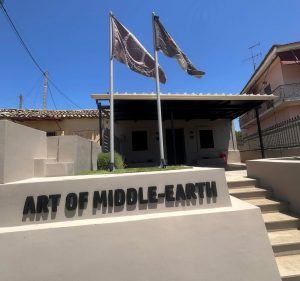 The gallery itself is a small building which used to be Spiros’s art studio and before that a community centre for the village owned by his grandfather. It has been refurbished with a shaded patio area where we sat down for a chat with the author himself before entering the gallery.
Spiros is an enthusiastic raconteur who arrived in Tolkien themed clothing and was keen to talk on a wide range of subjects from his early artistic inspiration to his trail blazing role as the first artist in the Balkan area to do Tolkien themed and inspired artwork.
Unlike many fantasy aficionados, Spiros’s entry into the Tolkien legendarium came not through the Hobbit, but through the Silmarillion – the posthumously published combination of creation myth and prequel story to the Lord of the Rings that many readers have found to be ‘a step too far.’
Reading it in translation into Greek at the age of fifteen he was particularly struck by the image and idea of Ulmo – who, of all the valar, stayed closest to the exiled elves in the tumult of the first age and who bears comparison with Poseidon of Greek mythos. Those parallels between Greek and Tolkien mythos remain strong for Spiros who sees future generations as likely to look back at Tolkien with the same academic rigour and narrative curiosity as contemporary generations look back on Homer.
However, Spiros finds Tolkien’s writing inevitably loses some of its poetry and meaning in translation, or at least these must be reshaped to fit the vessel of a different language, so he prefers to read it in English.
Spiros was also struck by the tale of Luthien and Beren – itself inspired by Tolkein’s own marriage to Edith – which influenced his own thinking on relationships – and indeed is reflected in the design of his own wedding which can be seen on youtube here.
 Despite always wanting to be an artist, Spiros’s initial career – after obligatory military service – was as an interior designer. He established something of a reputation in that profession on Corfu and alongside that work he was developing his skills as a fine artist and securing fine art commissions. However, the 2014 Greek Economic crisis, when Spiros was in his mid-thirties, was a time of great turbulence when many Greek people felt like there was no future and that uncertainty still remains today. In that moment Spiros threw his energy into work as an artist with the modest ambition of making just enough to pay the bills.
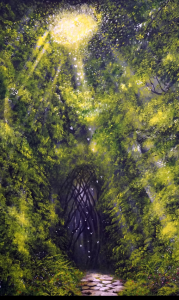 |
In 2016, The Sacred Path of Mirkwood marked the beginning of a new artistic direction shaped by mythology, symbolism, atmosphere, and the literary world of J.R.R. Tolkien. At that point things were so tight that Spiros only had the one canvas to work with and he had to recycle it, by painting it over in black to obscure the previous work before he could begin this foundational piece of his Tolkien Art Journey. The painting was later selected for the National Bank of Greece’s 175th Anniversary Art Competition and we got to see it within the gallery.
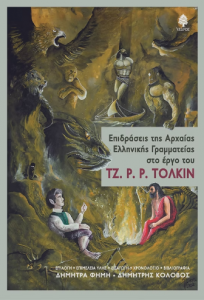
Within the gallery, this piece is placed alongside the original of a more recent work the cover for Oxford academic Dimitra Fimi’s 2021 project on “Echoes of Ancient Greek in Tolkien’s work.” This cover features Tolkien’s Bilbo and Homer’s Odysseus in conversation, each accompanied by the key features and opponents in their respective journeys there and back again. |
 |
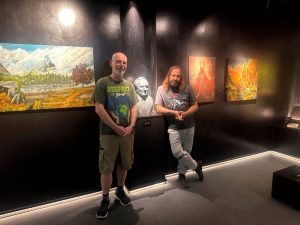
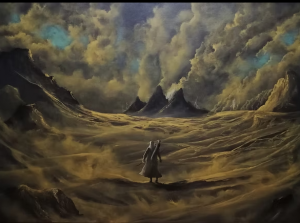
The gallery itself is a modest dark walled room which is home to nine of Spiros’s painting illustrating the inspiration that his art draws from Tolkien’s works. Given that his journey started with the Silmarillion, it is not surprising that events from that work feature heavily such as Beren in Anfauglith, capturing the hero’s journey across the wasteland to confront Morgoth.
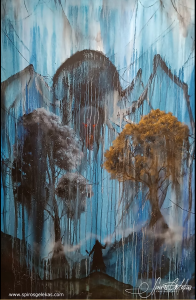
The striking impressionistic image of the darkening of Valinor, with Melkor (soon to be renamed Morgoth) and Ungoliant louring over the twin trees as the world itself seems to weep down the tear-streaked canvas.
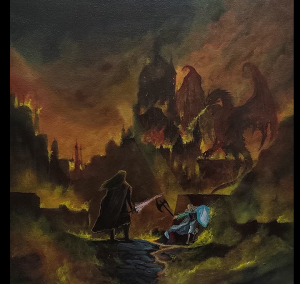
And then there is The Moment that Never Finds Rest in the fall of Gondolin, as Ancalagon the Black sets the city ablaze around the tower of Ecthilion, and Tuor emerges from the darkness to confront Maeglin the betrayer.
Besides artistic recognition on an international stage, with his works sharing exhibitions with Dali and with Picasso, Spiros has been commissioned to contribute sketches and paintings to a number of Tolkien publications including calendars and magazine covers.
With over twelve hundred paintings, some completed in a day, others taking a matter of months, Spiros has had a prolific decade as a Tolken artist, although he prefers to be seen as a high fantasy artist. With, all but forty or so of those works sold on, Spiros has been able to do somewhat better than ‘just meeting the bills.’ However, he remains committed to supporting both to his own local community in Vragoniatika as well as the wider fantasy community of artists and other creatives. This is one of the reasons why the gallery is located outside the main town of Corfu and in a village enroute to kavos, where it can be accessed by bus or taxi – but only by appointment with Spiros himself. The other reason Spiros gave is a Greek pun, as the name of the local community ‘mesi gi’ literally translates as middle-earth, because it lies at a point exactly midway between Corfu’s two main ports.