
Fantasy-Hive

Main Menu

  • Home
  • About Us
  • Interviews
    • Author Spotlight
    • By Author Surname
  • Book Reviews
    • Latest
    • Hive Reads
    • Self-Published
    • By Author Surname
  • Writing
    • Write of Way
    • Worldbuilding By The Numbers
  • Features and Content
    • Ask the Wizard
    • Busy Little Bees Book Reviews
    • Cover Reveals
    • Cruising the Cosmere
    • Excerpts
    • News and Announcements
    • Original Fiction
      • Four-Part Fiction
    • SPFBO
    • The Unseen Academic
    • Tough Travelling
    • Women In SFF
    • Wyrd & Wonder
  • Top Picks

logo

Fantasy-Hive

  • Home
  • About Us
  • Interviews
    • Author Spotlight
    • By Author Surname
  • Book Reviews
    • Latest
    • Hive Reads
    • Self-Published
    • By Author Surname
  • Writing
    • Write of Way
    • Worldbuilding By The Numbers
  • Features and Content
    • Ask the Wizard
    • Busy Little Bees Book Reviews
    • Cover Reveals
    • Cruising the Cosmere
    • Excerpts
    • News and Announcements
    • Original Fiction
      • Four-Part Fiction
    • SPFBO
    • The Unseen Academic
    • Tough Travelling
    • Women In SFF
    • Wyrd & Wonder
  • Top Picks
Book ReviewsFantasy
Home›Book Reviews›The Killing Moon by N. K. Jemisin

The Killing Moon by N. K. Jemisin
By Laura M. Hughes
September 15, 2017
7229
0

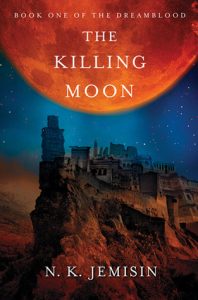
The Killing Moon (Dreamblood) by N. K. JemisinThe Killing Moon is a fantasy tale set in a region based loosely on ancient Egypt and Nubia. The author uses delicate prose to weave a sad, captivating tale of love, loss and loyalty against a backdrop of religious conflict and political intrigue.

The plot of The Killing Moon revolves around an innovative system of magic based on a combination of Freudian dream theory and ancient Egyptian medicine. The idea is that there are four natural by-products of dreaming: dreambile, dreamblood, dreamichor and dreamseed. Each of these can be harvested from anyone, and each has its own uses in religious healing, but the most rare and valuable is dreamblood. Dreamblood is produced at the moment of death, and can only be collected by Gatherers, who are essentially assassins completing contracts submitted to their order, the Hetawa. However, unlike most fantasy assassins, Gathering is mostly a peaceful art, and many of the victims, or ‘tithebearers’, are old or sick people who submitted the request to be Gathered on their own behalf, or that of a loved one. Jemisin uses vastly different character perspectives on the art of Gathering to explore, but not dwell on, what is essentially a moral debate about the ethics of euthanasia, and uses this as the foundation of the cultural differences between the warring states of Gujaareh and Kisua.

With a few exceptions, the story is told from the point of view of three main characters: Sunandi, a Kisuati ambassador trained in the art of negotiation and spying; Ehiru, the most revered Gatherer in Gujaareh; and Nijiri, Ehiru’s apprentice and closest friend. Each of the characters is likeable in their own way, and each hold different views, coming into conflict in a number of ways. However, I didn’t really feel much of a connection with any of them, and felt that the formal traditions and heavy focus on religion kept the characters at a distance, particularly Ehiru and Nijiri. I felt that they could perhaps have been developed more as individuals, despite the relatively short length of the book and the confines of the story.

The plot itself is intriguing, if fairly straightforward. A series of mysterious and horrific murders can mean only one thing: a Reaper – a monster possessing abilities that are a twisted perversion of a Gatherer’s own – is loose in the dark streets of Gujaareh. Somehow, its appearance is connected to both the royal Prince and the Hetawa, and an investigation into its origin reveals even darker plots of corruption and impending war. The characters’ journey of discovery throughout the novel is an intriguing and pleasant read, with a couple of twists and turns along the way. The pacing is steady and fluid, although the author foregoes much of the action, choosing instead to focus on the internal conflict of both Ehiru and Nijiri. For the most part this is fine, as there are plenty of beautiful moonlit cityscapes and evocative dream sequences to fill the imagination. However, there are two major conflicts towards the end, both of which happen entirely off-page, making the aftermath and epilogue somewhat anticlimactic and leaving me feeling a bit hollow.

Despite this, I look forward to reading book two in this duology, The Shadowed Sun. I enjoyed the writing style and flowing pace of The Killing Moon, and in spite of the disconnect I felt with the characters, I was thoroughly immersed in Jemisin’s world.

TagsBook ReviewsDreambloodEhirufantasyN. K. JemisinOrbit BooksThe Killing Moon

Laura M. Hughes

Laura works as a freelance editor beneath the grey, pigeon-filled skies of northern England. When she isn’t working on a manuscript or writing for the Hive, you're most likely to find her on Twitter, playing Dragon Age, or hoarding polyhedral dice. Laura also writes LitRPG under the pen name Demi Harper; her first novel, GOD OF GNOMES, was published in September 2019. She created The Fantasy Hive in 2017; her sanity has been steadily disintegrating ever since.

Leave a reply Cancel reply

Welcome

Welcome to The Fantasy Hive

We’re a collaborative review site run by volunteers who love Fantasy, Sci-fi, Horror, and everything in-between.

On our site, you can find not only book reviews but author interviews, cover reveals, excerpts from books, acquisition announcements, guest posts by your favourite authors, and so much more.

Have fun exploring…

The Fantasy Hive Team

Visit our shop

Content

  • Ask the Wizard
  • Cat & Jonathan’s Horror Corner
  • Cover Reveals
  • Cruising the Cosmere
  • Excerpts
  • Guests Posts
  • Interviews
  • Lists
  • The Monster Botherer
  • News and Announcements
  • Original Fiction
  • SPFBO
  • Top Picks
  • Tough Travelling
  • Women In SFF
  • Wyrd & Wonder
  • The Unseen Academic

Support the Site

Archives

  • December 2025
  • November 2025
  • October 2025
  • September 2025
  • August 2025
  • July 2025
  • June 2025
  • May 2025
  • April 2025
  • March 2025
  • February 2025
  • January 2025
  • December 2024
  • November 2024
  • October 2024
  • September 2024
  • August 2024
  • July 2024
  • June 2024
  • May 2024
  • April 2024
  • March 2024
  • February 2024
  • January 2024
  • December 2023
  • November 2023
  • October 2023
  • September 2023
  • August 2023
  • July 2023
  • June 2023
  • May 2023
  • April 2023
  • March 2023
  • February 2023
  • January 2023
  • December 2022
  • November 2022
  • October 2022
  • September 2022
  • August 2022
  • July 2022
  • June 2022
  • May 2022
  • April 2022
  • March 2022
  • February 2022
  • January 2022
  • December 2021
  • November 2021
  • October 2021
  • September 2021
  • August 2021
  • July 2021
  • June 2021
  • May 2021
  • April 2021
  • March 2021
  • February 2021
  • January 2021
  • December 2020
  • November 2020
  • October 2020
  • September 2020
  • August 2020
  • July 2020
  • June 2020
  • May 2020
  • April 2020
  • March 2020
  • February 2020
  • January 2020
  • December 2019
  • November 2019
  • October 2019
  • September 2019
  • August 2019
  • July 2019
  • June 2019
  • May 2019
  • April 2019
  • March 2019
  • February 2019
  • January 2019
  • December 2018
  • November 2018
  • October 2018
  • September 2018
  • August 2018
  • July 2018
  • June 2018
  • May 2018
  • April 2018
  • March 2018
  • February 2018
  • January 2018
  • December 2017
  • November 2017
  • October 2017
  • September 2017
We use cookies to ensure that we give you the best experience on our website. If you continue to use this site we will assume that you are happy with it.