
Amberlough by Lara Elena Donnelly
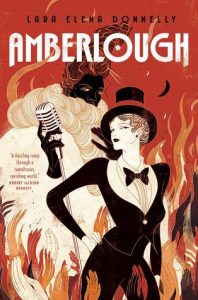 “At the beginning of the workweek, most of Amberlough’s salary-folk crawled reluctantly from their bed – or someone else’s – and let the trolleys tow them, hungover and half asleep, to the office. Amberlough City, eponymous capital of the larger state, was not home to many early risers.”
Amberlough (2017) by Lara Elena Donnelly is a lyrical and haunting fantasy novel. Centred around the Weimar-era Berlin decadence of the cabaret scene in the fantastical city of Amberlough, the novel is a celebration of sexual liberation, and an elegiac portrait of the fall of liberty to fascism. Drawing more from the Cold War intrigue of John Le Carre’s spy novels and the decadent glamour under threat in Bob Fosse’s film of Kander and Ebb’s Cabaret (1972) than from Tolkien or Martin, Donnelly has written an original and unique fantasy whose warnings about the horrors of living under fascism could not be more timely.
Amberlough City is the capital of Amberlough, one of the five states of Gedda. While its people enjoy the sexual freedom of its decadent night life, the rest of Gedda is beginning to fall under the sway of Caleb Acherby’s One State Party in Nuesklend, the Ospies, who want to unify Gedda at the cost of its thriving diversity. Cyril DePaul is a secret agent working for the Federal Office of Central Intelligence Services. Retired from the field after a mission gone south nearly costs him his life, Cyril is called back for one last mission, to go to Nuesklend and infiltrate the Ospies. Cyril’s lover, Aristide Makricosta, MCs at the Bumble Bee Cabaret. He also runs a major smuggling ring. As the Ospies strengthen their hold over Gedda, Cyril goes from trying to protect Aristide from the fallout to desperately needing his lover’s help. Aristide enlists Cordelia Lehane, one of the dancers at the Bumble Bee Cabaret and one of Aristide’s runners, to hide Cyril’s sexuality while he is with the Ospies and to act as a go-between. As the political situation in Gedda worsens, these three people are driven to more and more extremes as they each in their different ways struggle to survive the impending onslaught of fascism.

Donnelly portrays a vibrant, diverse community falling under the heel of fascism with heartbreaking plausibility. Fascism spreads through Amberlough like a rot, until the streets of the city are no longer filled with the revels of the sexually liberated populace but are prowled by gangs of jackbooted thugs. Amberlough’s 1930’s-era chic, with its trolleys, its cafes and its burlesque clubs, is eroded into boarded up, graffiti strewn decay. This transformation has clear echoes of Weimar Republic era Germany falling under the sway of the Nazis. Donnelly’s characters all come to realise that their lifestyles will no longer be tolerated by the state they live under, and the parallels with real life history give their struggles a sense of urgency and vitality; our historical understanding of the worse horrors Gedda likely has ahead of it give the story added poignancy.
Donnelly’s characters find themselves labelled as undesirables under the new Ospie regime for a range of reasons that reflects their different backgrounds and life history. Both Cyril and Aristide’s homosexuality make them targets of state sanctioned and private violence. However Cyril comes from a wealthy family; the DePauls being descended from a respected Amberlough General. Compared to Aristide, an immigrant visibly marked out as such by his darker skin, Cyril comes from a position of comfortable privilege which allows him to pass among the Nuesklend elite in the first place. Cordelia is from a working class background, and supplements her meagre income from the Bumble Bee Cabaret by running drugs and turning tricks. She has been forced into a life of petty crime through desperation and a lack of other options. Her criminal activities and her association with the Bumble Bee Cabaret, which the Ospies see as a symbol of Amberlough’s moral decadence, pit her against the Ospies and their desire for increased social control.
Cyril, Aristide and Cordelia’s different perspectives and personalities allows them to bounce of each other pleasingly; in particular Cyril and Cordelia develop an amusing odd couple relationship. However Donnelly puts this to effective dramatic and thematic use. All three characters are to one extent or another using each other. Cyril’s privilege is contrasted against Aristide and Cordelia’s more streetwise nature. His initial desire to protect them from the fallout of the Ospie takeover is stymied by his own cowardice, and ironically both Cordelia and Aristide wind up being better at looking after themselves and him than the other way round.
 Donnelly’s characters are complex, and all wind up being compromised to some extent; one cannot act within the strictures of a fascist society and keep one’s hands clean. Amberlough asks if it is even possible for a person to live ethically in a morally corrupt society. Cyril bargains his safety and the safety of his lover against that of the whole of Gedda, and thus winds up assisting the Ospie rise to power. Aristide, because of his connections in the criminal underworld, is far more effectively able to help himself and those close to him evade capture and escape from Amberlough before it’s too late. However he is also looking out for himself and his friends, and has no desire or hope of fighting the Ospie regime. His best option is to escape and rebuild, his resilience of character that allowed him to escape his previous life as a sheep farmer to become a club MC and a drug kingpin give him the strength to do this. Cyril’s conflicts with his own selfishness and his understanding of the horrific consequences of his actions lead him to dither and wind up causing more harm, even as he flirts with atonement. Cordelia witnesses her friends in the Bumble Bee Cabaret murdered and driven to suicide. She winds up driven to terrorism to fight the Ospie regime, exploiting Aristide’s contacts to gather munitions.

Throughout Amberlough reminds us powerfully that the wages of fascism are paranoia, violence and death. Donnelly made a conscious choice to write Amberlough as Fantasy. One could justifiably ask if it would be possible to tell the same story set in 1930’s Weimar Republic Germany and achieve the same effect. What Donnelly gains by writing Amberlough as fantasy is that she is able to evoke that era without tying the novel to a closed historical narrative where the audience knows how it plays out. This allows her to highlight the relevance of her story to our own unfinished present, where we see the worrying rise of the far right across the Western world. Because Donnelly doesn’t compromise her vision – she plays hardball, forcing her characters to face the consequences of their actions and decisions, and working them through with a relentless logic – it allows Amberlough to function as a vivid and powerful warning. Amberlough‘s vivid setting and fully realised characters get under the reader’s skin, and force them to ask uncomfortable questions about our own present and our own moral complicity. It is this that makes Amberlough such a timely and necessary novel.
This review appeared on Fantasy-Faction on 2nd May 2017.
