The Eye of the World by Robert Jordan
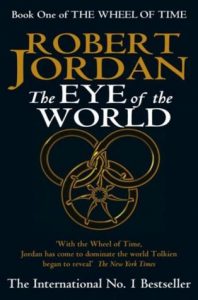 Let me put something in perspective.
If you read Neuromancer, you remember the surreal paradise of Straylight, the space station Case and the crew travel to. You remember McCoy Pauley, the “Flatline,” his accent, and his bizarre dead man’s laugh. You remember the sequence when Case jacks into the matrix to take on the T.A. AI. And if you’re like me, you remember the last line, “He never saw Molly again.”
The entire story of Neuromancer took place in 270 pages. All of its minutely detailed worldbuilding, its revelations about Riviera and Wintermute, and Case’s struggles to get over Linda Lee are encapsulated in those 270 pages.
Page 270 is where I stopped reading The Eye of the World from sheer disinterest. There were no characters I cared about, no aspects of the world that captured my imagination, and nothing in the plot that made me keep turning pages. In the space of 270 pages, the same length that entire masterpieces of fantasy/sci-fi have been written, nothing of substance had even appeared to give me a reason to finish the book.
Let’s go deeper here.
Wizard of Earthsea. If you read the first book in the Earthsea series, you know Ged becomes Ogion’s apprentice, travels to Roke, stays a year in Kurremkarmerruk’s tower learning runes, builds a rivalry with Jasper, unleashes a gebbeth on the world, fights a clan of dragons to a stand-still, finds the Ring of Erreth Akbe on an abandoned sandbar, and travels to the end of the world to confront his own death in 183 pages.
The Fellowship of the Ring. By page 200 in Fellowship, Frodo and his friends have already made it through the Old Forest, the Barrow-Downs, and the encounter with the Ringwraith on the road. They’ve encountered Elves on their travels, watched Bilbo disappear, and Frodo has learned about the diabolical nature of the Ring and the stakes of destroying it.
In 270 pages or less, each of these stories accomplished what Eye of the World did not: present an engaging cast of characters, the beginnings of an interesting, well-paced plot, and a reason to care about any of it. You could say everyone’s tastes are different, and that if I didn’t like it, that has everything to do with me and little to do with the story. As a writer, I disagree.
To borrow from Harry Plinkett’s Star Wars prequel reviews, a litmus test that every character in fiction should be able to pass is to have someone describe them without explaining their appearance, their job, or role in the plot of the story. What’s their personality, their character? What do they want, and what drives them as a person? Taking a step beyond that, are the character’s desires or goals driving the story? What will they get at the end of it all? All of these are roundabout ways of saying “Why should I care about what happens in this story?”
I couldn’t answer any of these questions about the characters or the plot of The Eye of the World because, as in most D&D campaigns, the story lurches forward because The Plot requires it to. This isn’t a story about people struggling for something, this is a puppet show. Set on a pair of rails, the characters have to play along with no agency and no motivation beyond staying alive.
I’ll make a note here about Egwene, who develops the desire to become an Aes Sedai after Moraine reveals her ability to channel. Egwene has a personal stake in getting to Tar Valon: she wants to become special and learn the extent of her abilities. But Egwene’s presence on the journey to Tar Valon is so incidental, so badly rationalized as “a part of the Pattern,” that it renders her whole role in the plot moot.
But what frustrates me almost as much as the characters and plot is the insistence on the part of fans that The Eye of the World represents good, even great worldbuilding. As I’ve said before, good worldbuilding has very little to do with depth or complexity and everything to do with how it immerses readers in the story at hand. Looking at H.P. Lovecraft’s Mountains of Madness, the overwhelming detail of the expedition’s gear and supplies ends up grounding you a scientific mindset that makes everything afterward, from the frozen city to the ice to the shoggoths, all the more credulous and frightening.
Instead, The Eye of the World alternates between spending page after page describing mind-numbing, mundane medieval farming life and reeling off long expositions about this world’s history and lore, the most egregious example being Moraine’s recounting of the heritage of Edmond’s Field. There is nothing immediate and applicable about these details, like Neuromancer’s complex descriptions of the technology Case is using, and nothing vivid and interesting that reminds me I’m in a fantasy world, like Case’s wanderings through Night City.
Someone might argue that Jordan’s prose is what makes everything hang together. I read 1100 pages of Neal Stephenson’s Cryptonomicon almost on the strength of the writing alone. If anyone sits down and compares the writing in Eye of the World to a random chapter in Cryptonomicon (even the one with the Captain Crunch), the difference in sheer vividness will be immediately clear.
So, to sum it all up: I don’t think The Eye of the World is a good fantasy book. I don’t think it represents what fantasy should be, or what a book should do. If it can’t give me one good reason to keep reading it in the span of pages that other books have told entire stories, I think it’s safe to say that it’s not a good book overall.