
Frontera by Lewis Shiner (Book Review)
“’Kane, man, this is not a myth. This is happening. Real Russians, real lasers, real corpses, real soon.’
“’But what if the other was real, too? Like some kind of tension in the universe, and it has to keep happening over and over again until somebody gets it right. See, because Jason got the Fleece but he didn’t do it right and ended up all alone, an outcast. Percival gets to see the grail, but he doesn’t get to keep it. Yamato-Takeru was a great warrior, but his spirit was weak and that was what killed him.’”
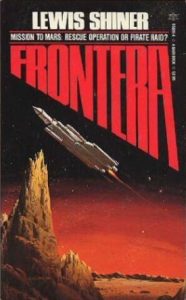
By the time his short story ‘Till Human Voices Laid Us Low’ and his collaboration with Bruce Sterling ‘Mozart In Mirrorshades’ were included in Sterling’s 1986 genre-defining cyberpunk anthology Mirrorshades, Lewis Shiner had already published his debut novel Frontera. Shiner’s first novel might surprise those only familiar with cyberpunk via William Gibson’s Neuromancer (1984), published the same year. Frontera contains no mention of cyberspace, and takes place largely on the decaying Mars colony that gives the novel its name. Given its hard science approach to the colonisation of Mars, and its plot’s reliance on heroic motifs from Joseph Campbell’s Hero With A Thousand Faces (1968), at a surface glance one might mistake it for a more pessimistic take on Golden Age SF tropes. However, Frontera is a much more interesting book than that. Shiner’s protagonist, the mirrorshades-wearing Kane, is a broken man, both physically and mentally, and the novel shows how his attempt to live out the heroic mythic cycle only leads to more violent toxic masculinity. In its exploration of Kane’s post-traumatic stress disorder and his Freudian father issues, the novel deconstructs the typical heroic male figure as well as the myths that power them.
Given that virtual reality is absent, it’s worth looking at what makes Frontera feel aligned with more typical examples of cyberpunk. Shiner depicts an Earth suffering in the violent throes of late-period capitalism – nation states have collapsed, and giant corporations have essentially taken their place, to the extent of having wars between each other using their own private security forces as armies. This has led to a situation where those not employed by the companies are out on their own, resulting in extreme poverty and riots. Though the Cold War rivalry and the threat of a nuclear World War III hang over the story, the antagonistic forces are private enterprises whose CEOs have decided that reinvesting in space travel will open up new frontiers for their voracious desires for profit, now that Earth is nearly bled dry. Shiner’s future has a tangibly used feel to it, from the decaying Mars base of Frontera itself to the repurposed NASA and Soviet spacecraft the characters travel in. Kane’s first view of Frontera is telling:
“He’d been nearly unconscious when they brought him from the ship to the infirmary, and now, stepping out under the dome for his first real look at the colony, Kane felt only dismay. He’d expected something that looked like the future, and what he saw reminded him of a shopping mall in decay: cramped, faded, lived-in.”
The utopian futurism of the 1960s has been replaced by the tired corporate cynicism of the 1980s. Frontera is not a romantic or exciting venue for exploration and venture, it is a dismal run-down recapitulation of the worst of American suburbia where the inhabitants have coped with the gruelling labour required to stay alive by retreating into private worlds of alcoholic despondency. This is underscored by Kane’s antagonist, Curtis. Following the collapse of the original efforts to found Frontera, which resulted in the colonists being stranded on Mars and left to die, Curtis’s charisma and ambition inspired the remaining colonists to survive. However, now that it is apparent that the futurist dreams promised them are not achievable, he has become a cynical, power-hungry dictator who runs the colony as a surveillance state. His arrogance and narcissism cause many deaths and nearly kickstart World War III back on Earth.
Another aspect that situates Frontera in the realm of cyberpunk is Kane’s neural implants. Having suffered a severe head injury whilst fighting in the corporate wars over resources in Africa, Kane’s life is saved by implanting a computer into his brain, which unbeknownst to him can be loaded with different discs, allowing Morgan, his unscrupulous uncle and head of Pulsystems, to essentially programme Kane against his will. Because Kane studied mythology at university, his programming manifests as mythic images and visions which convince him that he is a hero acting out a Campbellian heroic cycle. Thus Kane is literally programmed by the tropes and assumptions of popular mythology. This is a wonderfully clever metaphor for the way stories and narratives “programme” us with certain assumptions about the world and our place in it. However, in real life this is something that can frequently be problematic. The masculine nature of the Campbellian archetypes reduces women to objects to be won by the hero, and so can encourage men to assume they are entitled to women’s sexuality as a “reward”. The brilliance of Frontera lies in Shiner’s willingness to explore this, whilst using the Campbellian cycle as a scaffold to give structure to the story. Kane’s programming does not make him actually more heroic – the disastrous conflict between various corporate interests and the colony’s groundbreaking discoveries are in the end defused by Molly, one of the colonists, Verb, her estranged prodigy daughter, and Mayakenska, a Russian cosmonaut whose sacrifice prevents further bloodshed. Kane’s fixation on winning a boon to take to Earth and his need to achieve this through violent confrontation with Curtis make him a liability who must be kept out the way while the female characters do the actual work. In the end, his macho conflict with Curtis only results in escalating both characters’ violent tendencies and toxic masculinity. Kane’s big moment of heroism comes from him ultimately resisting the control of his programming to leave the technology that Morgan is desperate to get his hands on with the colonists so they can repair the damage caused by the conflict between Curtis, Kane and the Russians, a final throwing off of the multiple absent but domineering father figures in his life that allows him to take back control of his own destiny.

[…] and by the way, I really appreciate the review you did of Frontera. You showed me some stuff in there that I was not all that conscious of, and made me feel better […]