THE MILL: A COSMOS by Bess Brenck Kalischer (BOOK REVIEW)
Bess Brenck Kalischer – The Mill: A Cosmos (1922, translated by W. C. Bamberger 2021)
“The concave mirrors were so oddly dimmed. The big city pierced me. All the flesh had fallen from it. Travel posters were pasted about its skeleton. The dwarves’ dwelling, a goblin-contemplation.
No sooner had I read this, which made my stomach turn, than I suddenly also had eyes on the inside, as rockets flew out of the posters and every shell that burst was a little story.”
Bess Brenck Kalischer was a German expressionist poet. The Mill: A Cosmos is her only novel. It was published in German in 1922 but has remained unpublished in English until now, thanks to a translation by W. C. Bamberger released by Wakefield Press. This is excellent news for fans of experimental literature and unconventional uses of the fantastic and speculative. Kalischer’s novel, which tells the story of a woman in a sanatorium undergoing a traumatic breakdown, is an audacious, confounding and visionary text. The Mill portrays its protagonist’s journey through madness via a disjointed narrative that draws from fairy tale, science fiction and mythology to inspire its glorious flights of unfettered dream imagery. Its fractured narrative successfully conveys a real sense of madness and confusion, moving from wry parody to poetic flights of fancy and back again. Utterly strange and inspired, once taken it is a journey not soon forgotten.
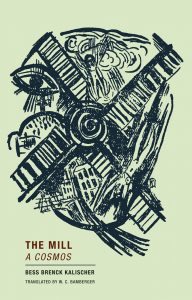 The Mill: A Cosmos opens with a quote of the Swedish saying, “Much bread rises in a winter night.” This is immediately followed by the nightmarish image of a monstrously enormous mill emerging from the ground. The image of bread and mills is central to the novel, and the saying hints that, though the protagonist faces a frightening night, they will emerge from it stronger and wiser. The novel’s protagonist is an unnamed woman who is being kept at an institute following a breakdown, but this is information that is only given to the reader towards the end of the book, when we encounter a section of a doctor’s report on her condition mixed in with the novel’s stream of consciousness prose. The reader is dropped right into Kalischer’s disconcerting imagery and fragmented narrative with little in the way to orient themselves; part of the pleasure of the novel is surrendering oneself to Kalischer’s sweeping vision. There isn’t much in the way of coherent plot, but the psychological force of the novel is astounding, as we are taken on a journey through a traumatised mind as it slowly pulls itself back together. In this way, Kalischer’s novel anticipates the experimental work of Anna Kavan in works such as Asylum Piece (1940).
The trauma of the First World War hangs heavily over The Mill, with its repeated imagery of bombs, violence and torn-up earth. Much of Kalischer’s imagery is nightmarish and disconcerting, a journey through a mind as ravaged as the post-war landscapes her prose echoes. The protagonist’s only guide is a figure she refers to as “my mysterious being”, who maybe an angel, or a demon, or the protagonist’s inner self. The narrative is divided into individual named sections, some of which last several pages, but many of which are single paragraphs or lines, small snatches of tone poems or imagery. Some of the sections are sardonic parodies, engaging with or slyly satirising ideas prevalent in German expressionism at the time, from Kant to Nietzsche to Max Steiner. Others play with ideas or motifs from folk songs or fairy tales. Don Quixote is a recurring point of reference, perhaps unsurprisingly given how mills are so central to the text. What initially appears entirely chaotic, jumping from idea to idea with barely space to breath, eventually assumes its own kind of bizarre logic, as characters and ideas return and are expanded on in later sections. ‘The Island of Destiny, or Encounter with the Caliph’, is a gorgeous epic rendered in the style of One Thousand And One Arabian Nights, whilst ‘On Sirius’ is science fiction with an almost Douglas Adams-esque sense of the absurd, albeit much more trippy. The kaleidoscopic array of vivid fragments, each one with a hallucinatory vividness, combines to create something unique and powerful, even if parts of it may be ridiculously obscure.
Kalischer’s novel is stridently feminist, albeit on its own strange, impressionistic turns. Many of the fairy tale and folklore motifs are used to critique the portrayal of women in the original, hinting that much of the source of the protagonist’s torment comes from the restrictive roles expected of women during the war and before women’s suffrage. Kalischer displays a playful approach to gender and sexuality throughout, from the forbidden romance between her protagonist and her doctor, to the scene in which an androgynous nurse gets all the female patients in the ward hot and bothered. From these elements, one can get a sense of the social changes around gender and sexuality that were beginning when Kalischer wrote her book and would continue over the next decades.
Beneath the roiling onslaught of bizarre imagery and playful reference, Kalischer’s novel is a striking and unique work, a novel that uses fantastical and speculative elements in new and playful ways. W. C. Bamberger’s translation does a fantastic job of wrangling a particularly strange and confounding text, and his notes are very helpful in terms of highlighting the novel’s many and varied allusions, and his extensive introduction is crucial in setting out the author and novel’s historical and social context. It will not be for everyone, but it is a treat for the adventurous and inquisitive reader, and a fine example of the excellent work Wakefield Press do.