
BEAUTIFUL STAR by Yukio Mishima (BOOK REVIEW)
Yukio Mishima – Beautiful Star (1962, translated by Stephen Dodd 2022)
“Death now enveloped earthlings in the form of beautiful clouds. The high crimson and violet banks glowing in the evening sky were all toxic. An incessant seepage of invisible death. This springtime poison, scattered throughout the highest reaches of the sky, was falling to Earth, passing through vegetables and milk, and finally lodging itself deep within human bones. Tiny flecks of death on a tireless journey, weaving their way through the structures of radiant flora and fauna in the fields of the Earth, in search of some dark abode. Death’s eventual resting place within human bones spoke loud and clear of an unperishable core within the body of living people. Bones generally go unnoticed until death, but now they were singing out even in life, like trumpets. Death blossomed from the beautiful vegetable fields bathed in sunlight, from pastures hemmed in by streams and green woods, from landscapes overflowing with flowers and honeybees.”
Celebrated Japanese literary author Yukio Mishima considered Beautiful Star to be his masterpiece, yet it has only just now been translated into English for the first time. Beautiful Star is a gorgeous, haunting novel, one clearly written in the shadow of the bombings of Hiroshima and Nagasaki, and the dread of nuclear destruction that shaped the Cold War era. Mishima’s beautiful novel is about a Japanese family who wake up one day convinced that they are each aliens from a different planet inhabiting human bodies, and that it is their sacred duty to bring peace to humanity to save them from the insanity of nuclear Armageddon. Beautiful Star is a heartfelt call for peace, and a meditation on family and alienation. That Mishima uses the speculative to achieve this seems thoroughly appropriate, for it is the speculative that gives us a planetary viewpoint on humanity.
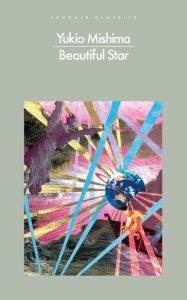 Beautiful Star is the story of the Osugi family, an ordinary family from the city of Hanno, whose lives are changed when they see flying saucers and are imparted with the knowledge that they come from other worlds. Juichiro, the father, is from Mars; Iyoko, the mother, is from Jupiter; Kazuo, the son, is from Mercury; and Akiko, the daughter, is from Venus. This secret knowledge brings them together, with the secret mission to bring together others like them and to save humanity from destroying itself with the atomic bomb. Juichiro sets up the Universal Friendship Association by putting an advert in a tabloid magazine, and soon the whole family is involved in spreading the word about flying saucers and writing letters to world leaders urging peace. What follows is a moving exploration of humanity and its foibles, through the everyday life of the Osugi family.
Are the Osugi family delusional or are they really aliens? The answer doesn’t really matter, as the family explore the human experience. Akiko falls in love with a young man who leaves her when she falls pregnant; Kazuo goes from being obsessed with girls to undergoing a disillusioning initiation into the world of local politics; Juichiro struggles with how to best support his children as they grow up; Iyoko does her best to fulfil the supportive role of mother and housewife without losing herself. Mishima celebrates the miraculous of the everyday by showing it to us via the perspective of aliens. The thoroughly normal triumphs and tragedies that the Osugi family face during their sacred mission to bring peace to Earth and so return it to its unfallen state of a beautiful star serve to remind them and the reader what it is they are fighting for, and what we all stand to lose.
The alien perspective also serves to show the utter insanity of nuclear destruction and so highlight the need to prevent it. Post-war Japan, as the only country to be attacked by atomic weapons, had a unique perspective on the horrors of nuclear annihilation that underpinned the USA and Russia’s Cold War conflicts. The Osugi family’s alien perspective allows them to see just how fragile and vulnerable the Earth and humanity are, how dangerously the world teeters on the brink. This is similar to the overview effect experienced by astronauts on seeing the Earth from space for the first time, and Mishima’s novel can be seen as an attempt to communicate this kind of overlook effect to humanity via literature to prevent nuclear war.
Mishima is also aware of the darkness that resides in humanity’s heart, how feelings of helplessness and vulnerability can curdle into nihilism and a desire for death. We see this represented through the characters of Haguro, Kurita and Sone, three men who see flying saucers and are granted a similar revelation to the Osugi family. But instead of seeking to save humanity, Haguro and his friends are driven in the other direction, deciding that the only appropriate response to humanity’s fragility is to put them out of their misery by destroying them as soon as possible. Haguro, Kurita and Sone are thoroughly unpleasant characters, full of loathing and misanthropy in contrast to the warmth and humanity of the Osugi family. Thus the revelation of the flying saucers works on what is already there inside the person. The novel’s climax involves Haguro, with his sidekicks’ assistance, trying to convince Juichiro that his view is the correct one, and Juichiro’s rebuttals. The philosophical discussion between these two very different men is the true heart of the novel, in which Mishima defends hope and optimism over nihilism and destruction, and is utterly riveting. Beautiful Star’s moving celebration of humanity, with all its weaknesses as well as its strengths, can be seen in Juichiro’s proposed epitaph for the human race:
“Here sleeps the human species.
They ended up lying all the time,
They offered up flowers for both good and bad fortune,
They often kept small birds,
They were frequently late getting to appointments
And they often laughed.
May they rest forever in eternal peace.”
Juichiro’s celebration of the mundane reflects how Mishima’s novel celebrates the Osugi’s family life as much as their work toward peace. Beautiful Star finds beauty, love and human tragedy in the shadow of atomic threat. It is a wonderful and unique exploration of the human condition and how we relate to ourselves and each other, and a heartfelt plea for all of us to live less destructively. It is a beautiful piece of writing, and a great example of how the speculative can be employed in thoughtful and unexpected ways.

One of the most beautiful, transcendental, acidly comic philosophical novels ever penned. There is hardly a page which does not through up an idea or description shot through with beauty. Provocative and reflective by turns, Mishima dances on top of pins with language as his partner.
Beautifully put!
[…] And I hear that last year saw the first English translation of another Mishima novel, a 1962 one called Beautiful Star. Its translator was Stephen Dodd, who also rendered Life for Sale into English. Beautiful Star sees Mishima having a go at science fiction. It’s about “a Japanese family who wake up one day convinced that they are each aliens from a different planet in….” […]