
BRISTOLCON 2025 (Convention Report)
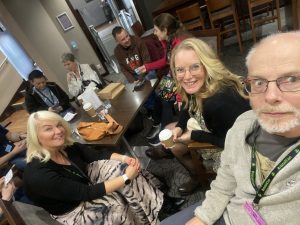
Barcon commences
With the clocks poised to go back and Halloween looming it was time for Bristolcon once more with its sixteenth convention and the second year of being an expanded two day event on Saturday 25th and Sunday 26th of October. But this year there was the added complication of WorldFantasyCon joined together with The British Fantasy Society’s FantasyCon taking place in Brighton from Thursday 30th October through to Sunday 2nd of November.
For some people this was a conflict of priorities, feeling obliged to choose one or t’other – and the Bristolcon Panel recognizing this tension had budgeted accordingly for a slightly smaller attendance than usual.
For others this was an opportunity for a 10-day extended fantasy ‘party time’ taking in Bristol and Brighton with a variety of routes and activities to be pursued in travelling between the two conventions.
It will surprise no-one that I fell into the latter category, so this post on BristolCon will be followed by one about my Brighton experiences.
As with last year, BristolCon’s program of 52 events (panels, workshops, interviews and ceremonies) did mean it was impossible for any one individual to do more than sample a fraction of what was on offer and my total of 9 panels/sessions was slightly up on last year’s 8. I might have managed a few more, but the vagaries of the program did inevitably generate clashes where two panels that particularly caught my eye were on simultaneously for example “Science Fiction as Activism” vs “Editors who needs them and how can you tell?”
With Guests of Honour, J E Hannaford, Ben Jeapes and John Higgins, alongside some iconic panelists like Adrian Tchaikovsky, Cheryl Morgan and Anna Smith Spark there was an abundance of expertise and insights on offer.
What follows is just a few snippets from each panel, gleaned from my contemporaneous but sadly illegible scribbled notes.
Guest of Honour Interview – Jenny Hannaford
interviewed by Anna Smith Spark
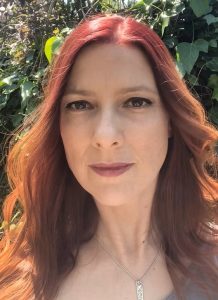
Author J E Hannaford
Jenny Hyannaford is the first self-published author to be a Guest of Honour at Bristolcon and the interview ranged over her career in teaching and her writing journey. Her first success came with her Selkie story The Skin written during lockdown, but the first book she wrote was actually Gates of Hope which she described as her “problem child” and was written once her son was born, launched in the enthusiasm of a NaNoWriMo month. Jenn was warm in her praise of support from the fantasy community – not just her friend and interviewer Anna Smith Spark, but SPFBO5 winner Justin Lee Andersen who told her “Your worldbuilding is great, your story telling is great, you just need to learn to write.” Jenny took that advice to heart in reworking Gates of Hope to follow on the success of her first trilogy.
As a scientist, Jenny’s passion for verisimilitude includes working out the genetic inheritability of different features of the creatures and characters in her novels. That focus on authenticity means there is huge iceberg of worldbuilding lurking beneath the surface and underpinning the tip-of-the iceberg story that is visible to the reader. Another story detail that drew Jenny’s perfectionism was the nature of the Moonhounds (which Anna described as her favourite animals in all of SFF). Unlike Barbara Sleigh’s eponymous cat Carbonel – who merely needed the listener to touch the witch’s broom to hear perfectly enunciated sardonic feline observations – Jenny was aware that animals lack the physical equipment to shape sounds into words and the mental architecture to think in words. As so often, a constraint proved to be the impetus for creativity and her moonhounds – in appearance inspired by Rhodesian ridgebacks and shih tzu bichon frise – think in images and communicate telepathically with their bonded human pairs.
In a wide ranging discussion, Jenny
- confessed that, drawing on experiences as teacher and parent, “I write teenagers the way they really are”,
- admitted that “I’m rubbish at marketing” and
- gave a shout out to her beta readers and alpha readers saying “It’s all about the people who support you and who you support.”
“Remove words from a sentence until it just make sense and then add one word back, to add a bit more depth.”
When asked about writing advice, she noted that “I used to overwrite a lot” but her key piece of advice now to address this is “Remove words from a sentence until it just make sense and then add one word back, to add a bit more depth.”
Science Fiction as Activism
How can genre influence our attempts to bring change in the real world? What can we learn from SFF and how do we put it into practice?
No realm of human endeavour can sit entirely apart from the society and politics of its own time. This is particularly so with comedy – often condemned by those with no sense of humour and even less self-awareness as being “too woke”. The same is also true of speculative fiction – an inherently progressive genre preoccupied with future ways and other places of being. As geo-politics gets increasingly alarming, with a bewildered populace looking in vain for some sign that there are sane adults in the driving seat of national policies, the politics and speculative fiction theme is becoming a staple of convention panels.
In his briefing email to panelists, David Cartwright as moderator noted that “While the subject has the potential to become quite heavy in discussion, I’m hoping we can balance the weight of the subject with a hearty dose of levity.”
My own notes are somewhat limited, as being a participant left less scope for scribbling, but I do remember Cheryl Morgan as CEO of Wizard’s Tower Press mentioning activism within the newly released anthology Fight Like a Girl 2. The intention had been to look at other ways of ‘fighting’ than the bad-ass out-men-ing the men that might had been an earlier expectation of ‘strong’ female characters. So this was more Sansa than Arya.
Cheryl also noted how the “online safety act” was a dangerous tool open to potential misuse through the powers it gave a future minister to proscribe certain viewpoints or voices on a political whim. “Protecting the children” has always been the emotive rallying cry of those who want to censor the voices of diversity and strip away fundamental rights.
Languages in Speculative Fiction
With the evolution of real-world languages so entangled in history and culture, what opportunities do languages give in speculative fiction to go deeper than mere world building and become integral to the plot.
An erudite panel discussed a number of fictional languages as well as some of their real-world experiences of working and thinking in multiple languages. While Tolkien’s elvish creations were a popular and elegant creation, Nicola Alter was struck by China Mieville’s Arieke in Embassytown who, speaking simultaneously through two mouths showed an imaginative way that language could become central to the plot, since specially attuned “ambassador pairs” were required to facilitate interplanetary trade. The representation of this dual speaking presented challenges with the written text using a particular kind of fractional font while the audio book used layered sounds.
Helen Claire Gould and Nicola Alter both mentioned how fictional languages had made the transition into real life with Helen discussing the idea of Klingon being a language one could get a qualification in while Nicola having seen Dothraki requested as a ‘language that should be offered’ on feedback forms at the language institute where she worked. She also mentioned the difficulty of never quite being able to express yourself in a learned language that is not your mother tongue in the way you want to, but also how knowing 2 (or more) languages can potentially lead to creativity in terms of thinking of other ways of saying things – eg. through a literal translation of a German phrase into English. Piotr Swietlik highlighted how even within a supposedly uniform language like his native Polish – there are important variations with regional dialects – giving the audience examples of words for the same thing that sounded very different. Nathan Taylor-Gray brought an experience of exploring languages used in various utopias to the panel and how writers tried to find ways to elevate the language and eradicate its shortcomings just as much as they sought to elevate society. He also mentioned the special power of language in the film Arrival where language again was central to the plot.
Team Jacob and Team Nosferatu
Have vampires, werewolves and zombies been done to (un)death or are they still ripe for readers and writers of speculative fiction to enjoy? Does it take just a sprinkling of sparkles or would it need more radical surgery to rebuild these tropes better, stronger, faster than before?
The quality of discussion was in no way proportional to audience numbers, with the panel of five outnumbering the audience of three, one of whom was actually obliged to be there to give the time signals. Possibly it was the timing (5.00 pm when everyone was starting to think about a bit of food before the evening Barcon) or the draw of the adjacent panel about the how far the controversial opinions of authors might taint our perceptions about their work.
The final choice – from a panelist who asserted “I live in the fanfic sphere so I’ve seen it all” – fell to the creature from the black lagoon which is apparently doing very well on “the monster fucker circuit.”
Moderated again by David Cartwright – who promised “not to be too hard on Twilight” – the panel had a fun discussion and concluded with favourite monsters that defied some of those tropes. For me it was the weeping angels from Dr Who, other panelists picked zombies and the vampires of the Dresden files. The final choice – from a panelist who asserted “I live in the fanfic sphere so I’ve seen it all” – fell to the creature from the black lagoon which is apparently doing very well on “the monster fucker circuit.”
A Decade of SPFBO
What’s changed and what’s stayed the same, both in the contest and in self-publishing.
This was an unexpected pleasure for me, gently ribbing Julia Kitvaria Sarene for having been deputed to appear on this panel, we turned to the program guide and realized my name had also been put down. Armed with three bottles of whisky I hastened to the panel moderated by Special Guest Jennie Hanaford.
SPFBO in its tenth year is undergoing a slight shift and a special event with a six-month Champion of Champions contest running through to December of 2025, allowing a best of the best winner to be selected before the contest resumes its normal annual progress in January 2026, henceforward fitting neatly into the calendar year.
With the big five publishers seemingly chasing the tails of tiktok trends in search of ‘safe bets’ for commercial success, the Indie and self-published sphere continue to be a hotbed of experimentation. This is very clear in the great variety of winners of SPFBO over the years, cosy-fantasy vying with romantasy, and gritty grim dark epics. Certainly there are no set expectations from the SPFBO judges who – unlike publishing editors – are picking a winner rather a money-maker.
What Potions Can’t Heal
SFF often delves into all kinds of emotional, psychological, and physical trauma – war, death, plague, neglect, abuse, injury and all manner of other hurts and harms – but what happens after the journey or adventure is over; or, on the adventure that comes after the one just completed?
Convening at 10.00 am on Sunday after what – for many had been a robust Barcon evening – there was perhaps a need for some healing potions. The panel, sympathetically moderated by Johannes T Evans trod delicately through the issues of post-traumatic stress disorder that could be part and parcel of speculative fiction character experiences, but these are often elided in imagined worlds where – as far as I am aware – there are no therapists and only Deanna Troi as a concession to the need for counselling.
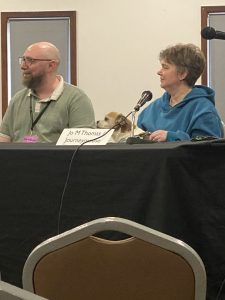
David Green, Jo Thomas and Rosie the Dog
Lost Cities and Legends
The stories of Atlantis, Prester John, El Dorado and Shangri-La have echoed for decades and longer. What is the attraction of lost cities and legends.
Within an erudite panel Jo Thomas – charmingly accompanied by Rosie the dog – mentioned her love of Folklore and how bits got added to legends, while David Green talked about how his keen interest in history sparked an interest in missing places. Picking up on this Juliet McKenna mentioned how LIDAR scanning of the Amazon Rainforest was revealing the imprint left by many more lost cities. The fiction and the reality of lost cities merge with Atlantis legends finding their reality in the destruction of the Minoan civilization by the Santorini eruption, or the loss of Doggerland in the catastrophic sea-level rises at the end of the last ice age.
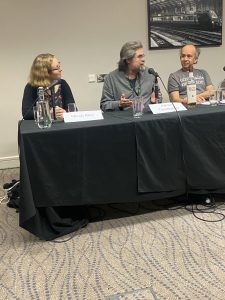
Nicola Alter, Adrian Tchaikovsky and Kevlin Henney (Moderator)
What’s in a Name – A Ro’se by any other name would smell as sweet.
Where can and do authors find their naming inspiration and does it matter to the readers. Is it sufficient to have a random combination of three consonants and two vowels, or is it better to follow some in-world system of given and family names. Where an apostrophe can be the difference between life and death (or should I say de’ath) what are the speculative fiction place/people names you loved the most and why?
The naming conventions of Star Wars and Lord of the Rings came in for some scathing comparisons. The former were noted as random constructions of words and syllables that somehow acquired a weight the names themselves did not deserve through the actions of the characters that bore them – I mean ‘Han Solo’ and ‘Luke Skwalker’ – who is ever going to swipe right on those names. Adrian Tchaikovsky revealed the rationale behind the naming of his multi-generational spiders in the iconic Children of Time. As the species of spiders were inspired by the jumping Portids, or Portia species, the name of the first arachnid character came quite naturally. But that first name initiated a Shakespearean inspiration leading to Fabian, Bianca and Viola for the other recurring monikers.
Closing Ceremony
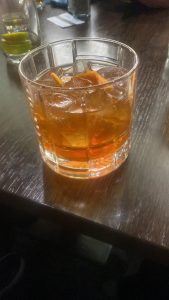
Hilton Doubletree does the best Old Fashioned (IMHO)
The irrepressible Bav, in his first full year as official Chair of Bristolcon, compared an entertaining and well attended closing ceremony, with presentations, raffle prizes, and a award for the best karaoke performance. Jenny Hannaford collected the latter having – as a Guest of Honour – been compelled to perform and neatly evaded any questions about her singing talent by performing her set in a dinosaur costume. The event closed with the announcement of next years Guests of Honour including well-deserved local recognition for Cheryl Morgan, CEO of Wizard Tower Books and stalwart of many a convention in the UK and abroad.
With that all that was left was the tidying up – a not substantial task given how much technical and physical apparatus goes into hosting a convention. The scale of the undertaking became most visible when some of us came along to help load up the vans and cars taking all the equipment into storage, with Si – leader of the tech-team – doing an impressive Tetris job in loading the van so snuggly a mouse would have struggled to make a home.
So until next year, it was goodbye to Con-time – apart from those of us heading off to Brighton…
Great recap! Really thorough and some great observations. It brought back lots of memories for me that had since gotten blurry 😅 And you’re right, Bav did do such an amazing job as chair – from the start to the finish, a great con!
I’m glad you liked it (the report and the convention!) I do like to jot some details down to help flesh out the warm but imprecise glow of ‘impressions’ of what a great time was had by all!