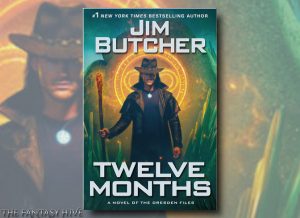
TWELVE MONTHS by Jim Butcher (BOOK REVIEW)
Twelve Months by Jim Butcher (Dresden Files #18)
A somber reflective book giving us a book that we and Dresden need by way of Breaking Bad, Hobbit and Batman
Life sometimes gives you your new year gift pretty early, and it is with great delight that I got handed the copy of my most-awaited 2026 release a few weeks early. Twelve Months by Jim Butcher is a long-awaited entry in the long-running Dresden Files series, and it comes more than five years after the last entry, Battle Ground. I am thankful to Orbit UK for my early review copy of the same. Needless to say, this was a book I finished in less than a day of getting it (as is the case with any of the recent Dresden books). The magic is still there, and Jim Butcher can still write a fabulously paced book that is unputdownable.
“Memories fade. Like pain. Like wounds. Preserve the brightest ones. Talk about them to other people. You’re going to find a lot more compassion and understanding than you think. And talk about the worst, too. And let them go”
 Jim Butcher had this series planned for a long time, and Mirror, Mirror was technically the book that was supposed to follow Battle Ground. Following some of the momentous and painful events of Battle Ground and to assess some of the fallout on Dresden, Twelve Months came into existence. A book that gives Harry Dresden time and space to breathe, reflect, remember, and maybe recover. Seventeen prior entries in this series have us primed to Jim’s template – non-stop action, a steady dose of banter, some major magical showdown, and some quiet moments of reflection. However, Twelve Months deviates from that formula by focusing its attention on the reflection element of the series. It is something that this series has earned the right to do, given the time and effort to build up this universe. In a way, it’s reminiscent of “The Fly” episode from Breaking Bad – a divisive episode helmed by Rian Johnson that has Walter White hunting for a lone fly that has crept into his meticulous meth lab while having a serious heart-to-heart discussion with Jesse Pinkman. It’s an episode where nothing much really happens (hence the divisive nature of the discourse around it), but it allows for some good conversations and reflections on the mental state of the lead characters. It is also worth noting that post this episode, the show hits new levels of awesomeness in plotting, acting, and heartbreak.
Twelve Months is likely to be divisive in the same way. It is not really a “traditional” Dresden book, but to paraphrase from The Dark Knight – It is the book that we need, not the book we deserve (this isn’t going to be the last Batman reference in this review). Dresden has gone through a lot, and this book sums up the cumulative effect of all his losses and pain. This necessitates a change in pace, and in a way, it helps position the rest of the books in the series well, given this book of reflection. While this is a broken, grieving, and damaged Dresden, things still move on in the Dresden-verse, and he has multiple balls to juggle even as he tries to battle his functional depression. Thomas’ fate, Mab’s long-standing expectations, and Chicago’s tenuous state post Battle Ground all weigh heavily on him even as he tries to go through the dictates of what the White Court Vampire alliance needs. All these are complex plots that hang in play for our beleaguered, broken Wizard, and he tries to manage them all, in some cases well, not so well in other cases.
“The real problem with any kind of militant order was that there always seemed to be a few people in them who were militant first, orderly second.”
Dresden, as a character, presents interesting comparisons with Batman, and it’s not just the Chicago element. Dresden is in his true elements as an investigator, detective, and a problem solver of sorts, and like Batman, some of these elements get sidelined due to his general ass-kicking proclivities. Throughout the series, Dresden gets increasingly powerful, but his best books are the ones that utilize his investigative nature. It is that element that works really well in this book. He takes on investigating how to solve Thomas’ condition, and that necessitates him diving deep into the vampiric lore and the nature of magic in itself. This is a throwback to the early days of this series, where Harry wants to do nothing but spend his team exploring magic and creating useful and joyful things out of it. In a way, this helps him in his recovery process – not just having a task to do but a task aligned with the core of what makes Dresden happy. It does, of course, feature different kinds of obstacles and complications, especially with Lara Raith, but this part of the book was quite strong and enjoyable.
The after-effects of Chicago being a battleground are evident in this book, and that’s an element that’s rather well done. Usually, the collateral of these big blow-up events is hinted at, but Butcher delves deep into what happens later, and by inserting Dresden at the center of some of these events, we get a pretty solid view into how desperate the situation is and the kind of predators (magical or otherwise) who seek to exploit these conditions. Butcher also offers some veiled commentary on the marginalization and the hatred of certain communities, drawing parallels to our current world. The sense of paranoia and fear of magical communities, especially those who don’t have a lot of power, is well etched, and some of the actions and consequent reactions from both sides indicate how easy it is for things to get triggered through the actions of some bad apples on both sides.
“That’s why routine was important. Fires are all chaos. Putting them out requires the imposition of order and getting your head back into order means routine”
This book showcases how Dresden is growing into a true leader. He is not just the muscle on the ground, but more of a figure people look up to. It’s not just when Dresden plunges headlong into powerful magical adversaries, but also managing things and keeping them from escalating. This shows growth in Dresden as a character as well, thinking beyond the immediate precepts of actions to avoiding and forestalling conflicts and trying to find common ground. There is a real sense of Dresden building something for himself that can place him among the great powers, and it hints at interesting directions for the books to come. Dresden also finds himself making some interesting allies, all of which hint towards a more powerful role for him. Though I hope it doesn’t come to politicking, Dresden is best when he is ass-kicking, deliverer of justice through “Fuego “ and “Forzare” Dresden. This is yet another situation where Dresden is like Batman. While they started as loners, they both now have a veritable family and allies around them to help them get better, challenge and question them, and ultimately grow and become better leaders to take on pretty much the world.
A part of how Dresden recovers is also through conversations. Twelve Months packs in a bunch of interesting conversations, some long-awaited, some expected, and one completely unexpected. The “Starborn” piece gets bandied a bit in some of these, but no major reveals, barring one very interesting adversary-to-be popping up, a monster of old, a figure of legend. Dresden’s relationship with the White Council is also explored, both official and unofficial relationship that makes for some interesting conversations and choices as well as a sense of catharsis. Some of these conversations, especially among Dresden’s friends, well-wishers, and families, drive the narrative well while providing a “therapy’ of sorts. It also reinforces the strong sense of found family that Dresden has built around himself.
“Times change. People don’t. Anger doesn’t. Violence doesn’t. Instinct doesn’t”
Among all the fires the book packs in, it is ultimately about the two climaxes that it has. One of which is done way better than the other. Thomas’ situation is a tricky one to resolve, and in a way, while this could have only ended one way, it is nonetheless a very well done and emotional ending that is hard and bitter-sweet on all parties, while adhering to some of the more inflexible norms of the parties in question. The other climax felt a bit shoe-horned, like the author wanted this to end in action, and it felt a fair bit tacked on. While it does provide for a few moments of deep satisfaction and some PTSD recovery for Dresden, it just felt like action for the sake of action – like we need a big fight to close this thing off.
A major criticism of the Hobbit movie franchise was how it stretched maybe a 1.5 movie worth of material into a bloated trilogy (I still enjoyed those while noticing the bloat). In a way, you could make the same case of Peace Talks, Battle Ground, and Twelve Months. Peace Talks probably didn’t have too much material forcing Butcher to introduce newer conflicts, Battle Ground was all action, while Twelve Months again doesn’t have a lot in traditional Dresden style to carry on. Maybe there’s a world in which these three books are condensed into two books, making it more substantial, but it is not this world. Therein lies the divisive nature of this book (and by extension the previous two books as well). There are going to be criticisms of the rather thin nature of this book, without much action or overall progression of the series. However, Butcher can still write the heck out of these books. I finished the book in a frenzy, and it’s just the sheer craft of the writing that the pace is so easy that you don’t notice the time fly at all. Some of the solutions also seem rather convenient. But if there is one thing to take away from these three books, Mab is FREAKING TERRIFYING.
Twelve Months is a chance of pace from the traditional Dresden fare and is a book that looks like it has spent time in the trenches. In a way, it completes the arc set up in Peace Talks and Battle Ground in quite a few ways and is an essential book showcasing Harry Dresden’s character growth, even if it comes at the cost of the overall series progression and action. While the book still reads fantastically easily and well, I suspect the reaction to this book is going to be divisive, especially given the long wait. In a way, though, this is an essential book that sets Dresden up for what is to come. I will be interested to see how this book reads in the future, unburdened by the weight of the long wait (and I suspect it will hold up better than it does now). I can’t wait to see what Mirror Mirror holds for us.
Rating – 3.5/5
Twelve Months is due for release 20th January, you can pre-order your copy on Bookshop.org