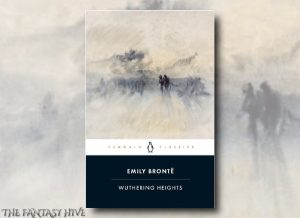
WUTHERING HEIGHTS by Emily Brontë (BOOK REVIEW)
Emily Brontë – Wuthering Heights (1847)
“She abandoned them under a delusion,” he answered; “picturing in me a hero of romance, and expecting unlimited indulgences from my chivalrous devotions. I can hardly regard her in the light of a rational creature, so obstinately has she persisted in forming a fabulous notion of my character and acting on the false impression she cherished. But, at last, I think she begins to know me: I don’t perceive the silly smiles and grimaces that provoked me at first and the senseless incapability of discerning that I was in earnest when I gave her my opinion of her infatuation and herself. It was a marvellous effort of perspicacity to discover that I did not love her. I believed, at one time, no lessons could teach her that! And yet it is poorly learnt; for this morning she announced, as a piece of appalling intelligence, that I had actually succeeded in making her hate me! A positive labour of Hercules, I assure you! If it can be achieved, I have cause to return thanks. Can I trust your assertion, Isabella? Are you sure you hate me? If I let you alone for half a day, won’t you come sighing and wheedling to me again?”
What can one say about Emily Brontë’s Wuthering Heights (1847) that’s not already been said? Probably not much, but here I am sticking my oar in anyways. Emily’s only novel is one of those works that’s remained a classic for a reason. It’s a remarkable work of gothic horror with indelible characters. In popular culture, particularly the movie adaptations, it is often reduced to a romance between Heathcliff and Catherine Earnshaw. I’ve quoted Heathcliff’s own dismissal of this from the novel itself just to demonstrate how very much I reject this reading. Heathcliff warns the reader themselves to avoid thinking of him as a romantic hero, I suspect because Emily was well aware of the effect his brooding anti-heroic presence would have on readers. Heathcliff is an orphan who is abused by his adopted family, despite the benevolent intentions of his ward Mr Earnshaw, who responds by enacting an elaborate revenge to utterly destroy the Earnshaws. Wuthering Heights is the tale of his ghastly revenge, his obsessive manipulations, and his toxic relationship with Cathy Earnshaw, the only other person in the novel almost as deranged as Heathcliff himself. It’s a novel of hauntings, of the dark secret things that we can never forgive or forget, with the West Yorkshire moors as the almost supernatural tableaux on which this all plays out. So it’s in this context I’m going to talk about Wuthering Heights.
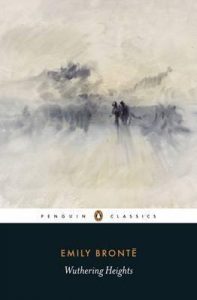 Most people are familiar with the plot of Wuthering Heights to some degree – after all, there’s the exquisite Kate Bush song to remind us. But it’s worth remembering what an eccentrically structured novel it is. We are introduced to Heathcliff at the beginning of the novel, long after the bulk of the events of the story have finished, by Mr Lockwood, who is Heathcliff’s new tenant, renting a house on his land. At first he’s impressed with Heathcliff’s standoffishness, until he witnesses a Texas Chainsaw Massacre-worthy uncomfortable family dinner with Heathcliff, his niece Cathy Linton and his nephew Hareton Earnshaw. Snowed in, he spends a profoundly uncomfortable night under Heathcliff’s roof before returning to his house where his housekeeper Nelly tells him Heathcliff’s story. This means that we are always at a level of remove from the characters, we see them either through the somewhat naïve Mr Lockwood or through Nelly, who we find out is so enmeshed in these people’s lives there’s no way she can be remotely objective about them. This is probably for the best, given the novel’s outrageous intensity; any closer and the reader would be in danger of being sucked into Cathy and Heathcliff’s madness.
Heathcliff is a dark-skinned boy that Mr Earnshaw finds on the streets of Liverpool and brings back home to his family – himself, his wife, and his children Hindley and Catherine. Whilst Catherine finds in Heathcliff a kindred spirit, Hindley loathes him on sight and does his best to make his life miserable. A further thorn in Heathcliff’s side appears in the form of the Earnshaw’s neighbours the Lintons, whose stability is an ironic mirror to the Earnshaw’s familiar chaos. Mr Earnshaw dies, leaving Hindley in charge of the family, and Catherine chooses to marry the Linton son Edgar over Heathcliff, at which point Heathcliff decides he’s going to destroy them all. What follows is essentially Heathcliff’s deranged plans for revenge. He exploits Hindley’s addiction to gambling and drink to utterly ruin him, seduces and marries Edgar’s sister Isabella in order to destroy the Lintons. He raises Hindley’s son Hareton as an uneducated brute, and manipulates Catherine and Edgar’s daughter Catherine Linton into marrying his and Isabella’s vicious son Linton, engineering events so that the Earnshaw and Linton families will loose all their land, money and property to his son and ultimately himself.
Where’s all the romance in this? I’m glad you asked! Heathcliff and Catherine’s relationship is absolutely deranged. They have a bizarre co-dependency going on that no one can really get in the way of, least of all poor Edgar. Their obsessive and destructive passion for each other burns Catherine out – she dies young, leaving Heathcliff abandoned by the one human being that he cared for. Such is the intensity of their bond that Heathcliff at one point attempts to disinter Catherine’s rotting corpse so that he can be together with her again. Oh yeah did I mention this is a horror novel? Heathcliff violently calls on Catherine’s ghost to haunt him, and it certainly appears from events that his summoning is successful. The night Mr Lockwood spends in Wuthering Heights is disturbed by Catherine’s spirit hammering on the window asking to be let in from the moors – at which point the terrified Lockwood scrapes Cathy’s arms against the broken glass of the window in an attempt to stop her from coming in. This kind of visceral haunting is typical of the book’s approach to the gothic. Emily’s ghosts are physical, embodied beings caught in their suffering, like the later spectres of M. R. James. The novel avoids showing us these apparitions directly, but their presence is felt throughout the novel in its bare-knuckled intensity and constant pitch of feverish delirium. Wuthering Heights is a book that barely ever slows down for a breath. Lockwood seems happy enough to dismiss his experiences as a dream, but most of the characters who aren’t as staid as Lockwood know better. At the end of the novel, the moors are full of rumours of Cathy and Heathcliff’s ghosts reunited haunting the moors, two untamed spirits that will never be at peace. The novel’s iconic closing lines see the blithe Mr Lockwood smugly satisfied that the family saga is finally over and everyone at peace, something it is impossible for the sensitive reader to believe.
The other aspect of the novel that engages directly with the Weird and the uncanny is Emily’s use of landscape. No one who has read Wuthering Heights can forget the intensity with which she paints the moors, an alluring and dangerous landscape as treacherous as the book’s main character. There is something of folk horror in the way the land seems to intensify the characters’ manias, passions and fears, a sense that the moors have a hold on them that goes deeper than the rational. I also found myself thinking of Arkady and Boris Strugatsky’s Roadside Picnic (1972) and the Zone, an area of land marked by an alien visitation that distorts reality to its will. Emily’s moors similarly feel scarred by the numinous and weirdly agential. There’s a sense that when the characters go out into the moors they are changed by them, something that only Heathcliff and Cathy are chaotic enough to fully embrace. Perhaps this, more than anything else, is why their spirits will not rest, but will forever wander the moors. Cruel, capricious yet disturbingly alluring, Heathcliff and Cathy are made of the same stuff as the moors.
So why am I telling you all this? Rereading Wuthering Heights was a joy, but frankly it’s one I would be wary of giving into all too frequently. It remains one of my favourite books, but its dark hypnotic magic is hard to shake off. Given how visual and visceral it is, it is perhaps surprising that adaptations keep insisting on ignoring its gothic and horror dimensions – we’re due for another attempt this February that looks particularly anodyne. But perhaps no adaptation could ever do justice to Emily’s powerfully putrid vision in all its ghastly glory. I remain convinced that the one perfect adaptation of the novel is the aforementioned Kate Bush song. On the surface, it looks like a big sweeping romantic ballad, but one listen to Kate Bush’s chillingly sinister lyrics is enough to let you know that she absolutely understands that Wuthering Heights is a horror story. So I’ll leave the closing words to Kate: “Ooh, let me have it, let me grab your soul away…”