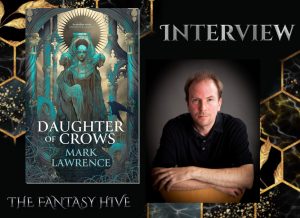
INTERVIEW WITH MARK LAWRENCE (DAUGHTER OF CROWS)
Mark Lawrence is married with four children, one of whom is severely disabled. Before becoming a fulltime writer in 2015, his day job was as a research scientist focused on various rather intractable problems in the field of artificial intelligence. He has held secret level clearance with both US and UK governments. At one point he was qualified to say ‘this isn’t rocket science … oh wait, it actually is’.
Mark used to have a list of hobbies back when he did science by day. Now his time is really just divided between writing and caring for his disabled daughter. There are occasional forays into computer games too.
TOM: Thank you for taking the time to come to speak with us again at the Fantasy Hive, especially as you are joining us from Hospital where your daughter Celyn is in the midst of another long and difficult stay. We do hope you both get out and back home before too long. (Celyn and Mark did thankfully make it home from Hospital in the week just before this interview was published.)
I’m sure many of your fans are looking forward to the launch of a new Lawrence trilogy with Daughter of Crows – your 19th book – coming out on 24th March. Last time we spoke it was about the library trilogy and your 16th book – The Book that Wouldn’t Burn. You said then “I like to change things up” and that you didn’t want readers to think that “my 16th book must be Prince of Thorns #16”. We’ve certainly seen this in the progression in your chosen protagonists from cynical and immoral Jorg through cowardly Jalan, schoolgirl and ninja nun Nona, mathematical genius Nick, ice dwelling Yaz, librarian Livira and jack of many trades Evar. However, Rue – protagonist of Daughter of Crows manages to be different again to all of those.
Can you tell us a bit about how Rue diverges again from the characters you have written before and what drew your writing in that direction?
ML: As I grow my collection of main characters, the option of just making the newest the polar opposite of those that went before (as Jalan was to Jorg) vanishes and the differences must be more subtle. One big difference in this book is not so much a difference in character as a difference in the period over which we keep that character company.
Previously in my work we’ve spent at most around a decade or so in the company of the main character. In Daughter of Crows it’s closer to six decades, and that gives a very different window on a person. We change across the course of our life. A person is not a static target on these timescales. Even if Rue were identical to some other character of mine at 10 (she isn’t) we would still be looking at a different person 50 years later.
I’ve looked at the nature vs nurture issue before, and in Daughter of Crows the nurture is … extreme, but we also get a long time to see what if any elements of nature might survive and/or reestablish themselves over the years.
Rue is tough – perhaps the toughest of all my characters, but maybe even more vulnerable to kindness. To say she has been hard done by is an understatement.
TOM: Of course we don’t see Rue just as an old woman. The events of the present-time story are interleaved with the back story of the first few years of ‘training’ that girls undergo at the misleadingly named ‘Academy of Kindness’. Periods of training and mentorship feature in quite a lot of fantasy novels (both in the SPFBO entrants I’m reading and in another ARC I have got on the go at the moment) and you have explored this theme yourself in Red Sister with Nona and the other ninja nuns in training enduring discomfort at the Convent of Sweet Mercy. However, the Academy of Kindness – while still a single-sex girls establishment – is something of a departure from even that convent austerity.
What can students expect when they enter the Academy of Kindness and more importantly why would anyone want to?
ML: Nobody would ever want to enter the Academy – unless, possibly, it was an escape from somewhere even worse. The place is more of a statement than an optimal solution to the problem of producing killers. Its excesses are about building a legend around those who emerge from it. The intended message is, in part, if we will do this to ourselves … what will we do to you?
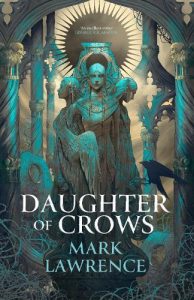 TOM: We are full of prejudices about good and evil – like bees are good heroic little pollinators while wasps are evil spiteful little allergy triggers. Extending this into popular culture – and society at large – we cling to an ideal of believing good people will save us from bad times. Speculative fiction often indulges this with flawed but charismatic heroes overcoming angst and doing great deeds to save the world/universe from evil. However, the tagline for Daughter of Crows is “Set a thief to catch a thief. Set a monster to punish monsters.”
Why does the world of Daughter of Crows need more monsters?
ML: I’m not sure it does. The book doesn’t try to sell the reader on the notion that any of this is a good idea. The Academy is a reaction to the terrors of a world free of any justice other than that imposed by the rich and powerful on the poor and weak. Its graduates are charged with upholding the very basic justice of the ancient world, and applying it much like the Furies did, to absolutely anyone, viscount or vagrant, without favour. Though, having said that, for murders outside the family, there’s a wergild that can be paid, which obviously favours the rich. Still – no system is perfect – and compensation can be life or death to families robbed of a breadwinner.
But yes, the world in which the story takes place is not a gentle one, or a fair one, and even harsh justice can be better than no justice.
TOM: The Library trilogy had some real-world allusions with ideas around an infinite access to knowledge and the degree to which it could be corrupted or misused, with the library serving as a metaphor for the internet. It also had an objectionable king (or would-be president?) called Oanold. In the end I did take away a notion that library-like knowledge should be preserved but in a more distributed fashion rather than a centralized way that was corruptible and exploitable.
Were there any similar real-world inspirations, intentional parallels or buried easter eggs for readers to look out for in Daughter of Crows?
ML: Any depths in Daughter of Crows extend in a different direction to those in The Library Trilogy. Those books, concerned themselves as much with ideas about knowledge and society as they did with the characters unfolding the plot. The Academy of Kindness trilogy, beyond the plot, adventure, and excitement, is a study of a character, and more than that, about how age and time interact with nature and nurture. It is, as everyone notes, a relatively unusual fantasy book in that it puts an old person front and centre, albeit with large doses of their childhood in focus too.
By the end, we will have seen Rue’s life across the full range of maiden, mother, and crone. I don’t claim to have any great wisdom to impart on the subject of aging and change. But I am aging and I have changed. At 60, I’m what many people consider old. It’s in my nature to reflect on these things … a lot. And in this book I’ve given myself a place to at least share some of my observations.
For me, that’s one of the joys and powers of writing and reading. From the writing side: to put on the page what you’ve felt and seen and hoped for, and to have faith that in the overlap you share with the reader these things will strike a chord. And as a reader: to feel seen. To be told things you may well have already known, but to have them put in words, perhaps for the first time, or perhaps just in a different way that might offer something new.
TOM: With the library trilogy there was a very loose biblical inspiration in the notion of the first city (Enoch) and the first library and sibling rivalry between two grandsons of Adam and Eve about the purpose of libraries. The magic ‘system’ in Daughter of Crows has a kind of Greek humours of the body feel to it, with ingredients and elixirs that are focused on organs like the brain and the heart, and notions like memory, anger and revenge.
Where there any similar inspirations from mythology or religion for the myth and magic systems in Daughter of Crows?
ML: Well, the inspiration for much of it is extremely direct. I ‘steal’ the Furies and The Morrigan and others directly from mythology. I think the idea of gaining power from eating the heart or brain or drinking the blood of some powerful creature or enemy is longstanding. So, again, I can’t claim any great degree of originality there.
I’ve always been more interested in character than in magic systems. I can appreciate the fun to be had with some “hard” magic system, a set of strict(ish) rules within whose constraints the game must be played. But I’ve never really wanted to write such a book. I prefer my magic to be a bit more magical and a bit less role-playing game-ish.
So yes, the mythology is (for reasons given in the trilogy) a mishmash of our own. And the magic is broadly familiar, with perhaps the memory magics being the most interesting in their own right. But just as I’m content to write a book where the weapons are swords and spears rather than inventing some new bladed items – I’m happy to use perennial favourites like necromancy, because I’m hoping to engage the reader with character and ideas rather than new flavours of enchantment.
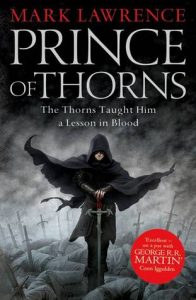 TOM: Companionship has been a theme in your writing from Jorg’s road brothers, through Nona’s fellow students, Nick’s D&D playing friends, Livira’s fellow acolytes and Evar’s siblings. Episodes of betrayal have been the anomaly used to illuminate that fundamental companionship. However, this is somewhat inverted in Daughter of Crows. The ‘found’ families are smaller – rarely more than trios, friendly companionship is a rare shaft of light in the midst of a routine of betrayal, and – in the story of ‘Eldest’ the narrative feels more like horror than fantasy.
To what extent do you feel Rue’s path, both at the Academy and as an old woman, is darker than with any of your protagonists except possibly Jorg?
ML: Oh, it’s definitely darker than all of them, Jorg too. I’ve said it’s the first grimdark I’ve written since The Broken Empire. People often call me a grimdark author because the first of my first six trilogies was grimdark. But they’re wrong. None of the following 15 books were grimdark.
This one is.
Rue has a much tougher time than Jorg. His whole grievance basically comes down to one act of violence against him and his family (which admittedly does lead him down dark paths). I don’t want to minimize that – it’s plenty to screw someone up, though Jorg’s over-reaction is as much about who he is as it is about what was done to him.
Rue never had a chance.
That she is less of a monster than she should be is the wonder here.
TOM: Your own path has changed somewhat in recent years with your severely disabled daughter Celyn now old enough to access support as an adult rather than being so heavily dependent on parental care. This has enabled you to travel more, attending conventions, meet the wider community of fans and fellow fantasy afficionados in person rather than almost exclusively on line, and even getting a passport!
How have you found the convention going experience? What have been its plusses and minuses and where can fans next find you outside Bristol?
ML: It’s certainly true that I’ve done a lot more travelling in the past 2 years. Up from ‘none’ in the previous 20 or so.
Right now though, I’m sitting beside Celyn’s hospital bed late at night on the 19th day of her current stay. Things are looking very bad. Worse even than back in December when they thought she had hours left. So, what the future holds … I’ve no idea.
I had planned to go to Eastercon in a couple of months.
I’ve very much enjoyed going to cons – and also to the cities where they’re held – and to places where there are no conventions at all, just places I wanted to go. But right now it’s hard to imagine leaving Celyn for even a day if we manage to bring her home.
TOM: The speculative fiction community of Sci-Fi and fantasy fans is, for many of us, a wonderful found family of readers and also writers. It’s a community that you have contributed a lot to yourself for example through creating and maintaining the Self Published Fantasy Blog Off (SPFBO which – and I will brook no argument on this – is pronounced Spiff-bow). It even has its own Wikipedia page here https://en.wikipedia.org/wiki/Self-Published_Fantasy_Blog-Off
What do you think are the secrets of SPFBO’s success as a competition, and what have you personally enjoyed most about its process and its books?
ML: The competition has succeeded because of the generosity (with time and expertise) of people like yourself in reading and judging the entries. That’s not a secret though – it’s self-evident.
A slightly less obvious reason for the competition’s success is simply timing. It happened at the right time. I don’t think the format or the details of its implementation are super important. It would have flourished in a number of guises. The most important thing has been to avoid drama and give the people inclined to sniping as few targets as possible.
I’m a sucker for competitions and I enjoy seeing the scoreboard develop and the books jockeying for position. And then I enjoy reading the winner and any other entries that catch my attention to a sufficient degree. It’s good for me to read books from a range of subgenres that I might not otherwise have tried. And I’ve found a number of my favourite books ever from the contest.
TOM: You honed your craft in a writing group. Indeed, it was one of your fellow group members who – by bombarding with copies of The Writers and Artists Yearbook – guilted you into actually sending off Prince of Thorns to an agent (the rest – as they say – is history). You’ve been generous in support of other writers both through your ‘first page critiques’ (e.g. https://www.youtube.com/watch?v=UMDCQQkc-Kc) on your blog and through #writingadvice on your youtube channel which I admit I have referenced a few times in my own creative writing course. https://www.youtube.com/@marklawrence8418
If you could distill the writing advice and lessons you have acquired and applied down to a few (maybe ten?!) bullet points what would they be? (Full disclosure: this will probably be a power point slide in a course I run in the future.)
ML: You’re making me work hard here, Dr Munro!
The best I can do is throw out a number of random thoughts (almost certainly fewer than 10) caveated with the reminder of where and when I’m doing this.
- This one might make the rest of these points … pointless, but: don’t let anyone tell you how to write. It’s like someone telling you what food to enjoy. Everyone is different, and anyone who gives you a set of rules to write by is ignoring this fact. Great books can be written in a myriad of different ways – planned, not planned – written in 1 draft, written in 25 drafts etc.
- If you’re still reading, because these are ideas rather than rules: Since the chances of financial success are vanishingly small, irrespective of your talent, write something you enjoy writing. Aim to please yourself and nobody else. As a side benefit, this will probably increase your chances of pleasing someone else too.
- Be fearless. Put something honest on the page. The chances are that almost nobody will read it anyway, so why give even half a fuck what anyone else thinks? Don’t go out aiming to offend someone, but equally, don’t tie yourself in knots trying not to. You’re trying to create something worth looking at – art that’s colour-between-the-lines rarely commands much attention.
- There’s no such thing as filler. There are no “boring bits”. Everything you write needs to be worth reading. If you find it dull, you can be damn sure the reader will too. Conversely, if you find it fascinating … they may still hate it 😀
- Every line, paragraph, and page should aim to do several things at once. Two at the very least. You might not hit that target but it’s worth trying.
- Description can/should illuminate the character doing the describing as much as it does the thing being described.
- Point of view writing is a wonderful tool. Consider using it!
TOM: Your books have been translated into many languages and seem to have achieved particular success in Brazil, but less so in Spain which one might hypothesise is down to the skill of individual translators in transposing nuance rather than mechanically translating text. However, AI is now intruding on the work of translators https://www.publishersweekly.com/pw/by-topic/digital/content-and-e-books/article/98849-ai-translation-race-accelerates.html. The fun opening SPFBO cover contest had to be dropped due to the hard-to-track AI assisted/created entries. You yourself have run a couple of blog posts (https://mark—lawrence.blogspot.com/2025/08/so-is-ai-writing-any-good-part-2.html and https://mark—lawrence.blogspot.com/2023/09/so-is-ai-writing-any-good.html) to explore readers’ ability to distinguish between AI authored short stories and human authored ones (results suggest we could not pick between the two to any statistically significant extent!). However, your own background as a scientist was in the development of AI systems.
Given all that, do you think AI could take over all the fun creative elements of human activity, leaving us with the day to day drudgery or will LLM eventually collapse under the weight of its own incestuous self-referencing?
ML: My research was in a very different area to Large Language Models and very rarely involved the use of neural networks. It was more mathematical and concerned with decision-making using different methods.
As it happens I’ve recently had a number of my books published in Spain and a bunch more now under contract to be published – including The Broken Empire, for which only the first book came out 15 years ago (and bombed). So, we’ll see if it fares better on a second try. I think they’ve used the old translation but “reworked” it… Fingers crossed.
Moving on to the question itself … it certainly feels like AI could take over the fun stuff, yes. Given the enormous strides it’s taken in just the last 5 years, it seems entirely possible that it could take another couple of steps within a decade or two and take over writing books, making movies, painting pictures etc.
Do I want it to? Hell no. Will it plateau? Also possible. I don’t know enough to know, and I don’t think anyone else does either.
Frankly, the only thing I really want it to do is give us great medicines and treatments. I’d love to have more physics unraveled for us – but I have mixed emotions about it being handed out by machines and it would feel like a deep shame if human ingenuity and genius do soon run out of road in the sciences.
It’s a Brave New World. Scary times.
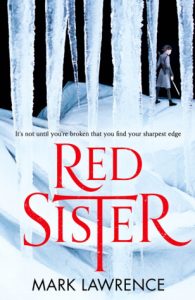 TOM: Taking us back to human writing, I think it’s fair to say writing (or perhaps publishing) success came to you when you were if not exactly ‘old’ certainly past the first flush of youth.
Do you have an attic full of trunk novels like Adrian Tchaikovsky where you were learning your craft, and if so do you feel you are still learning, or has writing always been an instinctive thing?
ML: I was 30 … maybe 31 … when I wrote my first book. It wasn’t good. I wrote another one in my late 30s. That one, Blood of the Red, is on Wattpad and my Patreon. It’s not my best work but the 48 people to have rated it on Goodreads have given it a generous 4.08 average. And that’s it – the next book was Prince of Thorns.
I do have a number of unpublished books written since Prince of Thorns. All of them are on my Patreon.
Memory – a thriller.
Darkest Tide – a horror.
I, Hubert – sci-fi comedy.
Gunlaw – weird western.
The Chinese Room – sci-fi thriller.
Maybe some others I can’t recall right now…
And yes, I write instinctively. I’m almost never conscious of having learned anything writing-wise.
TOM: On a spectrum of productivity you fall between the extremes of Rothfussian and Martin-esque procrastination and Tchaikovskian prolificness. It is an admirably consistent output that the readers can rely on. Given the approximate two-year lead time of publishing that means they can know that the final book in a trilogy is already in the publisher’s hands by the time they buy the first book.
What is it about your writing method, routine or attitude that facilitates such metronomic reliability?
ML: I write in bursts. With Celyn’s recent health I’ve not written anything for a month. So there’s not much by way of routine. It’s just that I write faster than a book a year and thus keep pretty well ahead of schedule, avoiding adding deadline stress to the huge amount of stress I habitually lug around with me.
The thing that saves me is that I very rarely revise anything. Most of my work is first draft. Which saves a vast amount of time.
TOM: The corollary of this is of course that the Academy of Kindness trilogy is finished even before you have published book one. So
What new directions will your writing take – can you drop a hint about the next protagonist(s) – even if just age-sex-location?
ML: Honesty compels me to say that I’ve actually only written two and a bit books of the trilogy at time of writing (Friday 13th February, 2026) and so I’ve given zero thought to what comes next.
My comparative sloth is in part due to a difficult year – sick family members – and an adventurous year – much more travelling – and to the fact I’ve got two books out this year (Daughter of Crows, and the Library-related, The Bookshop Book), which ate into the march I normally steal on my deadlines.
TOM: And finally just to avoid ending on an unlucky total of 13 questions.
What question would you like me to ask that I didn’t and how would you have answered it?
ML: This feels like me doing your job for you! 😮
Mark, how do you stay so handsome and virile at your advanced age?
Thanks for noticing, T.O. It’s down to a mix of healthy living, good genes, and drinking the blood of my enemies.
Daughter of Crows is due for publication 26th March – you can order your copy on Bookshop.org