Interview with Rose Biggin (MAKE-BELIEVE AND ARTIFICE)
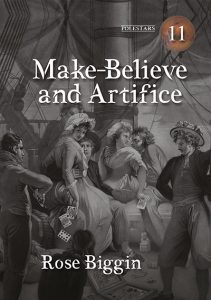
Rose Biggin is an author and performer. Her debut novel Wild Time (2020), co-written with Keir Cooper, is a punk reimagining of Shakespeare’s A Midsummer Night’s Dream. It became a surprise favourite of Jonathan Thornton’s when he was sent it to review that year. Her solo novel The Belladona Invitation (2023) is a lush gothic fantasy. Recently, her debut short story collection Make-Believe and Artifice (2025) was released by NewCon Press. Across 15 stories, it demonstrates Biggin’s remarkable talent for subversive reinterpretation, ribald imagination and dazzling wit. Rose Biggin was kind enough to speak to Jonathan Thornton via email about her unique approach to writing.
Your short story collection Make-Believe and Artifice is out now with NewCon Press.
Can you tell us a bit about it?
Thank you for inviting me into your Hive to talk about it.
The stories are a mix of fantasy and mystery, re-imaginings, masquarades, misbehaviour – including but not limited to a showbiz rooster who’ll meet his match, a fin de siècle Frankenstein in Soho, a private eye who can’t resist making an entrance, the unofficial guidebook to Camelot, a metaphysical game of Cluedo, stories of the theatre world, an infamous auction heist and a 17th century sea captain throwing dice with the winds. It’s my debut collection, spanning ten years of writing short fiction.
‘The Modjeska Waltz’ and ‘The Chandelier Bid’ imagine new adventures forIrene Adler from the Sherlock Holmes stories. What drew you to this character?
The game of the first story was: can I write a Sherlock Holmes tale in which Holmes himself does not appear at any point? In “The Modjeska Waltz”, Adler helps Moriarty pull off a diamond heist at a high society ball. The stories feel like a pair to me now but were actually written quite a way apart! – so the challenge of the second one was, among other things: Can I return to a specific voice & storyworld in this way, because as a rule I don’t tend to do sequels or a series across different projects. So: how to make it the same but different, how to return whilst also adding something, what’s another way of seeing this.
And can I ring a change on what a Sherlock Holmes story IS in some way, while keeping all the usual things that would be expected? In “The Chandelier Bid” Adler helps Holmes solve a fiendishly art-philosophical mystery: why is there such demand for the god-awful paintings of W. Bart?
The fact Irene Adler would narrate these was always obvious to me, it was a challenge (these are legendary shoes you’re stepping into, right?) and a creative necessity (her perspective gives a few literal ways to be able to answer some of the aforementioned challenges). She’s perhaps a bit older and wiser in the second story, more overtly confident in the first. But then I suppose she would be, and although they inform each other, the stories should stand alone as well as working as a pair.
 There’s a real sense of playfulness to your writing, which becomes explicit instories like ‘Miss Scarlett’ which reimagines the game Cluedo as a kind of existential noir. How is this important in your work?
Oh I love it. What’s the game of this story, what am I trying to pull off – what am I combining, what am I trying to mix to see what happens. How might we see things differently, what’s the idea before, during, after. These are some of the things I’m feeling out for early on, when I’m trying to get excited enough about a story to know it’s worth writing. When it has that momentum, and it’s the playfulness that can supply that momentum.
In general I don’t love having rules explained to me. So perhaps the stories are attempts to reframe their world(s) or be like, “hey, watch this.”
The Cluedo story in particular, since you’ve mentioned that one, gets some of its fun from taking seriously these high-stakes existential terms – it’s already inherently kind of fun to apply a noirish seriousness onto the trappings of the cosy murder mystery, which is the aesthetic Cluedo is drawing on of course – you’ve got your country manor, there’s a Colonel for goodness’ sake – but crucially, in Cluedo you only have to solve the practicalities of the murder, find out who and what and where, you don’t have to work out the why of the motive. So we don’t have the human horror/darkness you’d need for the STORY of a murder, it’s the game and the puzzle instead. Which of course it is, that’s its form – but the point is the darkness of the why is what motive expresses, it has a narrative function, so one of the games of the story “Miss Scarlett” is: can I put a sort of whirlpool of unknowingness into this structure somehow, can I give the mystery of death itself a presence on the board.
Humour and food also crop up in a lot of these stories. Can you talk a bit about the role they play in your imaginative process?
And dancefloors! It wasn’t until I was looking at the stories all together I realised how often I seem to enjoy writing a knees-up. I love writing massively raucous party crowd scenes. They’re fun and dramatically rich and you can just get a lot DONE in them. And similarly, food is another means of achieving these ends – obviously a meal scene or similar is a great way to have drama while showing various other things, so in a superficial way across the collection there are scenes where food is central – Irene Adler’s first meeting with Moriarty, in the story mentioned earlier, involves them scoping each other out over a cream tea, for example. But food is also an idea/texture in a synaesthetic way in the book, and it’s to do with pleasure in a similar way to the dancefloors and the playfulness.
Wit is the thing, I like wit (is that too much of a non-statement for a writer? who doesn’t enjoy wit – but I mean, like, aesthetically) – there’s something about how the right way applied it can do more than suggest a change of perspective, it can enact it – cause disruption or an up-ending that might then make you reconsider the pieces where they’ve fallen.
Your stories often engage with characters from myth and legend, from ‘A Map to Camelot’ which a sort of meta-exploration of the Arthurian myth, to ‘Helen/Hermione’, which explores the inner lives of Helen of Troy and her daughter. How do you find new voices and perspectives in older works?
Solve et coagula. I think it’s about exploring a gap, rather than trying to fill a gap in, I certainly think it’s not about assuming you know all the answers. Myth in particular responds well to being treated or approached in a fragmentary way, I feel. For me, it isn’t about trying to impose a sense of superiority from my own enlightened modernity – that’s a position that will date – but trying to meet these bodies of work on their own terms, to eyeball them right in the strangeness.
Your stories often engage with elements of performance, and you work with performing arts in various contexts as well as writing. How does this influence your approach to writing stories?
I’ve been a theatre maker and performer for as long as I’ve been writing and many of my projects cross between fiction and theatre in some way or another. In terms of the short fiction, perhaps it manifests the most in my having a big interest in style and perspective, as things that gives meaning to a work, are its whole form, can be a central part of where the game is.
My short stories aren’t written to be read aloud as this it isn’t their primary mode of encounter, but I have read my work at various lit events and conventions and book launches and things and I really love to do this, I have maybe a very tiny reputation in some contexts for this. Artistically I’m close to being at my happiest when I get to read a story of mine to a friendly audience (and then afterwards sell the merch). I am available for bookings and would love to be involved at an event in your local area.
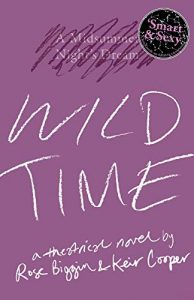 Your debut novel Wild Time is a punk theatrical reimagining of Shakespeare’s A Midsummer Night’s Dream. Where did this idea come from? Did you feel nervous taking the Bard’s work and making it your own?
Thank you for asking about WILD TIME because I love talking about this novel.
The original idea was to write something riffing on Titania in some way. The character always interested me; she’s super high status on the one hand, but on the other hand, the poor actor has to pretend to be asleep for ages. So the idea was going to be a sort of behind-the-scenes thing, or between-the-scenes, see the play from her perspective, I suppose… however, it became evident extremely quickly that this wasn’t at all satisfying as an artistic idea on its own.
So I was running through the problem with a theatremaker collaborator of mine, Keir Cooper (who also co-wrote one of the Adler stories) and together we found a different way of tackling the story.
Suddenly the challenge shifted into something much more exciting – let’s do what we want rather than be tied to any specific Dream plotpoint: can we write a novel that feels like Dream, that’s also totally different? There are a few assumptions that need to be unpacked of course there – what feels like Dream, what doesn’t? For example: when you only look at Titania (or indeed any singular perspective) it doesn’t feel like Dream any more. So that reveals something: that (to us, at least) the gonging-between-different-realms, the really big cast, the layering of textures – this is something inherent to the play. Okay, so we keep that but what else can we change, how much can we change and have it still feel Dreamy. Okay, let’s find a way to have the lovers involved, in name at least (they become celestial bodies being outrageous with spacetime). Okay, let’s keep the fling between Bottom and Titania but can we make it come about in a completely different way (Bottom being a part-time male stripper, among other things) and speaking of which, okay, let’s keep the mechanicals, but let’s ring the changes and bring in the observations from our own plentiful am-dram experiences we grew up with… it’s about changing things and watching the ripples.
And, ultimately, because Dream is a text of paradox and mischief, changing things drastically is completely aligned with this texture, so as outrageous as you’re being, it comes round to feeling true to the play again. We have Bottom’s performance as a tour de force! That’s different to Dream in an obvious way but, it DOES feel like Dream as well – because if you see the show you hope you’ve got a virtuosic performer in that role. So it is but it isn’t, it isn’t, but it is. And practically it’s lots of fun to ask a reader to imagine a set of brilliant performances, especially if they’re funny somehow.
I didn’t feel remotely nervous on “The Bard”’s behalf, but sometimes “is this going too far???” happened, which is a perfect rocket engine to bring to any project. As soon as you’re thinking that, you’re doing the right thing – it’s a good artistic principle in general plus you’ve got to step up to such a text as this one. It’s probably already clear by now that one of my favourite things to do is use a source or an idea as a springboard for whatever else feels fun to put in – and using this play as the source was like having the biggest, hugely energetic artistic permission.
Having said all that, our hope is that even a reader with no knowledge of the play at all can enjoy it as simply a well-wrought romp about fairies in Greece, flirtatious interplantery alignments and theatre fandom.
Wild Time explicitly deals with the sexuality present in A Midsummer Night’s Dream, but very much subverts it for its own ends. Was this an important partof engaging with this text for you?
A few reasons for this. For one, as a practical fun thing to do with the medium that mustn’t be taken for granted – since it’s prose, there’s no asking actors to do anything. It’s a contract between the novel and the reader. For another it’s part of the novel’s whole provocation, really – okay, the novel is saying this story is about sex, this text is all about sex, the play is, and the novel’s trying to (re)create that atmosphere and make it same-but-different… and if you really want to do that, you’ve got to go there.
We took pains to find plot points that allowed the sex to be hot and consensual – not seeing the need to remake certain dynamics (the novel came out in 2020), given that’s often a reasonable reading of some of what’s going on in Dream. And what would be the point in going so far and then skip o’er the acts themselves with an asterisk and a line break? – you may as well go back to the theatre then! And if you’re taking the idea of punking the Bard seriously, it’s fun to make it trashy while simultaneously tackling it with everything you’ve got. There’s some resisting the reverence.
The sex is cheek by jowl with the comedy. This was a really important element politically and also artistically in terms of the overall tone/style the novel is going for – but also, of course, ‘twas a massive technical challenge.
The most explicit sex in the book takes place in a chapter called ‘Ass’, which is set during the hour of midnight. It’s right in the middle of the book. (The novel takes place over roughly a night and a day and a night – before a wedding and through the big day.) We cut between three different stories, going back and forth: Titania and Bottom banging in the forest (FINALLY, after chapters of build-up including a flirtatious five-course meal with the fairies, there I go with the food again); at the same time, Oberon (King of the Fairies) and Theseus (Duke of Athens, mythological hero going through a bit of a late-life crisis) are getting drunk together in an exclusive upmarket club in a corner of Athens. (Because Oberon and Theseus are so often doubled in performance it was an additional pleasure that the novel could have both characters hang out together.) It’s Theseus’s stag do. He’s getting married in the morning – to Hippolyta, Queen of the Amazons. So, naturally, we also see the Amazons galloping through the streets of Athens on a very messy hen do. The Amazon hen do is one of the scenes people mention the most as their favourite bit. And it’s woven beside some pages of the dirtiest sex and comedy too. You’ve gotta stand out to stand out.
May I say at this juncture that WILD TIME is published by a punk micro-press that hates A****n and the best way to get hold of a copy is through Bandcamp???? Here’s the link… https://rosebiggin-keircooper.bandcamp.com/album/wild-time – click here and go to BOOKSHOP!
Your second novel The Belladona Invitation is a luscious gothic novel. Did you always want to write in this genre?
I’ve always had this texture in me. Back for a moment to the collection, “The New Woman” is maybe a bit of a forerunner of that novel in terms of some of its ideas – it’s the longest story in the collection, a fin de siecle Frankenstein of art and beauty set in the final days of 1899, and consciously employing something of that in the voice, there’s a deliberate decadence to the style in which it’s written. The Belladonna Invitation goes further with this – as far as possible! I don’t know if I always wanted to write a novel in this genre, but once I had the idea, the form came up to meet it, and suddenly it was clear voice was going to be everything – that it had to pull people into this world and keep them there. The novel is all about that effect, it’s a world of charisma and desire and a kind of obsession, an almost psychotically intense interiority. I was hugely energised by the realisation that I could try to write a ‘decadent’ novel in this way and turn some of the themes and preoccupations we’ve been talking about towards a different tone. Plus the novel has an intertext in the genre, in that it’s a dark and poisonous riff on The Lady of the Camellias (which isn’t as widely known now as some the things it has inspired – La traviata, Moulin Rouge.)
There’s perhaps an inverse appearance of my food theme, in that the world of the novel revolves around a poison salon run by the mysterious soprano and socialite of the title – in which patrons pay an obscene amount of money to deliberately ingest a deadly berry at a non-fatal dose. I’ve made it all sound dreadfully dark in a morbid way but really the poison salon is the setting, one of the jobs this queen of the demi-monde does. And the real story of the novel is not so much what happens, but the fact that what happens is told from the perspective of her new assistant, who desperately wants to be part of this lush and shadowy world even as she becomes ever more pulled into a power struggle that thinks it’s a love triangle but couldn’t ever be, not really.
If the collection is a bag of fizzy sweets and Wild Time is a hamper of fruit and pastries then this novel is dark chocolate gateaux.
What’s next for Rose Biggin?
I’m writing a trilogy (all in one book) about pirates. You heard it here first.