THE LIGHTHOUSE AT THE END OF THE WORLD by Philip A. Suggars (BOOK REVIEW)
Enter a London like no other in this fast-paced, captivating fantasy novel, perfect for fans of V.E. Schwab and Genevieve Cogman.
Oyster McLellen has spent his life causing mischief. Running with a small-time gang and fleecing money from tourists in Hyde Park to support his struggling family in the absence of his father, who abandoned them years ago.
When a simple money drop for his boss, Big Mickey, goes wrong, Oyster’s future looks bleak. His only chance to redeem himself in the eyes of Mickey is to get the money back, but as he pursues the thieves across South London he suddenly finds himself washed up on a beach, surrounded by broken phones and shattered office furniture.
His new world: Greater London. A city built on the detritus of our own, where leviathans crafted from broken skyscrapers roam the seas, where ink beetles nestle beneath the skin of its residents and where Oyster’s father, Lucas, may well have escaped to all those years ago.
But there are bigger things at stake. Oyster’s allegiances are torn between the enigmatic Nonesuch, the eccentric escapist Marya Petrovna, and the terrifying Mr Primrose – and he will have to choose who to align himself with quickly. Because plans are afoot: something ancient is brewing, and a choice needs to be made, the consequences of which will determine the fate of Londons, and life, everywhere.
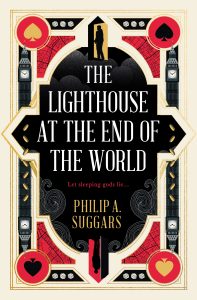 The Lighthouse at the End of the World is an engaging and creative debut novel by Philip A. Suggars. It mixes a gritty but sharply observed underbelly of contemporary South London with an imaginative and somewhat surreal parallel world where magical creatures, strange dialects and living buildings, mingle with more human eccentricities and venalities.
As an ex-South Londoner myself, I have often felt that part of the world was the poor relation of its ‘North of the River’ counterpart, not just in terms of its less than generous tube station allocation, but in the literary allusions which seem to love Highgate and Hampstead much more than Streatham and Tooting. (Though we should not forget that Shakespeare’s Globe Theatre was (and is) a south London attraction.)
So I enjoyed Suggars’ vivid capture of the South London setting, mundanely familiar to his protagonist Oyster yet stalked by arcanely nefarious forces. Unlike Peter Grant – wizardly police constable hero of Ben Aaronovitch’s Streets of London – Oyster walks on the wrong side of the law as part of a gang of hustlers and schemers who con tourists. However, the business of turning over thousands of pounds in card sharp cons is interrupted by two different strangers, and before long reader and protagonist are transported to a beach by a different city – a Greater London – beneath a strange painted sky.
Suggars’ cast of characters are refreshingly different – not just in the trio of close associates that Oyster has in his gangland subgroup – but in the array of strange humans, non-humans and almost humans that he meets along the way.
I particularly enjoyed the unsettling description of Primrose who seems to haunt his own body just as much as he haunts Oyster’s travails.
Primrose’s mock-heroic features arranged themselves into a smile. They were even more peculiar than the first time Oyster had laid eyes on him. A collection of features that lacked any unifying principle. The eyes were too black and too widely spaced, the nose suspended in the middle of the face and the mouth too thin and lipless. The face they comprised was moving subtly, each of its features pulling away from every other. It was a face that only existed. Thought Oyster, because Primrose’s will held it together.
Oyster himself makes a very human fallible protagonist swept up not so much by the tide of times as the whirlpool of times. The supporting characters are, themselves, all utterly unique. The chain-smoking, preposition-dropping Marya Petrovna proves an unlikely and acerbic ally in Oyster’s time of need, and – as a stubbornly rebellious older person – strikes a note for those of us desensitised to phalanxes of teenagers carrying the fight to the enemy. Suggars has a sharp ear for dialogue convincingly capturing the different cants in which the south London gangs and the shimmering denizens of Greater London speak, which ensures each character literally has their own distinctive voice, particularly so in the case of Nonesuch – the magically glowing Gebel – who feels like a kick-ass six-foot version of Tinkerbell. That impression is accentuated by the ‘den of corsairs’ feel to the city of scavengers where she lives – not so much an island of lost boys as a place of lost everythings. The incandescent Nonesuch with her Gebel quirks of speech makes for an engagingly anarchic alternative to the high elves and the dark fae that populate a lot of contemporary fantasy.
In sharp contrast to the recognisable fidelity with which Suggars renders South London, the cityscape and surroundings of ‘Greater London’ feels dizzyingly alien. It reminded me of The Truman Show‘s island-sized studio set encased beneath an artificial dome. However, beneath the ‘lid’ on Greater London, living mobile buildings stalk the land – fleshy tower blocks or old markets that walk and float and bond with their pilots – as if the organic spaceship The Pride of Enni that features in Claire North’s Slow Gods had interbred with the steampunk mobile version of London in Philip Reeves Mortal Engines.
In keeping with ‘Greater London’s’ distorted version of a normal city, Suggars’ prose has lines of sharply skewed observation.
On Oyster’s discomfort at being out in the open.
Parks had always seemed like anomalies in his natural environment, green blisters in the city’s concrete skin,
Reflecting on his absent father.
He thought about the last time he’d seen Lucas, outside the tower block. It had been so long ago, the memories had begun to atrophy, turning into faded copies of themselves; reducing to an essence which was really only a feeling. An absence in the shape of a man.
An unlikely meeting.
[He] smiled, broadly, revealing a mouthful of teeth that a life of recreational drug use had whittled down to grey pebbles.
The plot rattles along briskly enough while we are in our own safe familiar London, with inter and intra-gang conflict helping to keep Oyster and the reader on their toes. The grimy subculture is replete with unmarked territorial boundaries that are collectively understood and ferociously defended, with unwritten obligations that must not be betrayed, with hierarchies hammered home with casual violence. In short the setting of ordinary London generates enough tension before the intrusion of (or extrusion into) the fantastical.
Once we reach Greater London with its multiplicity of factions and agendas, all contained within discombobulatingly surreal surroundings, the plot complexities spiral up into (literally?!) a different dimension. Like Oyster himself the reader just has to hang on in the wild ride and wait for the themes to resolve into distinct threads through a series of switchback jumps between the two kinds of London.
In my own reading, beneath the different layers of character goals and needs, I did find elements of climate fiction, in the sense of ancient god-like forces performing rituals to decide which imperative (technology or nature) will drive humanity’s next epoch with the implicit recognition that the current epoch has been rather thoroughly fecked up.
Strange as the world of Greater London might be, Suggars has Marya make an interesting observation on perception and reality
“…Brain extrapolates reality from available inputs. So it is with everything. Even when you are awake, you dream the world into existence. Materiality is constructed from concepts and symbols in mind, but there is no fundamental connection between world outside and your internal reality. All meaning is mediated, constructed from labels in the mind. This is symbolic order.”
That struck a chord when I was reading about the way optical illusions work not because of what our eyes see, or what an image actually is, but because of how our brain processes information – the importance it attaches to boundaries for example and how it fills in colours where they don’t actually exist. Our impression of reality is no more ‘true to life’ than a black and white image is ‘true’ to the colour original.
And in that vein, Suggars’ bizarre city scape of Greater London, with its battling buildings and strangely nesting oversized messenger ladybirds, makes a delightful array of images and events to absorb and enjoy even as they challenge our ideas of what a fantasy reality should look like.
The Lighthouse at the End of the World is due for publication on 7th April from Titan Books, you can pre-order your copy on Bookshop.org