
FIRST MAGE ON THE MOON by Cameron Johnston (BOOK REVIEW)
The Space Race but with Magic
Cameron Johnston is quickly becoming one of my go-to authors with his ability to take a known concept or trope, add an interesting wrinkle to shift the perspective and framing around to craft an interesting and compelling story. The Last Shield was a gender-swapped Die Hard in a fantasy castle, and it was intensely entertaining (Review). When I got to know that his next book was about Mages on the Moon, I immediately added it to my most anticipated list of 2026 and was extremely happy when I got an early copy of the book. I am thankful to Angry Robot, Cameron Johnston, and NetGalley for this.
First Mage on the Moon features a group of mage-engineers representing the country of Unity brought together through different means and motives to build a rocket to reach the holy and sacred moon, where the gods apparently reside. The team has to do this under the artifice of building a long-range weapon while navigating bureaucracy, internal politics, and the perpetual war with the Ranneas Empire that blows hot and cold (Cold War, get it). What follows is a rather engaging narrative that deals with some of the nuts and bolts of the many stages of building a magical rocket while detailing how a group of individuals become a team, tensions, camaraderie and all that.
“Humanity was nothing if not a motley collection of inventive and curious creatures”
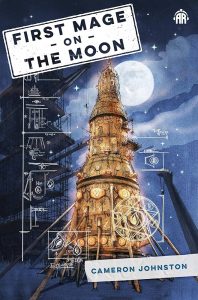 What is immediately apparent as one picks up the book is the inherent tension of an execution of two scientific leaders of the opposing empires accused of the crime of attempting to reach the moon. The narrative then shifts three years back and brings into focus one of our key characters, Ella Pickering. A former skymage (pilot), who is now disabled due to an accident, Ella ekes out a living doing basic magical engineering work, avoiding putting her head up the parapet and hoping that the world has forgotten her. When a secret magical experiment goes wrong, Ella is at the scene to help the lead R&D engineer, Jackan Grissom, and becomes an active participant in this project. Guylan Bluford, Jackan’s much younger rival engineer, finds himself initially co-opted into this project despite his misgivings, while Katherine Goddard blackmails herself onto the project as a way to do some interesting work. Katherine is also the daughter of Whitlaw Goddard, Jackan’s boss and Chief of the R&D division. This assorted team has to pull together and weather setbacks as they try to build this rocket to reach the gods.
“She has become inured to such things. Much of the world was not built to accommodate her needs”
It is these characters who drive the book. Ella is disabled and has to manage a wheelchair for everything, and her difficulties with that flow naturally into the book without giving too much attention. Jackan and Guylan have their own rivalry stewing around, which is tempered by the shared horror both men face during a quest outside of their labs. Katherine has her own shackles to escape and do something purposeful and worthwhile. All these play out in interesting and engaging ways as the events surrounding them escalate in many ways.
“Look at what a few people can achieve with only a tiny portion of the Unity’s resources. Imagine if both the Unity and the Empire instead spent all of that on medical research, engineering and advancing the arts of magic”
The inspiration for what Cameron Johnston builds is clearly the Space Race, a fact that is made clear when he names the R&D chiefs on the two opposing sides as Goddard and Tereshkova. The author also channels some of the optimism that works like The Martian and Project Hail Mary bring to the table in terms of human endeavor and problem-solving, and definitely crafts a book that is positive and good-natured for most of it. The futility of war gets explored, and what follows is the joy of scientific progress and achievement for the betterment of humanity, and not just for destruction. The themes get explored through the book through character conversations, and it never feels heavy or boring, even if the book details some of the intricacies of rocket building. This is also a reflection of the world we live in currently, where defense budgets go up, wars feel perpetual, but funding for true breakthrough developments to benefit everyone seems constrained at all levels.
Even if the mechanism is that of magic to build the rocket, the problems and constraints remain the same – be it the large ones like how to stabilize the flight, to small ones like managing the air when in mid-air, and the author makes interesting choices and explanations to make it sound as plausible as one can in this world. These choices also lead to interesting complications, as the Rannean Empire also cast its glance on this project.
“Everyone is so wrapped up in this never-ending grinding conflict that our dreams of anything better are smothered under the fearmongering domination of the hierarchs”
All of which brings us to the conclusion of the book, which is where the book takes a couple of dramatic and interesting choices. One of these choices is a surprisingly emotional finale that isn’t without blood and sacrifice. This plays out across the large scale, and there are moments of wonder and desperation as the clock races and the stakes get higher. The revelations at the end of this journey are quite interesting and are a fitting, mysterious, awe-filled, wondrous conclusion to this dramatic journey. The second of the choices brings the book back full circle to the execution at the beginning of the book, and this is where I felt the book chose to close things a bit abruptly – like almost saying my focus was the moon mission and not anything else. That did feel a bit abrupt to the remarkably easy pace of narration that has been the feature of this book and could have clearly used some fleshing out of scenes and sequences.
“People need to be reminded that magic is for something more than war”
First Mage on the Moon takes on an interesting spin on the Space Race, but with magic. It is an easy-paced book that is constantly engaging while focusing on the minutiae of the moon mission through a fun group of mages with their challenges and motivations. It is in keeping with Cameron Johnston’s interesting narrative and ideation style, and a tribute to science being a force of good. The momentum is perfect as the pace and desperation ratchet up to give a stunning and emotional ending – there is a portion at the end which is a few paragraphs, but one could easily fit a novel in that. I cannot wait to see what Cameron Johnston cooks up next.
First Mage on the Moon is available now. You can order your copy on Bookshop.org

love the comparison to Project Hail Mary—a good-natured, problem-solving fantasy is exactly what I need on my TBR list right now. The exploration of scientific progress versus war-time defense budgets feels surprisingly relevant to our current world. Would you say the ‘optimism’ of the book holds up even through that emotional finale?