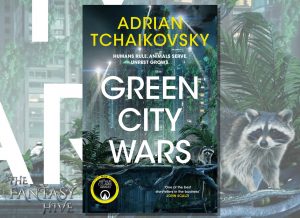
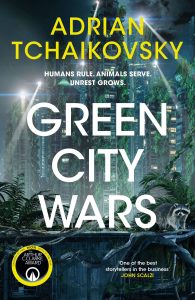
GREEN CITY WARS by Adrian Tchaikovsky (BOOK REVIEW)
Philip Marlowe meets Redwall in this superior adult noir tale, where all the characters are animals, fighting for survival in the city underneath the humans.
In the solar cities of the future, the humans relax in the sun and the animals work in the shadows. Genetically engineered Little Helpers, serving humanity—unseen, unheard.
Meet Skotch. Racoon, P.I.—Yours for a few buttons as long as the job isn’t too illegal, whatever that means.
A mouse has gone missing. Normally this wouldn’t raise any hackles, nor any alarms, but this mouse has something that everyone seems to want, though nobody appears particularly eager to say what that something is.
The fee is good—perhaps too good. Certainly not something Skotch can easily turn down.
If only Skotch can work out where the mouse is hiding, what he’s hiding, and why his secrets are upsetting a lot of animals caught up in the Green City wars.
In the Disney-Pixar movie Ratatouille (2007) there is a moment of crisis where the rogue rodent chef Remy has been set the task of impressing his nemesis – the food critic Anton Ego – with a dish. He creates a version of the homespun ratatouille that at once evokes and elevates Ego’s childhood memories of simple farmhouse gastronomy into adult Michelin starred excellence.
In a similar vein in Green City Wars, Tchaikovsky has taken those childhood memories of stories about talking animals battling conspiracy and adversity in the underbelly of human civilization and elegantly elevated them into a delightful, action packed grown-up adventure that still throws some effective brickbats at the iniquities of contemporary society.
 The tale of Skotch the racoon freelance investigator, travelling the unseen liminal spaces within the future eco-friendly human city of Neuwien Gunstadt had me dragging so many titles from long ago memories. The Rebels of Journey’s End, Mrs Frisby and the Rats of Nimh, The Borrowers, Carbonel, The Wind in the Willows, The Rescuers and many more.
The central premise of Green City Wars is that a future sustainable human society, rather than relying on robots and mechanical automation for their service needs, instead uses genetically engineered animals of all species to perform the menial tasks of clearing up human messes, fixing plumbing, correcting wiring. Furthermore, the Green City Citizens do not want to see the workers at work, merely reap the benefits of their efforts. So – like Asimov’s robots constrained by their three laws – the uplifted animals known as Gehirner – have to abide by Rule One that work for the humans must be completed without any animal ever intruding on human awareness. It’s as though the Wombles had been taken from their Wimbledon Common habitat and confined within the cavity walls, under-floors and ducting of some colossal vertical city of a skyscraper.
Of course genetic engineering is a complex process which places limitations on its creations. There is the need for access to geneware updates to iron out glitches and keep the animals at peak efficiency, and then there is the decay in their mental capacity which can only be staved off by regular doses of a drug called plangent to avoid them regressing into dumb animals barely able to retain their own name, let alone any sense of plot or purpose. The Gehirner are then effectively an indentured workforce held entirely in thrall by the need for essential health care which they only access through continuous employment. (Remind you of anywhere?!).
Having conjured up this delightful context, with its rationale for talking animals, Tchaikovsky then takes a walk on the wild side of his creation in spaces where humans neither care to know or go, and of course – unobserved – all kinds of things can happen.
Nobody, in those human planning sessions when the green cities were being designed, sat down and suggested that a cutthroat competitive economy should exist with the engineered animal population. It was all just a side effect of good intentions, the way things so often go.
And so a range of Mafia like economies have proliferated in the unobserved spaces as different factions strive to take control of the plangent supply or to get others to do the human service work for them. In places the factions break out in open warfare with the red and the grey (squirrels) in furious combat like the battles on the back page of the long ago Tufty comic – only in Tchaikovsky’s case he has armed them with spring loaded guns.
Our third person protagonist guide through this milieu is the racoon Skotch, once employed by the Uzco group, but now a freelancer commissioned by his former boss – a formidable turtle – to find a mouse. A particular mouse that has run from the Gehirner operated country club farms that feed the people of Neustadt, a mouse called Meece, that everyone wants a piece of – and with a little mouse there really is not a lot to go around.
As the blurb suggests there is a Chandleresque feel to the rapidly shifting narrative as Skotch negotiates a variety of annoying, dubious and downright lethal Gehirner as he struggles to discover what is about Meece that has focused so much attention on him. Action follows action at a dizzying pace building to a magnificent denouement in a watery crypt. Every character has their arc, from Maria the vengeful possum, to Tybelle the sharp-clawed genetically uplifted mercenary cat – safe in her status as a human’s pet and able to play with anything she might think of as food.
There are no Gehirner cats because Gehirner are service animals, the busy workers of the green city’s infrastructure. Who ever heard of a cat doing an honest day’s work.
There is the sinuous stoat Szerky, whose bullet dodging skills rival those of the agents in The Matrix. There is Lulu the chattering pigeon and Skotch’s wannabe sidekick cum chronicler who demands stories to tell her human owner in exchange for her misfiring assistance in Skotch’s quest to find Meece. There is Fischer the frog anarchist with his sniper rifle. And sooooo many more.
And the settings are as rich and varied as the characters. Ranging from Mad Parrot Alley to the Restaurant Franz-Ferdinand’s frequented by humans, cleaned up by Gehirner, or the zoo-like Barenhaus where – under the gaze of entranced tourists – Gehirner can legitimately sit and negotiate on neutral territory.
As you can tell from the name there is a very Austro-Germanic sense to Neuwien Grunstadt (New Vienna Green city!) and this creeps into the language the occasionally-appearing humans use and Skotch being addressed as Herr Wasbear or Herr Bandit, in a way that adds a nice texture to the story which a purely anglophone setting would lack.
The prose is full of sharp lines and observations.
“It’s a hard world full of moving parts, Skotch. You get soft, you get chewed up between them.”
Or this Monty Python reference
“Oh look,” he says sourly. “It’s the Revolutionary People’s front of Neuwien.”
Or this of the one human who acknowledges the Gehirner’s existence and offers them some refuge and protection in her subterranean chapel.
Saint Frances does not dress like a nun, who Skotch understands normally cosplay as penguins for some reason.
This is arguably a climate change book, simply because any book that imagines a future world from our contemporary perspective has to consider the outrun of climate change. However, since the progression of the climate crisis is thoroughly entangled with the machinations of late stage capitalism, adapting to climate change is as much as about culture and society as it is about science and the environment. Just as post war Britain had its utopian newtowns designed for what was then modern living, so too the Green Cities are post-climate change metropolises
The utopian cities that lived off the sun and had the carbon footprint of an ant wearing tight shoes.
Back in the old days-the polluted, oil burning, plastic-heavy days that the world is still trying to shrug off like a stinking dirty coat – humans built upwards. … And, honestly, not that much has changed. It’s just what the towers are made of, how they’re powered, the quality of air, the view, the aesthetics and health benefits of it all. … Sustainable society, as well as just sustainable living.
There is, perhaps, a side swipe being made at the AI of the world of LLMs in that the humans of Tchaikovsky’s world have been freed to indulge in creating art and poetry while the mundane essential work has been outsourced to the Gehirner. By contrast in our contemporary world the techbros seem certain that AI will replace human creativity and people will scrabble for menial work to earn the crusts they need to live on. The hand to mouth existence of these future Gehirners will feel uncomfortably familiar to many working underpaid yet still skilled jobs in the gig economy. In that sense, the Gehirner of Green City Wars are the fable showing what future human economic activity might be reduced to, a feudal 99% in indentured servitude to the 1%.
Since when did humans work? Or rather there were plenty of things humans did, but none of them counted as work to a Gehirner. Work was city business, keeping the lights on. The whole point of having Gehirner around was that humans didn’t need to do it.
And as with the old feudal societies, the ones at the bottom of the pile find refuge in faith – with some interesting takes on religion, reincarnation and the soul from a murder of crows who seem to have stepped out of the pages of Solyent Green, and who give Skotch one of his many precipitous cliff hanger moments. Besides the crows’ faith in reincarnation, the enigmatic figure of ‘the divine Jeff’ and his ‘four word mantra’ offers another avenue of hope to the oppressed Gehirner and something of an easter egg for the reader to unwrap. Which Jeff and what line? I will leave that to you!
Reading between the lines I was sure I could find references to Universal Basic Income, in Skotch’s struggle with the plight of the Gehirner. Tchaikovsky’s characters grapple with the idea that people (or animals) must be kept working, that to gain reward without work is a recipe for indolence and societal collapse.
As the charming science mouse Nimoy tells Skotch, “It is not written that we must sweat with work. Only that the work must be done.” While Skotch himself wrestles with a genetically programmed ‘protestant work ethic’ Of course animals had to labour in conditions of want and need, or else it would all fall apart. Idleness indolence and the end of the world.
But at its heart Green City Wars is an outrageously fun tale with a captivating protagonist constantly striving to decipher the mystery of the mouse while avoiding being crushed by the gears of factional politics and service industry.
Green City Wars is due for publication on 25th June – you can pre-order your copy on Bookshop.org