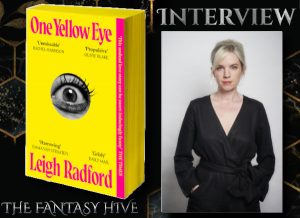
Interview with Leigh Radford (ONE YELLOW EYE)
Leigh Radford trained as a broadcast journalist. She produced and presented arts and entertainment content and documentaries for UK commercial radio, BBC Radio, Time Out, The Times and The Sun. A former book publicist, she is a 2023 graduate of Faber Academy. She is currently developing content for film and television through her production company, Kenosha Kickers.
Your debut novel One Yellow Eye came out last year, can you tell us a bit about it?
One Yellow Eye is about how far we’ll go to keep the ones we love alive. We meet Kesta Shelley, a biomedical scientist, three months after a zombie virus outbreak has decimated much of London, and life is struggling back to normal. All the infected have been rounded up and exterminated by government forces. Except for one zombie, Kesta’s husband Tim, who she’s chained to the radiator in their spare room while she works day and night – and increasingly unethically – to bring him back from the undead.
As someone who used to work in biological sciences, I was really impressed with how realistic your depiction of infectious disease research is. How did you go about researching this?
I am very relieved to hear this because I am a self-confessed science dunce! I was useless at it at school, that and maths! My mum was a biomedical scientist, and when I was a kid she used to take me to her laboratory after school. I found it grimly fascinating, the unique smell of the place, the eerie disquiet, and the body parts she used to keep (for work, not because she was creepy) in huge tubs of formaldehyde in a cold store room. Her work felt like sorcery to me. I wanted to honour that stressful environmental, evoking the cultural tone of lab work and research, the palpable life and death responsibility of looking down a microscope to divine a diagnosis, the race against the clock to understand a novel virus and then to take aggressive, uncharted steps to manage, then cure it. I did a lot of online reading into viral mutations and historic outbreaks. I wanted to posit a legitimate viral origin for those classic zombie traits we see in film and in literature, so I began looking into parasitic infections, hemorrhagic viruses, and of course horrifying zoonotic diseases which haven’t yet spread to humans. Then I had to posit how those different diseases might have contributed individually or mutated together to cause the virus in the book. Striking the right balance was tricky, because I wanted the science to read like a character in the story, rather than to make it too dry so that it overwhelmed the narrative. I didn’t consult my mum during the writing process at all because I felt it was important to approach it as a layperson writer rather than an expert. When she read the novel a week before publication, her review of my take on the science was that it wasn’t totally implausible. Coming from her, that was like winning the Nobel Prize for Medicine!
 Additionally, as a zombie afficionado, One Yellow Eye is the one piece of zombie media I’ve experienced since 2004’s Shaun of the Dead that’s felt like an original and vital take on the monster. How do you go about reinventing a much loved horror monster?
That’s really kind of you to say especially since Shaun of the Dead is one of my favourite films and was a huge influence on the novel. I think perhaps it’s because I didn’t set out to write a zombie novel, I set out to write a book about nursing my Dad when he was terminally ill, because I wanted to explore themes of grief and the battle against adversity to keep someone alive for as long as possible. Zombies then became a metaphor for the human condition when we lose all agency and most of our tangible humanity when disease takes us over. So, I wasn’t consciously trying to reinvent the zombie, I was just trying to tell a very human story about love and the fear of losing it. Perhaps that’s the bit that we forget about with zombies, that they were human once, and for me that’s what makes them the most tragic of all horror monsters.
One Yellow Eye also feels like it’s very much dealing with the COVID pandemic and the trauma we all lived through. Was this something you were intentionally exploring when you started the novel?
Not at all. I understand completely why people view OYE as a COVID novel but that was never on my radar. It was about losing my Dad, very slowly, to a pernicious disease from which there was no hope of his recovery. What I think COVID did, however, was build us a new world in which a pandemic could threaten and paralyse society. It made people feel more acutely vulnerable than ever before, so it helped lay a foundation for OYE, in that the world of zombie apocalypse, while extreme, suddenly felt real and possible.
The novel is also a profound exploration of grief and the difficulties of letting a loved one go. What drew you to explore this theme?
My Dad and I were really close, and each time he became ill – first with prostate cancer, then skin cancer, then finally acute myeloid leukaemia – I dropped everything and moved back in with my parents to help support him. I lived with them for the last six months when he became terminal, to spend as much time with him as possible and to help oversee his care. It’s the hardest thing I’ve ever done but also the most important. The shift in accountability, where I became more his nurse than his daughter was difficult, and to care for someone successfully you do have to keep a lid on your own emotions. When he died I had to deal with the aftermath of my complex grief and writing became a real solace for me.
It strikes me that one of the things that makes the novel so effective is the way it uses horror to explore big and challenging ideas. Is this something horror is particularly suited to?
I think horror gives us the dark, honest language to say the unspeakable and yes, for me, it was a revelation. Horror doesn’t shy away from pain and suffering, it will explore the entire, ugly gamut of what it is to be alive in this world. I also find horror readers to be incredibly emotionally astute. That said, I do take issue with the idea that unpalatable or challenging ideas can only be dealt with in genre fiction. This was my experience as a debut writer, I was told that if I was to publish the novel as pure commercial fiction I’d have to tone down the extreme horror of Kesta and Tim’s suffering, which of course wouldn’t have made the story authentic. I don’t think readers should be squeamish, or that stories about death should be marginalised. Horror is for everyone.
Kesta is a wonderful protagonist – she’s very messy and human. Her relationship with her husband and the way she’s trying to process those feelings are really well drawn. How important is characterisation to your writing process?
I think without vibrant, distinct characters you don’t have meaningful fiction. I never read a book expecting to love or familiarise with the central character, I want to read about someone else’s differing experience or to feel their plight or their pain. I want to be challenged I guess, so writing characters who are morally conflicted, feels more real. I didn’t expect readers to like Kesta all the time, but I hoped that by the end of the novel they’d understand why she’d done the things she’d done and ask themselves if they’d have done the same.
What’s next for Leigh Radford?
My second novel, She’s All The Rage will be out early next year! It’s about an anxious, down on her luck, thirty-something woman, who unwittingly becomes the new wearer of a second-hand suit, which may or may not be possessed by an ancient entity hellbent on mischief and revenge. It’s about how childhood shame can infect the fabric of who we are as adults no matter how hard we try to dress for a different part.
One Yellow Eye is now out in paperback – you can order order your copy from Bookshop.org