Interview with Shannon Chakraborty (THE TAPESTRY OF FATE)
Shannon Chakraborty is the critically acclaimed, Sunday Times bestselling author of The Daevabad Trilogy and The Adventures of Amina al-Sirafi. Her work has been translated into over a dozen languages and nominated for the Hugo, Locus, World Fantasy, Crawford, and Astounding awards.
sachakrabooks.com | Instagram: @sachakrabooks
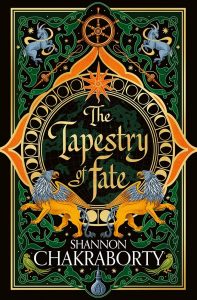
Welcome back to the Hive, Shannon! We’re so excited to be chatting to you about your highly anticipated sequel to Amina al-Sirafi! To start things off can you tell us a little of what readers can expect in the Tapestry of Fate? What is our Amina up to this time around?
The Tapestry of Fate picks up about a year after the first book ends, with Amina retrieving more magical Transgression for the peri council. She’s starting to feel the true cost of her arrangement; while part of her adores the adventure, it’s taking her away from her increasingly frustrated family. And her past is still chasing her—again in the form of Raksh, her estranged demon of a husband whose latest escapade has resulted in the peris sending her after her deadliest opponent yet and a terrifying new Transgression.
Beth and Nils had the pleasure of reading an ARC together and immediately loved being back with Amina. We became so invested in her conflict at the start of the story, torn between her love and duty to her family, and the oath she made the peris; as well as between wanting to keep her family safe but unable to tell them what from. We sympathised a great deal with Amina here. How did you find writing this opening? Was it easy to fall back into crafting Amina’s dilemmas?
The Tapestry of Fate was the hardest book I’ve ever written, for reasons that largely had nothing to do with the story. The first book came out while I was hospitalized with post-partum preeclampsia after a dangerous pregnancy that ended in an emergency induction and during a years long medical crisis with my eldest child. By the time my maternity leave was ending, I was just starting to claw my way back to health, but my brain felt like Swiss cheese and I was struggling to secure childcare. The prospect of writing about another mother doing anything similar felt like a cruel joke. I’d once been so sharp, recalling minutiae of historical details in my head, writing without an outline and now I struggled to hold the shape of the story I wanted to tell in my head, gone the moment my family life would pull me away again. So I took a break. Several breaks! I worked on another book, I read, I tried to give myself grace…and in the end, I told a different story. One that let me break out of my usual historical work into a city, antagonist, and magic that I entirely invented and created and loved. One that let Amina not balance it all because it’s impossible.
 Amina’s friendships do not fare much better, as you put her through the ringer with Dalila too! Was it challenging on a personal level to set your characters against each other?
At times! I always knew that I wanted the second book to shine more light on Dalila and her friendship with Amina, not only because we tend not to see enough female friendships in SFF, but because I wanted to explore how those relationships evolve. From starting out as two dashing young criminals on the high seas, these women have gone in incredibly different directions. Amina has tried to retire, had a kid, gotten pulled into the overwhelming responsibilities of family life. Dalila has gone another direction, choosing to dedicate herself to her work and her passion. How have these choices panned out for them? How does that affect how they view the other and their choices? In many ways, these were aspects that simmered below the surface of the first novel, finally exploding in the second when all these quiet judgements and hidden secrets come pouring out. And when a friendship breaks, when there’s true betrayal and heartbreak there, how do you come back from that? It was difficult to set them against each other, but I also wanted it to feel real; these are brutal emotions to go through!
One of our favourite scenes involved Amina and her crew visiting the fictional place of Sarilaglag. You describe it in such vivid detail with the array of ships and boats housing so many different criminal factions. What were your inspirations here?
Sarilaglag was my own madcap invention. All the outrageous criminal lore was there—medieval people loved true crime as much as their modern counterparts and there are countless texts detailing all sorts of conmen and thieves, the poems and wine songs of the outlaws themselves, and legal records illustrating their darkest deeds. But I was struggling to fit a central meeting place into a historical city during a period when I was having a hard time writing in general and I remember at one point just going “you write fantasy: just make it up and have it have been a well-kept secret!” So, I let myself just go wild with the concept, writing what felt like the most ridiculous of the historical facts into a sort of mash-up of Venice and pirate base in a single joyous draft.
Did you have a favourite scene to write?
Oh, Sarilaglag as described above. It was just so over the top and fun and helped break me out of a terrible writing rut.
We both found the interludes a fascinating addition that set a darker, more tragic tone to the novel. How did you find crafting these? We spotted Circe, but were there any other particular mythologies you drew upon?
I wish I drew on more mythologies, but the interludes were largely drawn from all too real and brutal episodes of human history. One of the impetuses for writing my antagonist’s POV was a staggering fact I learned early in the drafting of this book: that the very first written word in the history of humanity was likely a term for “female slave of foreign origin.” That’s ghastly to contemplate. All of our literature, our grand civilizations…and there is its beginning in the need to more effectively record the transaction of an enslaved woman stolen from her home. I try to look for the brighter spots in history, but “progress” is often built on the bones of people who lived lives so horrific we can’t even contemplate them and it was in those worlds in which my antagonist dwelled.
On a lighter note, my antagonist is a weaver and a witch—a not uncommon pairing—and I recall getting to a part of the book where she’s holding her spindle and invoking a spell and thinking “did I just sort of backwards invent a magic wand? Could there be some history behind this?” I would be very curious to know!
The Tapestry of Fate is an apt title for a book in which there were plenty of threads of your own to weave. Did you have any particular methods that helped you with your plotting this time round?
I would love to have some practical advice that wasn’t just sheer struggle, but it was exactly that do to all the medical, family and general life chaos that was going around. I’ve always been more of a pantser—I feel it lends to more organic plots and character development, but writing this book was truly so brutal that it pushed me to try new drafting strategies with the third Amina book (which have been working much better) so perhaps ask me in our next interview!
One such thread, or theme, that was important to both Amina and a key other character was motherhood. You really highlight the contradictions that pull at mothers and the restrictions and motivations that shape them. How important was it for you to represent the various complexities of motherhood?
Extremely important; a big part of why I wrote these books is because I wanted to feature working parents, especially mothers. We’re extremely rare in genre fiction and I think that’s a shame because there’s so much material to mine. Youthful protagonists and their coming of age will always be fascinating, but I’d argue that parents often have more responsibilities—and far, far more to lose. They let you lean into experience and competence in a far more realistic way as well as examining relationships as they age and possibly unravel.
But I didn’t want to just show hardship. Yes, balancing a career and friendships and your general passion and inner life with the raising of small humans is sometimes simply impossible in certain seasons of your life. In the end, the kids will come first and that is okay. It is normal to quietly contemplate the what-ifs and paths not taken without regretting your choices. Amina’s greatest personal adventure will always be her daughter, even if that’s not what the legends talk about.
If you could sail on the Marawati with Amina, where would you go and why?
While I would very much like to sail to Socotra, I am in truth quite embarrassingly afraid of being on the open ocean (near the shore is fine but I won’t even go on a cruise with my family). I was one of those kids obsessed with the Titanic who grew into an adult who has spent years researching historical maritime traditions and discovering all the many, many disasters can befall ships. No, thank you.
This year you’re finally able to do a book tour! How are you feeling about it? You must be so excited!
Oh my gosh, I am just so excited. My past releases have been during the worst of the pandemic or during medical emergencies. But I get such joy out of meeting readers and my conversation partners in the UK are some of my favorite people. It’s going to be a blast.
Can you tell us about your UK events that our readers might be able to attend?
Yes! I’ll be coming over the first week of June with stops in London, Bath, Manchester, and Edinburgh where I’ll also be attending the Cymera Festival.
Finally, what is the one thing you hope readers take away from your writing?
To let themselves not only be open to learning more about the past, but consider that it might have looked very different than what they expect. We all carry around unconscious biases and that extends to what we know—or think we know—about history. I fear discussions about the past seem to have occasionally taken on an aggressive edge, unfortunately mirroring our political climate. But we live in a glorious age of public history, and it should be a delight to learn new things, to have our expectations turned over, and to yes, occasionally question our ancestors and what society teaches. I know I learned an incredible amount while writing these books and dialoguing with academics, and I truly feel richer for the experience. People in the past were still people; they found joy, they grieved, they lived wildly colorful lives for their own reasons, not so they would fit an easy modern narrative.
Thank you so much for joining us today!
The Tapestry of Fate is due for publication on 21st May – you can pre-order your copy on Bookshop.org