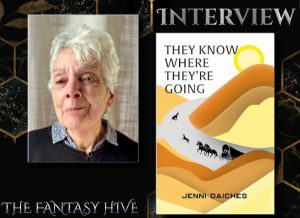
Interview with Jenni Daiches (THEY KNOW WHERE THEY’RE GOING)
Jenni Daiches is a Scottish author and literary historian. Her novel They Know Where They’re Going is a powerful and moving new work of climate fiction that explores the journey of a family who have had to leave their Cambridgeshire farm and travel across a drought-blighted England to reach a place in independent Scotland where the water is plentiful. Her previous novel Somewhere Else was long-listed for the 2025 Women’s Prize for Fiction and the Republic of Consciousness Prize. She has published collections of poetry, and under the name Jenni Calder published many works of biography an literary history. Jenni was kind enough to speak to the Fantasy Hive’s Jonathan Thornton via Zoom about her new novel and her writing process.
Your new book They Know Where They’re Going is coming out later this year from Scotland Street Press. Can you tell us a little bit about it?
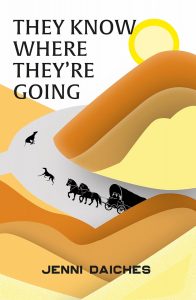
Yes, it’s set in the not very distant future, in 2041. And it’s about a family who have farmed for generations in Cambridgeshire and are forced to give up the farm because of drought. And because they have Scottish connections, they decide to make a journey north to a place where there will be more water. And it’s a rather unusual journey. They encounter various difficulties and hostility along the way, but they also encounter people who are helpful, people who are in a similar position to themselves. And it’s partly told through a journal that is kept by the daughter of the family, who is 16 years old.
It’s set in the near future in a world where we’re feeling the effects of climate change even more than we are now. What attracted you to this genre?
Well, I’m not sure exactly. It had never occurred to me before to set anything in the future. I’m not a science fiction reader. I’ve not had much interest in that kind of fiction. I am not sure how this idea came to me. I think from various different directions, as ideas normally do. But the extraordinary thing is here we are sitting even in Scotland it is very warm. And I feel like I finished the book some time ago, but I feel I could have made even more of the effects of heat and lack of water.
Yeah, I’m in Liverpool, and it’s absolutely scorching here as well.
Yeah, it’s not scorching here, but it’s unusually warm for Scotland. I mean, we don’t get a lot of hot summers here.
At the heart of the book is the family whose lives get uprooted. It’s kind of a migration novel, which is the kind of thing you’ve explored in previous novels…
Yes, that’s absolutely right. I mean, it’s very different, I think, from my last novel, but you’re absolutely right. It’s a story about migration, about displacement, about having to leave an old life and come to terms with something different. Of course, I end before we know how or if they come to terms with something different. But yes, I’m very interested in these ideas of people having no choice but to move, and with the awareness that the way things are in the world, that this is happening and going to happen more and more.
 The book features an independent Scotland which is having less of a problem with water than England, and the family have to deal with crossing the border. Can you talk a bit about this aspect of the book?
Well, it interested me as something to imagine and think about, because I don’t think it has had a place in conversations about Scottish independence. What happens if Scotland becomes independent and the country to which many more people want to move to than is currently the case? What happens if Scotland has something, i.e. water that everybody else wants and needs? Because there cannot be life without water. It’s absolutely crucial. So I was just interested in the idea of exploring some of those notions. I felt I’m not trying to predict a situation, I was trying to imagine a situation that was possible.
Yeah, there’s a tendency with science fiction where people read it as prediction, whereas in most cases it’s probably like you’re saying in that it’s about imagining what it would be like to be in this particular situation, and people read it as prediction later if the world happens to wind up resembling that…
Yeah. I think that’s exactly, exactly it. I mean, it’s always interesting and challenging to allow your imagination to go somewhere and think, well, supposing this was the situation, what would people do? How would they react? How would they attempt to come to terms with the differences in their lives that would be almost inevitable?
Your protagonist in the book is this 16 year old girl, so there’s a sense that it’s a coming of age story about a young woman navigating the world and discovering her place in it. But it’s a bit different when the world has changed so much that it’s become unrecognisable from how it was for previous generations, which I’m guessing a lot of young people probably feel like that already. Was that something you consciously wanted to engage with in the book?
To a certain extent, yes. Though I have to say, I think it’s the same for all teenager, the challenge of navigating a world in which it’s hard for the older generation to put themselves in their shoes, even though we were all teenagers once. I suppose the thing about Ishbel is that she had certain hopes for the way her life was going to go. She had been encouraged to believe she would go to university and perhaps have a life that was similar to the life that her mother didn’t have. And all of that, virtually overnight, when her father suddenly announces that he sold the farm and they’re going to leave, that just melts away. And who knows whether she’s going to be able to recover something similar, or whether the direction of her future is going to be totally different from anything she ever thought it might be.
Your previous book Somewhere Else was also a sort of family saga. Is family a theme that you’re particularly drawn to?
I mean, you can’t escape families. Not for absolutely everyone, but for most people, they experience families in some shape or form. Maybe not conventional families, but families of some kind. So yes, I am interested in the way families work, and the way different generations connect or fail to connect. And what happens when families are disrupted, because the other feature of the novel is that Isabel’s mother died a few years before the opening of the of the narrative, and she and her brothers have had to come to terms with that as well.
I was particularly taken with the poem The Horses by Edwyn Muir, which Ishbel talks about at the beginning of the book, but you have it printed at the end as well. I’d not read it before, but it definitely has interesting resonances with the text of the novel. Were you familiar with the poem beforehand and did it feed into the idea of the novel, or did you discover it later on and realise it seemed to be talking about some of the same things?
I did know the poem beforehand. And as I’m sure you’ve noticed, horses feature quite prominently in the story. But although I referenced the poem, and there were there’s one or two quotes from it earlier in the novel, it was actually my publisher’s suggestion to actually include it at the end. And I thought that was a really nice idea. I love the poem, I think it’s brilliant. Of course, it was envisaging a world after a nuclear war, so it’s a kind of different set of circumstances. But as you say, I’m really pleased that you sort of appreciate the resonance. It does seem to work in the context of my piece of fiction as well.
As well as being a novelist, you’ve written academic books under the name Jenni Calder, and you worked for the National Museum of Scotland. So you’ve been involved in a range of intellectual activities over the course of your life. Do you feel these all sort of feed back into your fiction writing?
Oh, absolutely. Everything feeds into it. I’m sure every writer of fiction feels this. No experience is wasted. You know, I’ve been around for quite a long time, so I have got quite a lot of experience, quite a lot of my life to draw on. And it’s quite a privileged position to be in, actually. You know, you reach a certain stage in your life, I’ve encountered a lot of people, I’ve done a lot of things, I’ve lived in a number of different countries. And all of that is grist in the mill, as far as writing fiction is concerned.
What are you working on at the moment, or has your main focus just been this book?
Well, it has been a focus for a big chunk of time, but yes, in the midst of seeing a new novel into the world, I’ve been working on other things as well. I am addicted to writing. I’m not entirely happy if I don’t have something on the go.
Thank you, Jenni Daiches, for speaking with us!
They Know Where They’re Going is due for publication on 6th July from Scotland Street Press. You can pre-order your copy on Bookshop.org