Interview with Lex Croucher (THE UNMAGICAL LIFE OF BRIAR JONES)
Lex Croucher is the New York Times, Indie & USA Today bestselling author of GWEN AND ART ARE NOT IN LOVE. With a background in social media for NGOs, Lex now writes queer historical rom-coms and fantasy for both adults and teenagers from their flat in London.
Welcome to the Hive Lex Croucher! It’s great to have you. Let’s start with the basics: tell us about The Unmagical Life of Briar Jones – why should readers check this book out?
Briar Jones is the book for everyone who didn’t get into magic school. It’s about being an outsider, missing out on the life you thought was your dream, and losing the person you love most in the world, only to find them again and discover that you’ve both been changed by the years you’ve spent apart. It’s also very queer. I like to describe it as dark academia fantasy—it’s about a magic school, but it’s mostly about the people attending the school (or in Briar’s case, working a temp summer job there) and how power or the lack of power has impacted them.
To have a protagonist be on the periphery of a magic school instead of learning in one is a refreshing take on a familiar setting. Tell us a bit about how you landed on this viewpoint for Briar.
Honestly, I didn’t enjoy school, and I’ve never liked the idea of writing a novel from the POV of someone attending one. I also wanted to write about the reality of an elite British boarding school and how much that would contrast with the dream of attending one. Briar, as an outsider who didn’t get in, is so ready to see the school through rose-tinted glasses, but the horrors won’t let them.
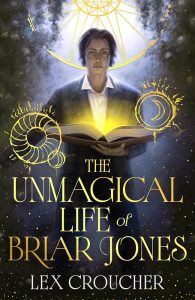 As a boarding school alum myself (though of a decidedly more chilled-out school), I can wholeheartedly say you nailed the swaggering arrogance of the scholars and the crumbling, austere vibes of the buildings. Did you use this project as an excuse to visit any particular locations for inspiration? Were you drawing on other influences?
The main school building itself was loosely based on Ightham Mote, a fourteenth-century manor house in Kent with a moat, which I did visit again for a research trip. I also went on a research tour of Eton, which was both fascinating and quite unnerving. There’s some of Oxford in there too, and I visited a friend doing a DPhil there and attended a formal. I generally spend as much time as possible jaunting around National Trust houses, so inspiration is easy to come by!
You’ve commented online about how you wanted to write a book where Briar’s gender isn’t a plot point of the story, they just happen to be a non-binary person living through these events. Given the dystopian climate of the world at the moment, I think this is really valuable representation. Why was it important for you on a personal level to write this particular perspective? How much of your own experience was woven into Briar’s?
On a personal level: I’m non-binary and it’s just one part of who I am, Briar is non-binary and it’s also just one part of who they are. I did wobble a bit when it came to deciding to write this in third-person present tense, because it meant there’d be they/thems on every page, completely unavoidable, and then I realised that was exactly why I should do it. I think you get used to it very quickly once you’re sucked into the story. I know there will be some people who close the book immediately, but I hope Briar wins a few hearts and minds. I also wanted to write a magic school book with a trans protagonist for reasons that are likely quite obvious.
Thaumaturgy as a magic system is highly reflective of this dark academia setting – complex language, rare tomes, and closely guarded secrets. How did you decide on the mechanics of it? Was the story inspired by the magic or vice versa?
The story came first. The magic really just needed to be mundane enough that it would ruin Briar’s image of flying carpets and wands, and I could think of nothing more excruciating than having to untangle a mixture of cryptic crosswords and contract law, both of which I understand next to nothing about despite tens of people kindly and slowly explaining them to me.
Briar’s prickly found family was the highlight of the book for me. In particular, their unapologetically flawed personalities. Did you find the misfit trio difficult to create, or did they tumble onto the page fully-formed?
They were quite easy from the offset! Supporting cast is my favourite type of character to write. I wanted someone who was all-in on the academia of Temple and who spoke in a very posh, old-fashioned jolly-hockey-sticks sort of parlance, a decision that was very much influenced by The Secret History, hence Westby. I wanted somebody who was much more modern in contrast, and genuinely quite kind, who’d been through the wars at Temple and therefore would look out for Briar a bit more than the others, hence Tate. Hadley was inspired by a mixture of about twenty different girls I knew in secondary school. Selfish out of self-preservation, making terrible choices, but ultimately someone who’s been failed by a lot of people and really needs her friends.
The monsters in this book are purely human, making them that much more terrifying to read about, especially when we later discover more sinister moments in the story. Was it a conscious decision for this story to be so much darker than your previous publications, or did the scholars demand it?
It was a very conscious decision. I wanted to show the true horrors of British boarding schools and the way the elite treat ordinary people. Frankly, some of the things I read about in biographies and first-hand accounts of boarding school were far worse than anything that made it into the book. I don’t think there was an honest way to write this without freaking a few people out.
Quickfire round:
Briar aside, who would you prefer to share a dorm with out of all of the scholars?
Tate all the way. He’d get really annoyed at me for leaving stuff on the floor and borrowing his clothes without asking.
If you were hired at Temple, which role would it be for?
They wouldn’t hire me at Temple, I’d fail the background check. Used to work for Greenpeace. That’s far too radical for the board of governors.
What would it take to get Eugenia to be my life coach?
An extremely competitive salary.
If you were going to tell a different character’s story from this world, whose would it be?
Bastian for sure. Lots of trauma there and difficult emotions, but I find him very endearing and fascinating. Unfortunately I can’t bring myself to write about homework. That’s what his story would be called: A Trauma of Homework.
What are the chances of there being a second book to explore the fallout of this one?
Quite low, because unplanned sequels are terrifying. I have one coming out later in the year, a sequel to my YA book Gwen and Art Are Not in Love, and I feel like I’ve willingly put my hands in a woodchipper.
And finally, how dare you give me a book hangover this gnarly. Have you got any recommendations for books that might ease the pain?
I’ll always recommend The Locked Tomb series by Tamsyn Muir. Metal from Heaven by August Clarke blew my head off, as did The Everlasting by Alix E. Harrow. Anything by Freya Marske, everything she touches turns to gold, it’s actually really annoying—Bodies of Magic is her next one, and it’s a medical dark academia fantasy which I adored. For some lighter fun, I just read the Check, Please! graphic novel by Ngozi Ukazu which is a pre-Heated Rivalry queer ice hockey romance, and that was delightful.
The Unmagical Life of Briar Jones is due for release 9th of June from Gollancz – you can order your copy on Bookshop.org