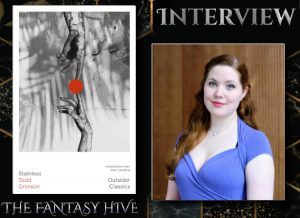
Interview with Dr Alex Carabine (STAINLESS)
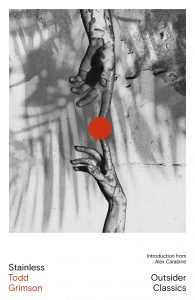
Dr Alex Carabine is a specialist in gothic, medieval and Victorian literature, art and culture. She hosts lectures and creative writing workshops on her Instagram @decadence.and.dark.ages. She has taught at the University of Liverpool and is the founder of Gothic University. Dr Carabine wrote the introduction to Dead Ink’s reissue of Todd Grimson’s lost classic 90s vampire novel Stainless, so to celebrate the novel’s rerelease, The Fantasy Hive has interviewed Dr Carabine about this incredible underrated horror novel and its place in the vampire canon.
Todd Grimson’s novel Stainless has just been reissued by Dead Ink, and you wrote the introduction to this new edition. Can you tell us a bit about the novel?
Stainless is a lost classic from the 90s that was published in 1996 and then it just kind of went under the radar. It only really penetrated like the American market anyway. It’s very difficult to find. And so it just kind of disappeared into the ether, but it’s actually a really interesting lost 90s vampire classic that I think needs to be reinstated and to find a place on any vampire lovers’ bookcase, because it does really strange and interesting things with the themes of the 19th century and violence and addiction and kind of weary jadedness as the millennium came on all through the lens of vampires. So in terms of narrative, it’s about Justine, who is a very frail vampire created just previous to the French Revolution. How she finds her way to America, we find that out in flashbacks. But the book opens with her and Keith in this really strange relationship, because Keith is an ex-musician, an ex-Junkie who has come to be dependent on Justine and Justine’s vampirism in both emotional and physical sense, and Justine becomes dependent on Keith to kind of re-contact humanity and the world and regain some semblance of herself. And it’s all told through these strange short bursts of narrative. It’s very kaleidoscopic, which is why it’s so hard to kind of describe all in one go here. Because there are so many characters, and you find out about events, about timelines, and whatnot, through these small snapshots that you have to kind of hold in your head all at once, and then it all culminates in the ending, which is kind of dramatic, explosive, and strange.
It does eventually build to this explosive climax, but quite subtly. The antagonist vampire David only shows up about half way through, so you have this whole section of the book where he’s not in the picture where it’s just these little vignettes that sort of tell you something about these two very fucked up people in their deeply fucked up relationship.
Absolutely, and again it’s all like through these like moments of reflection, like it’s only through David, this malevolent character that you mentioned, that you start piecing together bits of Justine’s background that have otherwise been invisible. Because Justine has kind of lost huge patches of her memory, and so you only find out about her not through a direct, reported narrative, where she explains her own perspective, but through people’s perspective of her, and you have to kind of piece everything together. But you’re right, it does all kind of like come together in the end in this really subtle and interesting, yet still somehow chaotic way.
It’s such a cinematic novel, it’s a shame it’s never been filmed. It’s full of these sumptuous set pieces, you can imagine it lending itself to a cinematic adaptation very easily.
It would make such a great film. And it’s worth noting as well that Todd Grimson was the writer of Brand New Cherry Flavor, which was turned into a Netflix TV show. Which is excellent, it is so good. I haven’t read Brand New Cherry Flavor, because again, most of these books are only available in America, so I’ve not been able to get a UK copy. But the Netflix show, that is this lush 90s LA, and it’s about a young woman making a film, so it’s got that cinematic aspect to it as well. So thinking about how well Brand New Cherry Flavor adapted to Netflix, it would be great to see Stainless filmed as a mini-series. I think this would be amazing, because it’s got that kind of slightly seedy LA that you find in something like The Lost Boys, which I know isn’t quite LA, but it’s got that kind of vibe to it. But I think this would be amazing as a TV show. I think I think it could irritate some people with all the different characters, but I think it could work really well. And it’s interesting as well that David is a silent actor as well.
Yeah, there are many roles that vampires play in this novel, so you have the vampire as addict, but also the vampire as actor. With David, any scene he’s in, he’s always presenting an image of himself. You never find out who he really is, apart from his smouldering resentment of Justine. It feels like he’s been performing for so long there’s nothing underneath it.
Absolutely, yeah. And you’re right, it’s just this kind of lustful vengeance that is actually really petty. It’s interesting that his origin story kind of mirrors Justine’s. Justine’s origin story is quite violent and tragic and just very glancingly told. Whereas his version of being sired by Justine was quite offhand, quite casual, not that dramatic, and that itself seems irritating to David, like it was just so negligible, and so he’s got this real vindictiveness about his character, which I think is just genius.
 The way the novel handles violence is really interesting. We see Justine doing some pretty violent things, but generally speaking to people who kind of deserve it. So Justine feels quite sympathetic, despite the fact that she’s clearly killed a lot of people over the yeas, so when David comes in and is so violent to her it’s a little bit of a shock.
Yeah, and especially because his is so much of the role, and there is so much artificiality to this character, so much theatricality. Whereas Justine, for all that she’s lost or violent or vampiric or girlish, she’s just kind of at least being real to that moment, you never really get too much of a sense that she’s putting it on in the way that David is putting it on. She’s struggling, and she might maybe be codependent in her relationship with Keith, which you can argue stops them both from being truly authentic. But she’s just doing her best, badly.
Similarly with her relationship with Keith, you wind up quite invested in it. They’ve both been through hell, and they’re trying to make some kind of human connection with each other, however poorly.
Yeah it really does show the kind of tenacity of love, even amidst all this monstrosity and violence, and that love is itself a very vulnerable and ego-ridden process and emotion. And that loving someone is dangerous, in a way that a vampire is dangerous to your health, love is dangerous in a whole different way. I was surprised by how much I was hoping they’d be ok in the end.
Yeah, despite that with the way that it’s written, it wouldn’t have been true to the rest of the book if there was a happy ending.
Absolutely 100%. And that’s something that I talk about in the introduction. I talk about how this is a great example of blank fiction, which has this preoccupation with this jaded attitude to everything. It reflects on the emptiness of consumerism, and also art that is made in a capitalist world, all of these sorts of things. Things like American Psycho is blank fiction, where it’s just relentlessly violent, and so to have this bleakness and violence which is already inherent in the vampire, and to explore it through this cynical and sleazy vibe is really interesting.
Yeah I’m really interested in this idea of blank fiction, because Stainless does seem to slot so well into that era when you had not just American Psycho but horror authors like Kathe Koja, or the other book that it’s very hard not to think about is Poppy Z. Brite’s excellent Lost Souls which again is vampires but in the 90s involving music but also that kind of sleazy urban emptiness…
Yeah, absolutely. And how everything is just this kind of performance. Even then nihilism is a performance of nihilism, which is like doubling down on the idea that nothing matters so intensely that everything matters really deeply. I think it pairs beautifully well with Lost Souls. So, if anyone’s read Lost Souls, they would love to read Stainless. It’s got a very similar kind of ethos, but again, this kind of moment in time, where it’s almost like through vampires and this concept of eternity, authors are looking ahead to the millennium in the 90s and looking at all this like American optimism that was around at that time, and how it’s going to be a fresh start, we’re going to party like it’s 1999 and instead just going, do we have to? We’ve got no evidence that it’s been great in the past. There’s no evidence that it will be great in the future. Eternity is actually a curse.
That’s one of the things about reading it now, we’re living in a time when the 90s are becoming quite romanticized. But books like this really do grasp the nihilistm and the angst of the era, in the same way that Nirvana’s music does, or Daria or Buffy The Vampire Slayer. A lot of the pop culture of that era was reflecting that pre-millennial tension.
Absolutely, and it’s interesting as well that the nostalgia we’re feeling for the 90s now doesn’t necessarily pick up on that sorrow that existed in the 90s. Instead they’re kind of aestheticizing it. I see a lot of people talking about Nirvana, but not necessarily talking about mental health and suicide and addiction. They’re instead just talking about what an amazing time it must have been to live in. Yes, but also no! It’s so interesting that the 90s now is this kind of return to an era before social media, for example, before we all got bombarded with this particular bubble of capitalism that we’re enduring, and it’s seen as a somewhat more innocent time, and you could kind of run around in the streets until the street lights came on, and then you’d go home. It’s like this Lost Boys-esque, but it was fraught with this anxiety and this sadness and this existentialism that just kind of gets glossed over now.
It’s funny because so much of what made the art at the time resonate was that it was very much dealing with that complete hopelessness, that mistrust of the future.
Definitely, and it’s the fact, as well, that these books, like Stainless itself, like Lost Boys, they were kind of staring at you head on in a way that doesn’t necessarily happen in pop culture. I think about Justine and her memory loss, and I think about her experiences as not just who is in the body of a very small, very vulnerable woman, and how a lot of the violence she experiences is the violence women in the patriarchal society experience, but forever. But so Justine is actually a really interesting representation of the trauma response to an eternity in that situation written in an era before they had no language to kind of like unpack that in the way that we might.
Yeah, it’s like the only way she’s managed to survive all this is by forgetting. She can’t remember because it’s too painful.
Absolutely, she is like a supernatural representation of dissociation, which is fascinating and really interesting to read. And I think that’s what you were saying about how super sympathetic she is. I think that’s what makes her really sympathetic, is that you can see all her pain and all her experiences in a way that even she can’t. And then all her actions kind of make sense through that lens. Especially when you throw in the fact that she is also supernatural, but that she also has to feed on people to survive, which is like a metaphor for co-dependency. And so she has to make choices about how to navigate her predatory tendencies. It’s interesting how she’s placed, especially within the vampire tradition, as well. There aren’t that many vampires like her. The female vampire was sexy and subversive, and then girl power. Like she was a threat, and then it was just like a sex kitten, and then it was girl power. And then now female vampires are just kind of normal. But Justine is this kind of perpetual victim in this really realistic way.
One of the things I really liked about the book is that in some of the vignettes you get a bit of a sense of what she was like in different eras. There’s that idea that the vampire is a dark mirror to society. There’s an extent to which Justine seems to reflect the chatacter that she’s with. When she’s with the noiresque policeman, who’s the most unpleasant character in the book, while she’s feeding off him she’s doing this quite sadistic experiment where she’s keeping a victim’s corpse to watch how it rots. Which is the kind of petty cruelty that has been since sanded off her. But it’s interesting to see her try a bunch of different responses to trauma, some of which are more destructive than others.
No, that’s really interesting. I haven’t thought about it from that perspective, but you’re right. Because there’s even that moment where she’s part of the French Revolution. She’s wearing a red bonnet and she’s screaming for aristocratic blood, and she just flees and goes to America. And again, that’s only really short, but it is this really like jarring perspective of Justine as someone who’s not just active in the world but politically active in the world, which takes a different level of awareness and engagement and commitment to a society. Whereas the Justine, as we meet her in this mansion in the 90s, there is something a bit Sunset Boulevard about her. Like this recluse woman in this huge mansion, who’s just tried to remove herself from the world. Which is beautifully gothic. So yes you’re right, it’s interesting to see Justine kind of absorb these characteristics, and it’s interesting as well because she does at one point note that the blood of the people she feeds on tastes differently depending on their habits. I mean, literally, because Keith was a heroin addict when they met, and she didn’t like his blood, so I wonder if there’s some kind of inference to be made there, that when she feeds on someone she assimilates them through vampirism
It’s like that Emily Dickinson poem, one does not need to be a chamber to be haunted, or a house to be haunted, where Justine herself becomes a haunted house. It’s fascinating as well, because Justine doesn’t do the level of navel gazing we’d expect from a vampire in the 90s. Because vampires throughout early vampire novels, they came and threatened the status quo, and then the status quo got to win, and the status quo got reestablished really violently. So everyone felt very safe at the end of the narrative. And then Anne Rrice came along, and then the vampire stared firmly into its own navel, which Justine doesn’t. She gets asked these kind of questions by Keith, and then we can’t really answer, because she’s just moth-eaten by time.
Again it sort of feeds into her weird sort of innocence, especially contrasted with David’s performative visciousness.
And he’s this kind of cult leader figure as well. And he’s absolutely depraved with the members of his cult, he makes them do things to each other, he does things to them. It is just an absolute nightmare that is told in this incredibly matter of fact kind of dry way. It’s interesting as well to think about the visuals of the text. Justine with her long, straight, dark hair is often put in a white dress, like a nightgown. So she’s even coded to be this kind of gothic heroine, like the visual of the dress, women wandering around with the candelabra, that Del Toro loves and was in the Frankenstein and Crimson Peak films. And we have that in Justine, except she is the monster and the monster’s victim all at once.
Justine reminds me of Drusilla from Buffy and Angel, that kind of innocence corrupted, and she’s just as much a victim as she is a monster.
I wonder if they actually read Stainless because it did okay in America before, like in the 90s, and then it was kind of fizzled out, so there would be room to imagine that Drusilla is influenced by Justine. It’s also this kind of malicious childlike innocence, because again, nowadays we like to view childhood as this kind of idyllic sweetness when children will also like hold magnifying glasses over ants to watch them sizzle and pop, or they hit something to see if it hurts, or whatever. So, there is this kind of sadistic element, which itself stems from innocence, because they’re learning about the harm that they can do and the repercussions of that. And they’re learning that they’re not the centre of universe. Whereas Justine’s almost regressed to that. We haven’t really talked that much about Keith.
I think Keith is a really interesting protagonist. He’s obviously quite damaged. He had this relationship with his ex that went sideways, and that’s why he’s not a musician anymore, because he got his hands mangled in prison, which is what drove him to drugs.
it’s almost like by Keith becoming an opium addict because of the mangling of his hands, we’re allowed to feel sympathy for him that we wouldn’t necessarily feel if he voluntarily got involved in the drug scene through music. So it’s like even he’s given a level of victimhood like Justina’s, so that we can kind of gloss over some of the more tricky questions.
Again he does some quite unpleasant and violent things in the book, but you do feel sympathy for this guy. Through this incredibly destructive codependent relationship, he sort of puts his life back together.
Absolutely, it’s like they’re doing this mutually beneficial reconnection to the world into life for each other. Where Keith kind of disappeared into grief, with Renata’s death, and the nature of Renata’s death, he feels a huge amount of grief for her loss. Then there’s the fact that he gets punished by the death in a way that is completely unjust, and ruins not just his hands, but his career. He cannot play guitar, his connection to the music is gone, so then he disappears into his opium addiction to begin to deal with the physical damage to his hands and the psychic damage he received his life. And so he just kind of disappears until Justine arrives, ostensibly to kill him, and then keeps him and slowly brings him back from this kind of narcotic death that he’s been in. And he does something kind of similar for Justine. She disappeared into this again very Sunset Boulevard LA death within this mansion, where she’d had a husband, and he died and left it to her. They both just had agreed to stop living, to all intents and purposes, until they fell in love with each other, and slowly through this incredibly unhealthy co-dependant relationship, pull each other out of it.
And it’s not even like it’s romanticized, because Keith and Justine are abusive to the each other. Keith literally injures and tries to kill Justine a couple of times, and she basically tries to do the same thing to him, and this whole jealousy and infidelity. Keith is a really interesting character, and he is an incredibly poignant character, and it’s his like humanity and his determined vulnerability that kind of carries them through. So that there’s a moment that comes where Keith does something that makes Justine feel like she’s poisoned him, and he’s become a monster himself. He’s done something to protect her, that ordinarily Justine would take care of, but now he’s done it to protect Justine, which is putting her in a human and also feminine position, and suddenly it introduces this tension in their relationship of, who are we to each other? And even from that, they get a degree of closeness. It’s such an interesting book, it’s such an interesting relationship.
The book manages this balancing act between these two monstrous characters who are doing monstrous things, but viewing them through a sympathetic lens. But because it’s a gungy dark book, it doesn’t feel like it’s selling short the horrific things that they’re doing.
It’s true, it is really like particularly good, and I also have to acknowledge as well, that although terrible things happen in this book, and not just violence, but there’s bigotry, there’s racism, there’s homophobia, but it’s all told with this denseness and this kind of lightness, where it doesn’t shy away from the very human parts of reality, but it doesn’t become aggressively triggering. You don’t read it and feel like you’re surviving something by reading it. You’re getting all the information you know you need to know about the horrors without Grimson necessarily rubbing your face in it and kind of delighting in that in a certain way.
Yeah, despite the luridity of the visuals, it’s surprisingly understated in parts, and reminds me almost of J.G. Ballard’s lack of affect. You get told matter-of-fact-ly about this horrendous thing happening, but not in an overwrought way. It’s just there, and part of how the text works is that you process it in quite a specific way.
Absolutely, and you’re left to kind of add the inferences to the text. If that, therefore, this. This is the motivation for what this character is doing. For anyone who hasn’t read the book yet, there is a trigger warning to this text for sure, but also I wouldn’t necessarily be frightened of reading this with those trigger words, because it is so matter of fact. Justine, at one point, mentions that when she was turned into a vampire, she was also ravished at the same time. So you get this kind of like antique term for sexual assault, which again situates her in time, because she can’t be sure of exactly what she got turned into a vampire, but pretty soon after that, there’s the French Revolution, so you can assume it’s the 16 or 1700s. So one that’s a really clever choice in terms of prose, because it locates her memory and time that is a very year-specific word to use, but also it distances the reader from what’s happened, because we have to kind of process the anachronism of the term, and then go, oh, that’s a rape, and then you add that to Justine’s character, but you aren’t necessarily dragged into the trauma of the experience. So again, trigger warnings for this text, but no red flags.
Yes, it’s very much a text about these things rather than any sort of gratuitous enjoyment of these things.
Absolutely. Sometimes I feel, especially with vampire novels, and there’s one that I was reading recently that I kind of had to let go because of this issue, was that the male author was demonstrating how sadistic the vampires were in his text by displaying a lot of female suffering to indicate how awful these vampires were. But I then had to ask the question, does the author not realize he’s doing the same thing, by essentially feeding off female suffering. That isn’t an issue here. There is a conscious engagement with the issues without necessarily glorifying in their descriptions.
Yeah. It’s not a book that needs to sit you down and say, this is racist, but it exposes you to that viewpoint in a way that you know that it’s critiquing it rather than endorsing it.
That character is very much the underbelly of film noir kind of cop, in a way that film noir, because of the way the era was set up, the books could go there a little bit, but the films couldn’t necessarily get there. It would be easy to read that cop as he’s kind of presented as non-critical. You have to apply critical thinking to him. Because if you didn’t think critically about this book, you could go, this book is racist, cause the character is so racist. But as soon as you start applying any degree of empathy or anything you’ve learned about Justine, you learn that through this cop, we’re just getting another facet to human monstrosity that acts as a foil to supernatural monstrosity. Grimson doesn’t patronise the reader by getting on a soapbox about things, he just expects you to keep up or do the work or get out. He’s not really interested in spoonfeeding the reader.
Which again is quite refreshing. It has that consistency of tone, which it needs in order to convey the vibes, but within that there are lovely surreal moments, like the bit where they’re in the car and he keeps trying to kill her, then he turns around and she’s in the car with him again. It’s such a strange, dream-like sequence.
It is so surreal, and honestly, it was one of the scenes that stands up most vividly in my head as well.
It’s a beautiful piece of writing. You could publish that chapter as a short story.
You could film it as a short again, that kind of like Lost Highway, this kind of dreamy nightmarish LA that probably does not exist anywhere outside of this literature, and David Lynch. But yeah, it is so surreal, and it’s at the beginning of the book as well, like it’s placed very early in the narrative, which I feel sets up the relationship perfectly. Because Keith is almost like testing things out, like the survival mechanism is coming in, this is a vampire, I have to kill her. And she comes back because she doesn’t know what else to do. She’s got nowhere else to go, so why wouldn’t she? And it didn’t hurt anyway. So what’s the problem. And then he tries it again, and then eventually they both just go, “Oh, well, let’s love each other instead.”
And it’s interesting as well that it kind of prepares you for the vampiric lore of the text to a certain degree. So you figure out oh she is a vampire, she will come back from the dead. She isn’t necessarily aggressive. And then that kind of sets you up for all the extra vampire bits. Like the fact that she produces a liquid like a sugar syrup that Keith becomes dependent on, and then later on, when she has to reveal herself as a vampire to two bystanders, she climbs the wall.
I really like both those characters, Tamara the doctor who’s been treating Keith and her husband. They have quite a believably flawed relationship, but it feels quite moving in the way that they become the people who witness what happens to Keith and Justine at the end.
Absolutely, I also enjoy, as well, the fact that she’s kind of supportive and very empathetic, but still very professional, very scientific. He however is very dry and a little bit dull. It’s almost sit-com-ish, how it’s like a double date setup, my best friend and his wild new girlfriend and the staid couple who’ve been together forever.
I think their participation in the final act and the sort of weird sadness and transcendence of that scene is really quite moving. The way it plays off those characters in the end is really nice.
That scene is really beautiful. I’s interesting how the kind of normality acts as, not necessarily a frame. It’s more like a foundation for the surrealness of the ending, for the sorrow of the ending, for the supernaturalness of the entire book. All of a sudden they both have spotlights on them, because in the unknown their relationship seems so wholesome and healing and important in that moment, because it isn’t what Justine and Keith got to have. Justine and Keith also shine so much the brighter because it’s against this kind of domestic suburban romantic relationship that a lot of people enjoy, and also endure. You couldn’t get two more dependable witnesses. A doctor, and the most boring man alive without imagination.
Thank you Alex Carabine for speaking with us!
Stainless is available now on Bookshop.org