CHILDREN OF RUIN by Adrian Tchaikovsky (Book Review)
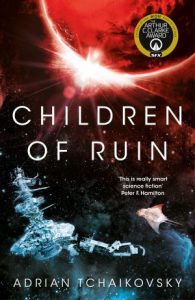 In Children of Time, Adrian Tchaikovsky delved deep into the alien familiarity of spiders, building – through accelerated evolution – a species wholly inhuman in its culture, appearance and thought processes. Throughout that first book the developing spider world is haunted by the Gilgamesh: an ark ship of humans who had fled the tattered ruins of an Earth fundamentally destroyed in an environmentalist revolution against the science party technocrats of the Old Empire of terraformers. The spiders’ world is offered some protection by its “creator”: the ultimate terraformer, Avrana Kern, who survived her own crew’s rebellion by imprisoning herself in an orbiting sentry unit.
Over the millennia of the first book, the spiders and the humans come to an understanding overseen by the downloadable artificial intelligence that Kern has morphed into. A few generations later and the spiders and humans have sent a mission to another potentially inhabited world, beckoned by its radio signals. Their spaceship, Voyager, is an organic, mutable thing – a synthesis of arachnid web-based building and human ingenuity carrying its own cantankerous copy of Kern. Children of Ruin is about the making of the strange solar system they are headed to and what happens when they get there.
In Children of Ruin, as in Children of Time, we follow two timelines, but this is not quite the parallel journeys of spider evolution and Gilgamesh ark-ship inter-stasis interludes. In Children of Ruin we are given a past timeline of the development of a strange solar system and the present timeline of what happens when the humano-spider (or arachno-human) voyagers arrive.
The past timeline follows a crew of terraformers – contemporaries of the original Avrana Kern – emerging into a solar system with two more or less habitable planets. The decision as to which one to terraform is complicated and gives the two chief scientists Senkovi and Baltiel ample opportunity to explore their own particular obsessions. Senkovi in particular is expertly drawn, a compelling believable creature, part genius, part mad scientist. It is his proposal to try and terraform the water world named Damascus, and it is his obsession to populate it with genetically engineered trained octopuses as a workforce. Baltiel meanwhile hungers to catalogue the vibrant, unfathomable – but unintelligent – flora and fauna of the other planet, Nod, with its biology so alien it is not just incompatible but incomprehensible in Earth terms.
The terraformers’ past adventures make an enthralling counterpoint to the present perils of the arachno-humans, who emerge from stasis into a baffling system in the midst of continuous warfare populated by species they have no means of communicating with.
Tchaikovsky leaps adroitly between past and present timelines, picking the moments of real tension as the reader breathlessly struggles to understand the past and to see how this might enable anyone to survive in the present.
The world building, of the literary rather than terraforming variety, is subtle. Baltiel and Senkovi communicate directly with each other and their computers through interfaces or implants so ordinary to them that Tchaikovsky doesn’t even describe them; the reader is left to infer the existence of these and countless other systems and structures from the impact they have on the story.
The writing is fluid, shot through with flashes of humour; for example, when Senkovi reflects on how Baltiel’s plans might earn him a place in posterity:
“There would be other names in footnotes or immortalised as geographical features. Mount Senkovi … or maybe not. Sounds like an instruction to a taxidermist.”
Or when Tchaikovsky arachnophises an old human phrase:
“Portia really is the sum of her ancestors, crouching on the cephalothoraxes of giants.”
Yet in this, he is also referencing a unique feature of his spider civilisation – their inheritance of knowledge as an embedded genetic understanding, rather than lessons learned from a book. In Children of Time, it is in the transmission of information – the indifference to vocal sounds, the lack of need for written words – that Tchaikovsky draws the most striking differences between his humans and his spiders. In Children of Ruin, he goes not just one but two or more steps further in defining new means of communication, of memory, of understanding. The spiders and the humans can at least inhabit the same environment, breathe the same air, share the same basic genetics. Senkovi’s discordant but somehow flourishing octopus civilisation are another degree of difference entirely, brains that do not know where their bodies end, limbs with sufficient nervous system to act independently, skin a mutable palate of colourful emotion by which they convey a capricious meaning.
Helena – the human translator travelling with the Voyager – faces as great a challenge in establishing communication as Tchaikovsky did in representing octopus thinking and emotion. While Tchaikovsky succeeded brilliantly in his challenge, I will leave it to the reader to discover how far Helena succeeds in hers.
 The octopus civilisation is given a significant leg-up by inheriting much more substantial terraforming technology of Kern’s generation, rather than the sad echo of that scientific brilliance that the Gilgamesh’s crew brought to the spiders. This puts the Voyager at an immediate disadvantage, as outgunned as Captain Janeway’s Voyager was by the Borg, though Tchaikovsky’s octopuses are as utterly different from the Borg as it is possible to be.
Tchaikovsky throws perils at both his past and present protagonists. The environmental revolution that effectively imprisoned Kern reaches out across thirty light-years to clutch at Senkovi and Baltiel’s heels. Helena’s companion Meshner, struggling with his spider companion Fabian, finds he risks his sanity in trying to develop communication between spider and human by direct brain implant.
But greater dangers than obliteration lurk on the world of Nod, and in the end, perhaps fittingly, this is a book about communication across untranslatable barriers; different forms of life seeking understanding and self-actualization and asking the question “What are we?”
Mark Lawrence has written powerfully that we humans are the sum of our memories. Gareth Powell recently asked if, one at a time, we replace the neurons of our brains by an artificial simulation, at what point do we stop being us and start being a copy?
That dilemma confronts the downloaded instance of Avrana Kern, who manages the arachno-human ship and its crew as tersely and efficiently as the supercomputer Orac in Blake’s Seven (which itself carried something of the downloaded personality of its irascible creator). Like the zombified captain Barbossa of the Black Pearl, Kern’s downloaded persona longs to feel again, to experience emotion, to connect with another like herself.
In the dangerous solar system of Nod and Damascus, that yearning leads a computer into error and a crew into danger. For on Nod, Tchaikovsky shows that an octopus space navy is far from the most alien concept his imagination can conjure. In a long-ago Star Trek episode, “The Devil in the Dark,” McCoy and Kirk meet a mine-infesting creature utterly incomprehensible because it is silicon-based rather than carbon-based. All is well when McCoy heals the injured alien with a poultice of cement and other building materials.
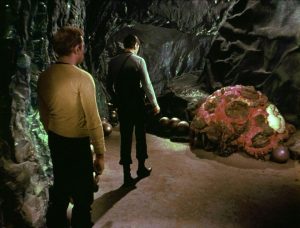
‘The Devil in the Dark’ (Star Trek)
Tchaikovsky goes one step further: a life form not based on DNA; a life form with an entirely different means of reproduction, of transmission of information, of sentience. If you thought John Hurt having a tentacled monster strapped to his face in Alien was scary, you have seen nothing yet.
The whole book is as vividly colourful as an octopus in the throes of emotion, as finely spun as the silkiest spider’s web and as full of existential human angst as Descartian philosophy running on Douglas Adams’ Deep Thought computer.
So to all avid sci-fi readers out there, I say: pick up this book as soon as you can. You will enjoy its ground-(and water- and ice-)breaking creativity, and be assured…
We’re going on an adventure.