
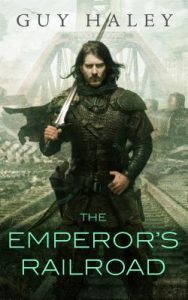
The Emperor’s Railroad by Guy Haley
 You only got an idea of what the Gone Before might have been like from up high. I could see the lines of the streets and the roads in the patterns of the trees, those marshes and forests that had been the homes of men. Now they’re only irregularities in the pattern’s of God’s world. I wondered then, and I’ve wondered many times since, how long before those traces are eaten up, broken down by the plants, pulled to pieces and digested by the Earth, so that there’s nothing left at all.
Guy Haley’s The Emperor’s Railroad (2016) is a compelling mashup of dying earth fantasy, the western, and the post-apocalypse zombie story. Haley deftly mixes elements of each to create a vivid world in which dragons and knights, frontier towns and the undead seamlessly coexist in the ruins of the United States of America, telling a tale of humanity’s hubris and interrogating religion and what it means to have faith in a difficult world.
Tying it all together and grounding it is the narrative voice of Haley’s view point character, Abney Hollister. Abney is recounting the formative events of his childhood looking back at them as an old man, and the contrast between the world-weary cynicism of the narration with the wide-eyed youthful idealism of the protagonist gives the story a feeling of time passed and a life lived. This links in with the sense of the smallness of one life against the unstoppable ravages of geological time. Abney’s voice, with its recognisable American twang and human warmth and sadness, brings the fantastical elements of the story into sharper focus and makes the whole thing more immediate and believable.
The Emperor’s Railroad tells the story of Abney and his mother’s flight from New Karlsville to Winfort, after their home town is overrun with zombies. They hitch a ride with the mail cart, hoping to make it safely to their mother’s cousin’s. But disaster strikes and the mailman is killed. They are left under the protection of Quinn, an enigmatic knight of the Dreaming Cities, who promises to guide them through the wilderness inhabited by the undead, the dangers, and decadence of the city of Charleston, and the desolation of the dragon sent to punish the Emperor, all of which lie in their way.
The novella successfully combines elements cherry-picked from different genres into a coherent whole, all under a post-apocalypse, far future banner. What could feel like a mess of disparate ideas works as a unified future mythology, both because Haley creates the sense that both the magical and fantastical elements, as well as the horrific, have some explanation in the rational that links them to the ruins of our world that we see everywhere, and because he creates such a vivid sense of a lived in world with recognisable, understandable characters.
Haley never outright explains away the horror or the magic – indeed, Abney, for all his years and his accumulated life’s wisdom, is still at heart a country boy raised on superstition and myths, who knows he doesn’t have any of the answers – but he leaves enough clues and hints within the text to imply a greater truth behind that which his characters have the knowledge or context to understand. Thus it is implied that there is some kind of infection element to the zombies, rather than a supernatural explanation, and the angels of the Dreaming Cities are implied to have some level of technology that is behind their apparent magic. The dragon, with its mixture of metal and flesh, as some kind of biotechnological nightmare, is a good example of this in action.
The other way Haley keeps all this hanging together is through his attention to detail, in particular the human and the mundane. Zombies have long since passed the point where they are overused in popular culture, the sense of horror and the uncanny they once invoked in danger of being replaced with familiarity and apathy. Haley makes them fresh again, partially by attention to granular detail – his description of their fleshless mouths resulting from them chewing off their own lips out of hunger is genuinely stomach-churning – but also in the way he drills down into the everyday experience of what living under this threat would be like.
Abney describes his memories of New Karlsville being overrun with zombies, and because it’s being told from the point of view of a child being called up for guard duty in the middle of the night and witnessing his home town overrun with monsters, because it focuses on the fear and the hopelessness rather than on the action and the gore, because it explores how the trauma of this event haunts Abney for years afterwards, this makes the undead freshly unsettling again.
The Western elements help give The Emperor’s Railroad its distinct flavour. As the apocalyptic events that have ended human civilisation before the novella starts have removed our modern technology and cultures, the world has reverted back to the kind of frontier town setting favoured by that genre. Quinn, the knight, with his taciturn nature, gruff personality and deeply held code of honour, draws as much from cowboy mythology as he does from European chivalry or the lone Samurai warrior. Armed with both guns and swords, he invokes all three.
The perilous journey between outposts, with the dangers of the wild and the threat of bandits, is also straight out of the Western genre. Quinn is on his own journey of redemption, following the war of the Emperor, and we only get to see a snapshot of it while his story coincides with Abney’s. This helps give him a sense of a greater character arc, his own depth of character hinted at whilst still keeping him as a remote and heroic figure which the young Abney is in awe of.
Religion, in particular faith in the angels of the Dreaming Cities, and the knights as their earthly representatives, plays a huge part in the lives of the people in The Emperor’s Railroad. Abney’s mother is sustained by her faith, even as Abney himself, becoming a teenager as their journey begins and having seen everyone he knew in his village die meaninglessly, is beginning to question what faith in a higher power means in such a harsh and punishing world.
This is further complicated as Abney learns more about the world around him. He has been taught that the Emperor was punished by the angels, who sent the dragon, because the Emperor in his pride turned against the angels. However, Abney learns from Quinn that there was disagreement amongst the differing factions of angels, and the Emperor simply happened to follow the losing faction. However long after the Emperor’s death, the people still living in these lands are still being punished for his sins. After seeing the horrors and injustices of the world, Abney has to find a way to reconcile what he has experienced with his faith. By the end of his story, he has learned:
Angels aren’t to be trusted. But that don’t mean that they are evil. I’ll tell you why. Remember this. If the Lord moves mysteriously against you, and at times his doings seem unfair, then remember that no man is without sin. Not you, nor I, nor the highest lord or the lowliest farmer.
Abney’s faith is not conciliatory, like his mother’s. It has much more of an air of Old Testament finality to it. However, it still helps him make sense of the world he lives in and the horrors he has experienced on his own terms.
Underlying the whole novella are the ruins of humanity. The global conflict, environmental devastation and spreading plagues that put an end to us are never explicitly spelled out, but the ghosts of our modern world haunt ever page of Haley’s novella. The story is littered with examples of our hubris, huge engineering structures, roads and bridges that we thought would last forever, eaten away, eroded and crumbling. Entire cities have disappeared, their traces only visible in the patterns where the wilderness has grown back.
There is a particularly moving and haunting scene where Abney, Quinn and his mother walk through the ruins of an old city, already overgrown with forest, and Abney tries to imagine what the city would have been like in its heyday. This sense of faded grandeur and lost civilisations suffuses the novella. It is echoed in the hubris of the Emperor, who tried to build his own rail lines and resurrect some of the lost technology of the ages past, and fought on the side of the angels of the Dreaming Cities, only to be crushed by the angels of a rival city with their dragon. The traces of his ruin and destruction are overlaid on top of ours. In this way we get a sense of the futility of human endeavours in the face of the ravages of geological time. It is Haley’s ability to achieve this, within an enjoyable, action-packed sword and sorcery genre fiction mash up adventure that makes The Emperor’s Railroad such a compelling read.
