JAWBONE by Mónica Ojeda (BOOK REVIEW)
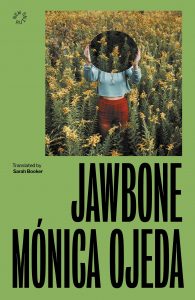
Mónica Ojeda – Jawbone (2017, translated by Sarah Booker 2021, published in the UK by New Ruins 2022)
“Monsters have to be taught how to be good daughters.”
“White, as you said in class, represents purity and light, but also the absence of color, death, and indefinition. It represents that which merely by showing itself anticipates terrible things that cannot be known. It’s such a clean and luminous color that it seems to be on the verge of becoming cloudy, on the verge of reaching its perfect pallor. In other words, white is like silence in a horror movie: when it appears, you know that something awful is about to happen. This is because it can easily be perverted and contaminated.”
Mónica Ojeda’s Jawbone (2017, translated by Sarah Booker 2021) is a powerful and disturbing work of horror fiction, one so startlingly original that it acts as a manifesto for a new kind of horror or Weird fiction. Jawbone ambitiously combines elements of Lovecraftian cosmic horror, literary allusions to Moby Dick, and internet creepypastas in its experimental scope, a broadness of influences and approaches that is reflected in its complex multi-voiced narrative. Ojeda’s conceptual idea of “white horror”, with white the colour as a potential space, always in the process of being corrupted, ties into her adolescent characters’ experience as the potential between the children they were and the adults they may become, with adolescence itself a source of primal and abject horror. The book mixes stream-of-consciousness, transcripts of therapy sessions, and snippets of personal exchanges in a disorienting and disturbing collage of conflicting and troubled perspectives. The end result is a powerful and original horror novel unlike anything the reader has experienced before. We owe New Ruins and translator Sarah Booker a debt of gratitude for bringing this masterpiece of Ecuadorian horror fiction into English and the UK. Booker does a remarkable job of translating the novel’s myriad voices and Ojeda’s linguistic inventiveness into a format that works.
 The multiple strands of Jawbone’s complex narrative centre on Annelise and Fernanda, two teenage girls who attend the Delta Bilingual Academy, and their literature teacher Miss Clara. The novel moves around in time, from Annelise and Fernanda’s intense friendship in the past to Fernanda’s present, kidnapped and held hostage by an increasingly deranged Miss Clara and alienated from her former best friend. The novel flashbacks to the friends’ time together, as Annelise creates a cult in worship of the White God, leading Fernanda and their friends Fiore, Natalia, Analía, and Xime in a series of increasingly dangerous and transgressive rituals, which test the boundaries between obsession, pain and love. Meanwhile Miss Clara, recovering from being abducted and tortured by two of her pupils in her previous school, decides to work at the prestigious Delta Bilingual Academy in the hope of regaining her stability, but the pressures her students put her under and her inability to cope with the death of her mother who she hero-worships and emulates cause her to descend further into mania. Through recollections of the stories and rituals the girls scare each other with, Miss Clara’s obsessive internal attempts to wrestle with her trauma, and transcripts of Fernanda’s therapy sessions, the reader is drawn towards Fernanda’s present where she fears for her life, and discovers the secrets and betrayals that have driven the best friends apart.
Jawbone’s nonlinear structure and multiple unreliable perspectives serve to disorient the reader, circling round the central traumas that its characters can’t help spiral into, driving up the tension as the importance of clues seen by one character are revealed when they are experienced by another character in a different context. The whole novel is like a complex puzzle, one that requires careful attention by the reader to reveal its secrets but is all the more satisfying because of it. Ojeda expertly conjures up the intensity of adolescence, especially those obsessive relationships which sit uncomfortably on the line between friendship, hero worship and love. Fernanda and Annelise’s friendship occupies this space, just one of many liminal spaces that the teenage girls find themselves drawn into as they leave childhood but before they become adults. Jawbone is about the fear and the allure of these twilight realms, the spaces where lust and violence overlap, where transgressive desires can be explored. This is the realm of the White God, which Annelise drags her unwitting friends into. Miss Clara, a young woman trying to occupy the older life of her mother, also finds herself in an interstitial space, and it is this which both draws her into her pupils’ world and serves as a constant source of fear and repulsion for Clara, driving her further and further into insanity.
Ojeda has a gift for character and voice, which anchors the book’s strangeness and uncomfortableness in something recognisable. The interactions between Annelise, Fernanda and their friends show a deft understanding of the patterns of teenage friendships, with Xime desperate to please and Analía more cynical about her inevitable position as outsider. The linguistic playfulness with which Ojeda captures Fernanda’s and Annelise’s voices reveal much about their characters and their attitudes towards authority figures. Fernanda teases and obfuscates her therapist, but her eventual capitulation and revealing of the truth reveals a core respect for adult authority. However Annelise’s sly manipulation of Miss Clara via her impertinent essays and the way she works her way into Clara’s head reveals no such qualms. Annelise serves only herself and the White God. She understands why adults fear adolescence, and exploits this fear in order to get what she wants. Whether or not she realises quite how fragile Miss Clara is and the full consequences of undermining Clara’s reality is left for interpretation.
Because it’s a novel about fear, about these teenage girls trying to scare themselves and others, there are frequent nested narratives, stories within stories that the girls tell each other. These demonstrate different approaches to horror, as they show the girls mapping out and exploring what it is that they find scary, what they can use to inspire fear in others. Similarly, the novel reflects a lot on fear, not least in Annelise’s lengthy essay about white horror which she writes in response to a homework assignment from Miss Clara in order to frighten her. These sections allow Ojeda to reflect on genre, on what it is about Lovecraft and Poe or Moby Dick that is frightening or disturbing, how her novel engages with this history and how it carves out its own path. Jawbone recognises itself as something new, a truly disturbing and disconcerting horror novel that draws on what came before only to push its transgression further. Anyone who is interested in horror or the Weird is advised to pick up this book as soon as possible, and I can only hope that Jawbone’s success will lead to more of Mónica Ojeda’s work becoming available in English.