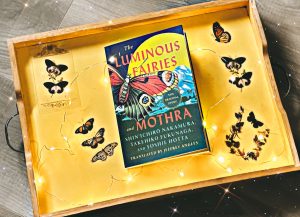
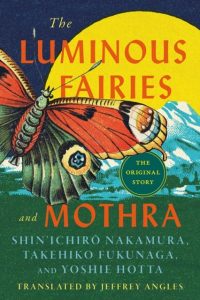
THE LUMINOUS FAIRIES AND MOTHRA by Shin’ichirō Nakamura, Takehiko Fukunaga, and Yoshie Hotta, translater by Jeffrey Angles (BOOK REVIEW)
The Luminous Fairies and Mothra by Shin’ichiro Nakamura, Takehiko Fukunaga and Yoshie Hotta and translated by Jeffrey Angles is the original Mothra story that inspired the 1961 film by Tōhō Studios. Yet this is not just a Kaiju story, it’s a fascinating subtle reflection on the political and environmental issues circulating post-war Japan.
A mysterious island on the South Pacific known as Infant Island was believed to be uninhabitable, but after a tornado capsized a ship, four miraculous survivors were rescued by the natives. Chūjō is a Japanese linguist being sent with an expedition of other Japanese and Rosilican scientists to Infant Island to study and communicate with these mysterious indigenous people. On arriving at the Island they discover deadly plants, curious natives and a race of tiny women who worship a strange god.
I will be going into some detail about the narrative of the novella here so if you do not know the story of Mothra please be warned that there are spoilers.
 On first impressions I was very intrigued by the structure of this novella. It is set into three parts, the first being by Shin’ichiro Nakamura and tells the tale of Chūjō and his time on the island. This was a great opening that really drew me in as we get a feel for this island and its unique beings who have survived for decades in isolation. It’s obviously an island that’s adapted to survive the nuclear blasts that the government have been experimenting with and the natives have found a way to stave off the deadly effects of radiation. There is also the mystery of the tiny women, the fairies. A Rosilican official named Nelson makes it clear he wants to capture them but Chūjō jumps to their defense which begins to show the political conflict between the two parties which is further explored as the novella unfolds.
We then move to Takehiko Fukunaga’s part which features Fukuda, a Japanese reporter, who befriends Chūjō and then goes to Infant Island to investigate the inhabitants. It is made clear that the government, particularly the Roscilian officials, do not want to publicly reveal the discoveries and have taken control of the media. Understandably this leaves the Japanese public angry and sparks Fukuda to see it for himself. I found this part to be my favourite because we learn even more about the Island, the fairies, which were called shōbijin, and their mythology, which involved a detailed story of the gods and of the creation of Mothra.
In the third and final part by Yoshie Hotta the author reflects upon much political unrest between Japan and Rosilica, a fictional country akin to America. The author details how the protests against an alliance with Rosilica, along with their capture of the shōbijin and their continued interference in Japan became rather heated. Yet both nations then face a bigger threat as Mothra is discovered to be on its way to find its lost shōbijin. Though I have never seen the original film I have seen many clips and this is probably the most memorable and cinematic scene, where Mothra attacks two major cities, destroying a part of Tokyo.
Though this novella is written by three different authors, I felt each part followed on naturally, seamlessly and never felt jarring. The authors all build upon the story in clever ways, ranging from setting up the story, building upon myth and the legend and then including political history in subtle ways. In the translator, Jeffrey Angles’ afterword, which was presented as an essay at the end, he writes in depth how the narrative reflected upon the Japanese nation just after the Cold War with America and can indeed be considered as post war literature. I found this fascinating to read about because I was not expecting this inclusion. I was drawn to this novella because I have seen many of the modern Kaiju-verse films and so I was curious to learn about some origins. Angles’ essay also talks about the history of Japanese Kaiju films and the choices made during adaptation and I noticed that this novella was written with very little descriptions which would allow a film director much scope in how the island, characters and even the fictional country of Rosilica could be depicted. I also enjoyed Angles’ thoughts on Mothra’s symbolism as a mother, a being that transforms, which I actually hadn’t thought about before and so I enjoyed seeing this kaiju in a different light.
The Luminous Fairies and Mothra is a tale with hidden depths, a surprising narrative structure and powerful themes. It’s a Kaiju origin story that enthralled and enlightened me.
ARC provided by Nicola at University of Minnesota Press in exchange for an honest review. Thank you for the copy!
The Luminous Fairies and Mothra is available now – you can order your copy on Bookshop.org