NORNCON 2026: Convention Report (1 of 2)
The Inaugural Norncon 8-9th May 2026
 Following on from the success of the 2025 Reconnect Eastercon hosted at the Hilton hotel in Belfast, a new star in the speculative fiction firmament was born and burst into life on Friday 8th and Saturday the 9th of May, with Norncon . The rarity of having an event literally just a couple of miles down the road from home was too good an opportunity to let go by. So Ash and I popped on the 6a Bus and headed down for my 15th and her 1st full blooded convention.
The Friday evening was for registration and an open mike event where a variety of local authors read from their works in progress before the guests of honour Adrian Tchaikovsky and Anna Smith Spark brought the evening to a close with well received readings of their works in progress or top secret projects.
Panels started at 10.00 am on Saturday and we got their early enough for Ash to be sure of a place in the workshop on Children’s fiction while I could make it to the Lagan Room’s opening panel on The Role of the Other. Even though I could only attend less than half the activities on offer, there were so fascinating observations, discussions and interviews, that my iPhone notes ran to nearly 3000 words – hence this report will be in two parts!
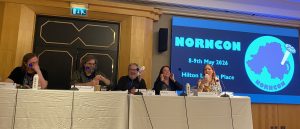
Panel 1 – The role of the other
Moderator: Jack Fennell
Panellists: Adrian Tchaikovsky, Ian McDonald,
Rachel (RB) Kelly, Jenny (JE) Hannaford
Role of the Other – Science fiction has always been driven by the concept of the ‘other’ – unknowable entities which stretch the imagination of us carbon-based life forms. Few in the current genre have played with the ‘other’ as comprehensively as Adrian Tchaikovsky, from spider-based civilisations (arachnophobes, look away now) to the bleak alien world of alien clay. What drives the concept of the other – and how far can our imagination really stretch?
The panel was in place admirably early and fell to chatting about hotel accommodation, a sufficiency of towels, the glittery jewels that a top-light made of the spray of shower droplets, the challenge for the feather allergic of ensuring down-free bedding and whether the panel room carpet design. Opinion was divide as to whether the surrealist pattern and colour scheme was intended to represent ochre clouds over a grey alien cityscape, or just a way of ensuring obdurate vomit stains would not be too apparent.
Then Jack Fennell called the meeting to order, reminded all those present of the panel brief (above) and pondered whether it was their fictional creations or the panellists themselves who were the unknowable entities. Which was a good point for some self-introductions.
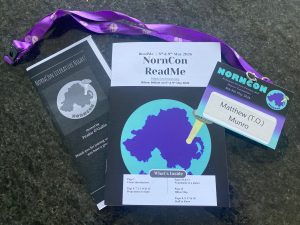
I, with my own “Matthew (T.O.) Munro” name badge, felt some fellow feeling for Rachel (RB) Kelly and Jenny (JE) Hannaford’s wrestling with the identity issue around using given names while flagging the pen names that most readers might recognise them by.
In his first question Jack first invited panellists to share their approach to writing “the other”
Adrian, with his focus on ‘fairly hard sci-fi’ tended to think in terms of environmental context and the thought experiment of how a living thing would evolve under a specific set of evolutionary pressures.
For Ian and Rachel it was not so much about writing aliens, as being interested in ‘the other within ourselves’ with questions like ‘ how otherly can humans make themselves’ and ‘How we can understand ourselves better by constructing what we are not?’
Jenny, with a background in science like Adrian, considered mythical others like the fae, but also insects but was curious about how emotions would develop in a nonhuman alongside the survivalist instincts
Adrian made the point that fiction and gaming tend to have ‘human’ as the default creature as is shown by having no modifiers on characteristics. But he felt writers needed to get out the mindset of seeing humans as ‘the norm’. A lot of what we would consider fundamental characteristics of a life form, are a very specialised aspect of the evolutionary niche that we occupy. For examples the family approach of raising young is very much a feature of mammalian life – (yeah baby turtles don’t even know who their mother is, let alone their dad!)family values and arrangements
Jack then went on to ask Rachel and Ian to expand on how humans can be ‘alien’ to each other
Rachel noted that contemporary social perspectives default to white male hetero viewpoints which she found fun to challenge by examining what othering looks like taken to the nth degree.
Ian felt that liminal spaces – eg human colonies on the moon – gave the opportunity to explore what it is to be human and to challenge family structures, for example with the notion of chain marriage where everyone has a ‘left’ and a ‘right’ partner, or the idea of a co-opted constantly expanding family which was like a friendly (benign) version of a cult cult, or taking an alternative look at gender with kids being just genderless ‘kids’ until they decide what they want to be. These are the kind of ideas that can only be explored through sci fi or quasi sci fi. Ian did take a quick side swipe at Heinlein because, despite his significant contribution to the genre, his vision of extra-terrestial civiliations seemed to assume that America is not only the default society but also the pinnacle of social evolution. (tbh I doubt even Heinlein would think that today!)
Turning to Jenny’s stories, Jenny suggested that context defines what the other is, but that apocalyptic scenarios remove context. Jenny’s stories set in a far future climate changed frame with a regressed society means that language changes. Birds can’t ‘wheel through the skies’ in a world that no longer has wheels. Emotional contentment and comes from a more animalistic meeting of basic needs – at the bottom of the Maslow pyramid – rather than higher levels of ambition and acquiring possessions.
The panel briefly commented on one proposed solution to the Fermi paradox (the idea that of the universe is teeming with life somewhere why haven’t we been contacted yet). The notion that Earth society had been examined and found deeply inadequate t the point that we were a quarantined neighbourhood that no interstellar traveller would go near. Which does sort of make sense in 2026
Jack observed that in Adrian’s Children of Time story the humans eventually came to terms with and appreciated the humanity of the spiders.
Adrian did point out that it wasn’t so much a spontaneous epiphany by the human characters so much as (SPOILER) having it forcibly injected into them. However, the fundamental issues was no so much one of commonality, of finding things in common, but a more basic idea of acquiring empathy and respect for the other life form. The Children books are all about the fact that diversity brings strength and resilience compared to biological monocultures. To restrict your own culture, to narrow down its genetic and social roots, is a phenomenally brittle construct that leaves no redundancy with which to absorb system shocks.
Jack then asked the panel about the extremely slimy kind of otherness, the kind that is beyond human comprehension – thinking particularly of Lovecraft’s writing.
Ian mentioned a quote he had heard about there are two types of aliens, there are walls (the incomprehensible) and there are mirrors (which reflect on humanity). In his view Lovecraft’s aliens are the walls.
Rachel was hesitant to see these walls as entirely impermeable. While no great fan of Lovecraft there are points of contact between the alien and the human – points where you can see the imprint of the author. Tentacles got mentioned as one of those points of contact which led to some reminiscing about a good past panel which had focussed on tentacles. (Maybe a future con panel could revisit the topic?)
Adrian’s writing involves both Walls and Mirrors, with Shroud being the work that is most decidedly wall-like in the aliens it features. He pointed out that anything which has evolved on other worlds is going to be more different from us than anything on earth is. However, there are two points of convergence for any alien life form. Firstly, there will be a instinct for survival and with that a sense of fear. Secondly, the aliens will be looking at the same universe with the same periodic table and Electro-magnetic spectrum.
Jenny acknowledged the existence of those basic biological commonalities but enjoyed playing with different biologies eg life that is not oxygen dependent or one that has very different reproductive systems. Real ‘otherness’ leads almost into horror because of human struggle to comprehend and ‘the other’ in simply trying to survive often comes across as the bad guy.
That put Adrian in mind of the Presger in Anne Leckie’s Imperial Radch series – impossibly powerful aliens who just don’t understand what humans are and how they work. That makes them not so much immoral as amoral, and when they do realise the humans are actually sentient (if technologically feeble) they enter into a treaty but one which the humans fear to break because the power is entirely on the presger side.
Jenny noted that the Presger are almost like the Fae /faeries and that they should be terrifying as that is how they appear in folklore – though in Romantasy they have the added feature of being both terrifying and hot!
Adrian thought that the ‘others’ were generally divided between those – like the Presger – who don’t understand humans and those who are ‘other’ but are very interested in humans of which vampires are arguably the archetype. He also observed that there is one attractive (but unlikely) idea that the notion of these ‘others’ originated in a past pre-history where there were multiple human species (more complex even than the interactions of Crogmagnon, Neanderthal and Denisovians)
Jenny raised the potential for the links between the Irish idea of changelings and possibly simple cases of undiagnosed autism – it’s not that your baby was swapped for some strange socially awkward and sinister fae child, it’s just that they’re neurodivergent.
Ian reflected on the sad fact that – lacking definable ‘others’ like alien species, humans tendency towards tribalism means we create others within ourselves. In his own book Sacrifice of Fools the long standing sectarian tensions of the troubles are given a kick up the backside when a contingent of aliens are deposited in the holy lands of Belfast (that is a section of streets whose names are derived from places in the levant).
Jack then asked for the panels views on the othering of characters with special powers such as are seen in the X-men or Nightbreed where the director was warned by one cinema mogul “You want to be careful or you’ll have people rooting for the monsters” – missing the whole point of the book and the film.
Ian observed how the coding of discrimination was pretty front and centre in the X-men films, particularly remembering the line “have you tried not being a mutant” but did feel there were complications in characters who are persecuted having compensatory super powers. He was also wary of the division there appeared to be between innate superpowers which were generally ‘bad’ and acquired superpowers (typically through some laboratory accident or scientific intervention) which were ‘good’ – which did not present diversity as well as it could have.
Rachel mentioned the book Supercell about a mutation which granted superpowers but because it was specifically linked to sickle cell disease meant the uplifting could only affect black people – which made for an interesting interrogation of issues of discrimination.
Jack raised the issue that ‘othering’ can be complicated by technology – for example with image processing (having being ‘trained’ on Caucasian features) showed a notoriously poor ability to identify black skin so that auto framing of images tended to elide, or misplace black people.
Adrian commented how a similar discrimination happened in health services where medicine is based around male health as the norm.
Rachel roundly agreed with the problem of medical misogyny, citing the underdiagnosis of autism in women as it does not present in the same way as men (see also heart attacks). While Ian added that street architecture, signage and even car seat belts are all designed to meet male averages.
Jenny concurred that societal norms do effectively ‘other’ certain groups and writing to reflect that can be challenging.
Jack then invited questions from the floor and the first one asked the panel about how one writes the ‘undetectable other’ and whether they had any recommendations.
Rachel suggested The Left Hand of Darkness and how it is the other appearing just like us that makes them dangerous, and particularly relevant to the Northern Ireland context of The Troubles where from each side of the religious divide ‘the others’ really did look ‘just like us.’
Adrian mentioned The Invasion of the Body Snatchers and also The Works of Vermin by Hieron Ennes which features a protagonist whose job is to eradicate vermin but who in the course of the story is given an increasingly broad definition of ‘vermin’. “works of vermin” with an exterminator and an expanding definition of vermin!
While trying to avoid spoilers, Jenny suggested Mark Lawrence’s Library Trilogy – beginning with The Book That Wouldn’t Burn.
A second floor questions asked about forms of ‘the other’ that were not physical differences.
Ian pointed that wealth has become a well-developed and socially accepted way for othering people. Billionaires are not like us. Yacht size, Yacht parking spots and the quantities of staff you have and – importantly – control are the metrics by which the billionaire class measure their success. And the problem is that wealth erodes empathy – the people you control are less than human (There is no sense of ‘sonder’ – that profound realization that every human being is living a life as vivid, complex, and chaotic as your own).
In that vein Adrian flagged up the Pratchett quote about “Evil begins when you begin to treat people as things” and also talked about othering in societies where everyone else is elevated – has some superpower – and the others are just the ones who are our own default norm.
Ian mentioned a book (or an idea?!) about a society where everyone was born a twin and the extreme rarity of being a single birth would be the other somehow cut off from the experiences of the society’s normal paired existence.
Jenny mentioned the work of David Green writing as autistic person and reflecting that in his characters and their experiences.
The final floor question asked about stories of encounters where one ‘other’ meets a different ‘other’ (another other, if you will?!)
The panel felt that there needed to be a human reference point to draw the reader in and anchor them in the story, and that it would be very difficult to make a story between unrelatable aliens compelling.
Ian mentioned Iain M Banks Culture books which were about aliens, but felt that although technically aliens, these beings were basically “humans with Cornish pasties on their heads” and that they were more human-like than truly ‘other.’
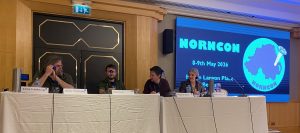 Panel 2 – Don’t cross the streams
Moderator: Peadar Ó Guilín
Panellists: Adrian Tchaikovsky, Sam Poots, Ruth Frances Long
Don’t cross the streams! Speculative writing often crosses into both science fiction and fantasy – and some writers are happy to tackle both. What’s the challenges of switching between the genres, and can the guests tell us which one they really love best?
In brief self-introductions, where Peadar assured us he would be moderating moderately, Ruth described herself as an author of fantasy and romance with some blending under the pen name Jessica Thorne. Sam is the current writer in residence at the University of Ulster and among his other talents he is a writer of role playing games and short stories. Adrian explained his qualification for this panel was largely in the huge range of his writing running from fantasy with giant spiders all the way to science fiction with giant spiders.
Peadar opened with the teasingly provocative question – Does anyone not like genre blending?
Ruth immediately leapt in with “publishers certainly don’t – they like things that they can sell very clearly and fit in a box, but I think readers like to be surprised.”
Sam wasn’t so sure readers really liked to be surprised, mentioning his wife Holly is a massive romance fan with its reassuringly predictable outcomes, although apparently love stories and romances are different beasts and mischaracterisation of them can lead to readers being disappointed at the lack of happy endings?!
Adrian felt it was hard to separate reader wants and publishers wants, and interestingly described readers as having a “leash distance” – that is to say a limit on how far they will go from their ideal book. For example, his own fantasy readership is smaller than his sci-fi readership – the sci-fi fans leash distance not extending into full blown fantasy.
Peadar was curious about that dichotomy given that – with the Shadow of the Apt series, Adrian had actually started out in fantasy. However, Adrian pointed out that a large number of readers had ‘discovered’ him through Children of Time, where he had become while not exactly famous, certainly better known. There is a tendency for readers to settle into a rut of the familiar and publishing marketing is very much focussed on that deepening the rut.
Peadar asked then if readers are either fantasy or sci-fi “inclined”?
Ruth described how romance is the spine of the story in both her fantasy and sci-fi writings and her readers follow authors because they like the Romance aspect which is to say “an emotionally fulfilling ending that doesn’t involve loss”. For romance readers – who are an incredibly loyal readership – Fantasy (or science fiction) comprise the setting but not the story.
Picking up on that idea Peadar turned to consider crime fiction – which is traditionally a tragic detective investigating an impossible murder in plots which could be applied in a variety of historical, fantastic or futuristic settings – it is the mystery element of the story that people want. However, is it possible to suspend disbelief when everything is happening in a spec-fic setting?
Adrian felt that the essence of sci-fi and fantasy is about the trappings – the special characteristics of the worlds or futures in which readers are immersed, and he noted that some genres don’t like the “woo” of magic or science!
Sam declared himself proud to be a writer of woo, and asserted that with crime fiction it is about the structure of story, the plot beats that you expect from the narrative. For example Guards! Guards! Guards! Is essentially a murder story, just one in which the murder weapon is a dragon. The author has to maintain a balance with the readers expectations of the type of story.
Peadar highlight the tightrope to be walked by authors in delivering something that is original but not too original. You can’t depart from the contract entirely but if you don’t depart at all they’ve seen it all before
Ruth agreed that the contract with the reader is important but emphasised the authors responsibility to follow the story .“It has to entertain and surprise you or you have no business putting it in other people’s hands!” Buts he also pointed out “You can’t betray what they come to you for – for example a detective novel is about making things make sense” That is to say, you need to explain the puzzle, so different genres come with different contracts
Picking up on that Adrian offered a brief critique of writers established in one genre thinking that they can just dip into a different genre and rush out a quality book, blind to their own arrogance in not understanding the genre contract – or even enjoying the genre, or what makes for originality in that field.
Ruth was particularly sceptical about people (and particularly celebrities) dipping into the children’s fiction – as though thinking – ‘a few hundred words, how hard can it be?’
Peadar asked what are the most interesting cross-genres?
Adrian enjoyed settings that were entirely set in a secondary world that like but not actually our world and cited Northern Ireland Author Bob Shaw’s book The Ragged Astronauts.
Sam particularly enjoyed the Saga comics, particular those concerning The Robot Kingdom where people had TVs for heads.
Peadar argued that sci-fiction is always trying to convince you it might be possible.
Adrian felt that to that extent science fiction writing did reflect the prevailing preoccupations (sometimes fringe preoccupations) of the science of the day. For example in the 1970s (the era of Uri Geller for those that remember it) the US government was investing a lot of research effort into the potential for ‘psychic powers’ to be a real thing – and the science fiction of that era features a spike of psychic power related stories (eg ITV’s The Tomorrow People?!)
Ruth liked Shanghai Immortal where an immortal version of Shanghai was iverlaid on our more familiar contemporary shanghai in an overlap between the real and the fantastical where the story’s great strength was in its main characters.
The Rivers of London fantastical detective stories garnered pretty unanimous appreciation from the panel for being “detective stories with Woo!” While future worlds where technology has been lost are a popular kind of sci fi of primitive societies struggling to recover greatness.
Peadar asked about the genre blend where fantasy that becomes sci-fi
Adrian felt there was a period in publishing where fantasy could only get published by having the story turn into sci-fi and that expectation only started fading when in the 1970s when Goodkind sparked an explosion of post-Tolkien and neo-Tolkien fantasy. However, the need for sci-fi to lie behind the fantasy does lingers on in computer games. Adrian also gave a shout out to James Alister Henry’s Pagans where Viking society and mythology has survived and endured to dominate an alternative 1920s Earth and provide the setting for an intriguing detective story.
Throwing the questioning over to the floor the first question was – when thinking particularly of genre blending in superhero comics – how can sci-fi robots and fantasy wizards be made to play nicely.
Adrian felt that superheroes comics and ideas sort of preceded the emergence of distinct sci-fi and fantasy genres which is where the seamless blending of the likes of Norse gods and Iron men came from.
Sam suggested that the comic format with its emphasis on images may be more driven by what will make for spectacular picture on the page, rather than any science/fantasy demarcation, and pointed out Hellboy as a combination of folklore with pulpy sci-fi.
A second floor question asked if there were any works that have been mis-pigeonholed in their genres?
Ruth felt a lot of women writers are pushed and pigeon holed into particular genre definitions. For example currently women writing fantasy are expected to deliver and be marketed as Romantasy. Before that woman writing fantasy were characterised as YA writers. It is a strange gender-to-genre pressure. She also reflected on a past con question about emerging genres remembered being asked “Has Romantasy murdered historical romance?” which is an interesting thought on the shift in the centre of gravity of readers across the genre landscape.
Adrian concluded by pointing out that ”Genre is a landscape with no hard borders, it’s all open country!” no matter how much publishers might like to draw them in!
Other Attractions
While I was in panels for the first three sessions, Ash tried out a workshop where she got to sit and chat with Shirley-Anne McMillan about The Changing Face of Children’s Literature in Northern Ireland, drawing on her own experience as the author of five YA novels and also the current Children’s Writing Fellow based at Queen’s University’s Seamus Heaney Centre.
We both got to peruse a well populated readers room, picking up a few trinkets as well as flyers relating to other imminent Cons or bids from cities hoping to host future cons.
In the panel on “The Beautiful and the Dark” about rendering the gritty awfulness of life in elegant prose, the panellists were asked a particularly memorable question. “Would you kill a dog?” (In the story, in the story, not in real life!). Only one panellist demurred while the rest were well up for a touch of caninicide. Let’s hope John Wick isn’t about!
The final workshop was on “Make your own folded book art” with Siobhán Murphy, where participants learned to upcycle unwanted hardbacks into art for their bookshelves… and take their creations home – in a particularly creative kind of destruction!
There will be more on our Norncon Experiences in the next post.