NORNCON 2026: Convention Report (2 of 2)
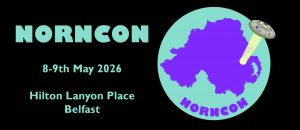
The Inaugural Norncon 8-9th May 2026
 Following on from the success of the 2025 Reconnect Eastercon hosted at the Hilton hotel in Belfast, a new star in the speculative fiction firmament was born and burst into life on Friday 8th and Saturday the 9th of May, with Norncon . The rarity of having an event literally just a couple of miles down the road from home was too good an opportunity to let go by. So Ash and I popped on the 6a Bus and headed down for my 15th and her 1st full blooded convention.
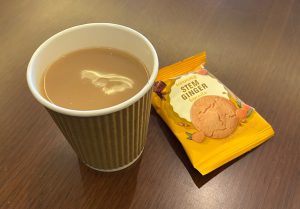
The hour long panels were timetabled at one and a half hour intervals, which allowed some circulation time and an opportunity for moderators to gather their panelists in The Green Room, tempting them in with tea, coffee and hotel biscuits.
As activities moved into the afternoon, I got to my first guest of honour interview, though panelist duties clashed with the second one.
Guest of Honour Interview
 Guest: Anna Smith Spark
Interviewer: by Jenny Hannaford
This interview was an intriguing inversion of the 2025 Bristolcon event where Jenny had been the Bristolcon Guest of Honour and Anna Smith Spark her interviewer.
They had been firm friends since Jenny first met Anna at the 2019 Bristolcon. Anna – being known as Queen of Grimdark – has quite a few panels which would touch on the dark corners of her writing, so Jenny was keen to probe in slightly different directions to open up a more rounded knowledge of our Guest of Honour.
Anna’s other claim to fame is her fabulous footwear so Jenny opened with
What inspired your love of exotic footwear and do you have a favourite pair?
Anna traced her love of creative shoes back to childhood and an early history as a Goth. She particularly remembered stalking Steven Erickson across the width of the 2019 Dublincon Dealers’ Room while wearing one of the more challenging pairs of spikey shoes. She did catch up with the great author and managed to supress her own star struck nerves sufficiently to engage him in a very professional author-to-author conversation. However, Erickson was suddenly shoved to one side by a woman who clearly had no idea who he was or even who Anna was – but just wanted to ask about THE SHOES, such is the power of exotic footwear. (Should really be RPG magical items?)
Coming back to the question Anna had two in mind, a cantilevered pair of shoes with no heels so “it looks like I’m walking on tiptoe” and a pair of shoes with dragons and spikes on that were associated with a particularly happy memory of a flight to GenCon on a small plane and discovering that the entire plane was full of GenCon people.
Jenny’s next question was, What got you into writing?
Anna’s dad is an avant grade post-modernist poet – and if you thought fantasy novels were a hard sell you should consider a poetry genre where “you lose money on every book.” She grew up surrounded by artists and poets and told herself stories all the time. Her dad also read her children’s versions of the great myths, performing them and doing all the voices. So fiction was very much in Anna’s blood. However, as a teenager she had a massive mental health crisis and stopped writing fiction for fear of ridicule.
Subsequently diagnosed as dyslexic, dyspraxia and autistic and becoming a mother she found herself trapped in a cafe with a child who wouldn’t speak and just suddenly started writing again. What poured out of her then in all its lush visceral descriptions became chapter two of The Court of Broken Knives.
Anna says that her prose doesn’t get edited apart from developmental and proof reading (being dyslexic there is a job of proof reading to be done.) Mostly what you see on the page is just as it poured out of her. Having ‘learnt’ to type at university while being a committed smoker, her style is one fingered typing with her left hand – leaving the right free for the cigarette, so it is quite a distinctive approach. (I mean even I use two fingers – one on each hand.)
She didn’t think she’d be able to write fighting scenes with men battling it out, since this is beyond her personal experience, but her fight scenes have actually been one of the aspects of the work that has earned most praise. It perhaps comes from the intuitive unplanned writing style.
“When I’m in the zone of writing in the flow of description or fighting I don’t think about it – I write with my hands. I’m not thinking about it I’m almost reading it as it appears on the screen.”
While Adrian Tchaikovsky has said he finds writing ‘relaxing’, for Anna the most appropriate word would be ‘frenetic’ although the process of writing is what and when Anna feels happy in.
Jenny then asked about Anna’s characters and how their love and relationships is really what makes the stories come alive. Where does that inspiration come from?
Anna grew up on what would now be called Romantasy so in The Court of Broken Knives, Mareth is a kind of dark Romantasy hero or anti-hero. The books title did lead to it being mis-shelved under YA – it is far darker than that.
However, you need relationships to drive the story. It is the connections between people – the found family of warriors – that forges bonds more important than anything else. Anna talked about the grizzled veteran Tobias in her stories who has his troop of young soldiers who are absolutely the most important thing to him. To keep them safe he will do unspeakable things, he and they will participate in a hideous sack of a city where they do absolutely disgusting things to people because keeping and protecting their bond, their connection, is what keeps them safe. (It really is them against the rest!).
In that vein, Anna threw out the rhetorical question “How many people would you kill to keep the people who are dear to you safe?” On The Long March in China after World War Two, Mao and his wife actually left their own children behind by the wayside as the communist forces addressed an existential struggle for survival. It was a sacrifice for the perceived greater good, but it poses a tricky question, “Do you let the world burn to keep your children safe?”
Jenny then asked about the shift in Anna’s more recent works to showcase a variety of female leads.
Anna described The Court of Broken Knives as a conventional male heavy story with Thalia as a fairly traditional love interest. By contrast Woman of the Sword came out of that idea of “Who would you be in your books?” Lidae is Anna injected into the books, “the ordinary woman making the same bad choices I make as a mother”. It was written while trapped at home in covid times trying to teach two children two different kinds of long division. It was a bit of psychological jolt after the highs of just completing a big name published fantasy trilogy, and Woman of the Sword was written out of the conviction that, “I was not put on this earth to teach long division”
Sword of Bronze and Ashes was written in the wake of that covid after a peaceful family holiday out on the country. Its protagonist Kanda is not Anna – she is instead the all-powerful, capable but grounded woman.
So where Lidae is the woman Anna ‘is’, Kanda is the woman Anna ‘would like to be’ (and “Mareth is the love of my life.”)
Jenny was aware that, as with Mark Lawrence’s oeuvre, there are interconnections between the different worlds in Anna’s writing and asked if she could exemplify some of those Easter Egg connections.
Anna started writing without doing any worldbuilding “It’s just me writing all my favourite bits of history!” But there are plays on language and a way to find the meaning behind Mareth and Thalia’s names! But these links are not too precise (or at least not too linear). Kanda’s world in A Sword of Bronze and Ashes could be the folklore that Mareth’s nanny told him as a child before the events of The Court of Broken Knives, or Kanda could be inhabiting a kind of dark ages in the far future after the fall of Mareth’s empire.
Food features in the descriptive aspects of your writing, but is there a scene that you were particularly fond of or a favourite food scene?
Anna commented on the idea of people so wealthy that they ate a banquet of ground up gems. This was a rather fanciful motif as one reader was eager to point out that gems were too hard to grind up and – even if they could be powdered – would shred the consumer’s intestines. However, the idea of precious stones eaten and then shat out for the night soil workers to sift through in search of wealth was still an idea that appealed to Anna not just because she thought it an almost perfect allegory for fantasy!
Thrown open to the floor one questioner asked, given the immeasurable value of Anna’s solitary typing finger, could you do speech to text in case your typing finger fell off?!
Anna replied that she simply couldn’t write with another finger and also couldn’t dictate! “I can read my own words, but the writing & typing is how I think! Without a laptop I wouldn’t be able function!”
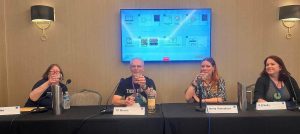 Panel 3 – Feeling the Heat Yet
Moderator: Jo Zebedee
Panellists: Matthew (TO) Munro, Rachel (RB) Kelly, Jenny (JE) Hannaford
Feeling the heat yet? We’re already facing the effects of global warming. What is the role of fiction in highlighting where things might go – and is it something we really want to read about?
Being a participant slightly restricted my ability to take notes (it had nothing to do with the very nice bottle of Killowen 55% ABV Whiskey which I brought along with me and that my fellow panelists helped me make inroads into). We certainly had a lively and enjoyable discussion.
As panelists our interest in climate change fiction was reflected in our own work and activities. Jenny writes books set in a far future world that has been deeply changed by the climate crisis (tbh you may not have to go to far into the future to see that!), Rachel has written two solar-punk novels set in orbit around a climate changed world, while my own PhD in Creative Writing was focused on the impact of and developments in climate change fiction.
Jo opened by inviting the panel to consider one of the climate change deniers favourite ‘arguments’ that is – the Earth’s climate has always changed through natural cycles so how do we even know that what’s going on now is man-made or even something we should be bothered about? As an example Jo cited the dinosaur extinction event was now believed to be a one-two combination punch involving intense volcanic activity as well as the asteroid impact that together changed the earth’s climate.
Leaping in, I had three points to make. Firstly, the record of ‘natural’ climate change proves that climate change can make a big difference to the habitability of the Earth. 10,000 years ago the temperature was 4 degrees colder, the oceans were 100 m lower, with the British Isles linked to Europe by a land bridge and glacial icecaps stretched as far south as Dublin and Birmingham. Flip it the other way and 4 degrees hotter and that too will also make a massive difference to which parts of the world are habitable. Secondly just because something happens naturally doesn’t mean it can’t also be man-made or affected by man. Fire is a natural occurring phenomenon, but if somebody sets your house on fire you’d expect the police and fire brigade to do more than just say “Well, it’s just natural innit!”. By then I’d forgotten my third point.
Fortunately Jenny pointed out the current rate of warming and CO2 concentration change is far faster than anything we have seen in the records of ‘natural’ climate change (which was my third point).
Rachel highlighted the key issue, that it simply isn’t ‘commercially viable’ to admit the problem. A combination of willful stupidity and the agendas of those with political leverage (cough the fossil fuel industry cough) creates a pressure to ignore the problem. This is compounded by the fact that, although fast changing in historical climate terms, the change in climate is still too slow to energise the political cycle. There is also the lag in climate change effects which means we are only now seeing the impacts of emissions from ten or more years ago. There is too limited an appreciation of how narrow the range of survivable temperatures is for food and water supply in our current civilisation. Despite the existential nature of the threat, there is pressure to ignore it and the current push back against political or conflict driven refugees is as nothing compared to what we can expect with climate refugees.
Jo wondered how does fiction address that problem and invited Rachel to explain what solarpunk was.
Rachel said that solarpunk or hopepunk is a new way of engaging with fiction, of presenting a future where we messed it up but we have fixed it and we have become better by being more aligned with nature. The influence of capitalism in our society is clear even in the idea of three meals a day, a capitalist construct intended to help regulate and corral an industrial workforce.
I agreed that climate fiction needs to be hopeful, to illustrate ways out of the crisis that make people feel empowered. We are past the stage where dire warnings of future awfulness are of any use, the facts are understood by those who care. I particularly recommended Kim Stanley Robinson’s Ministry for the Future, which charted how – in stages and subject to different pressures – the necessary changes might be made to avert total disaster. It also has an almost prescient opening (given ground temperatures in India are hitting 60 oC) where a heat dome in the Indian subcontinent caused a massive loss of life through heat exhaustion in wet-bulb temperatures above the limit of human survivability. I also had a soft spot for Jon Raymond’s Denial in which – following 2030s world-wide “upheavals” – fossil fuel executives and other agents of climate disaster have been put on Nuremberg style trials for ‘crimes against life’. The narrative follows a journalist tracking down one escaped oil executive some twenty years later.
Jenny talked about a particular very small, very temperature sensitive Mediterranean starfish she had studied whose progress Northwards is a clear indicator of the warming of the oceans. Having been confined to the Mediterranean in 1976, it was found (by Jenny) in the Isle of Man in 2000, and now in 2026 is being found North of Scotland.
Other book recommendations that came out of the panel were Ben Elton’s books Stark and This Other Eden. While Islands of Atonement was a hopeful non-fiction recommendation.
Echoing Jenny’s starfish experience one audience member commented on her experience of living in Arizona over a period of several decades and it is now so hot there that you cannot survive without air-conditioning.
Another floor question concerned the issue of individual action and responsibility and I pointed out that the carbon-footprint was a notion created by BP specifically to keep people preoccupied with (and feeling guilt ridden about) their own personal contribution to the crisis – what George Marshall calls the ‘tail-pipe’ end of the Carbon emissions problem. This is to distract focus from the ‘well-head’ end and demand action from the oil companies to just stop digging the stuff up. While we are all to a degree guilty (as consumers) of exacerbating the crisis there is a continuum of guilt with many people much more guilty than us. We should not be shamed out of demanding action from them.
Jenny felt confident that “We will get there in the end” but “it will be a mess.”
Rachel observed that there is a significant part for fiction to play because “Stories make hard science intelligible.”
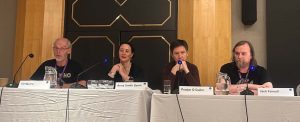 Panel 4 – The Draw of Dark Fiction
Moderator: Matthew (TO) Munro
Panellists: Anna Smith Spark, Peadar Ó Guilín, Jack Fennell,
Grimdark seems to be here to stay, with the continued popularity of authors such as Joe Abercrombie, Mark Lawrence and guest of honour the Queen of Grimdark herself, Anna Smith Spark. What are the elements that continue to resonate with the readers and, as our world grows darker, has its relevance grown? When we look back at Tolkien, writing at the time of WW2, does darkness in our world inspire our fiction to reflect it?
Again, as moderator I couldn’t be as comprehensive in taking notes but I still managed to jot down some interesting thoughts and observations from a very erudite panel.
I started by asking the panel how well this definition captured their understanding of Grimdark – “Grimdark is a subgenre of speculative fiction characterised by its bleak tone, morally ambiguous characters, and a general sense that the world is indifferent, if not outright hostile, to ideals like justice, honour, or hope.”
Peadar argued that every successful fantasy is beginning to be called Grimdark but the key common feature that he had found in all genuine grimdark books is that they used the word ‘cock’. However, fundamentally if the world of the book shows humanity to be meaningless then it is a Grimdark book. Grimdark seems to embrace a nihilistic kind of medieval context in which to write very horrible things and Peadar asserted that “This is great but you shouldn’t allow teenagers to read it.” Indeed he went on to say that he himself does not write Grimdark. When I challenged him about The Call and the way teenagers were transported to a dark threatening world from which they returned terribly deformed or even not at all, Peadar countered that there were still ideas of love and honour driving the characters and the story which placed it outside the Grimdark envelope.
Anna was doubtful about the opening claim of the panel brief, believing that Grimdark’s place in the pantheon of fantasy sub-genres might prove to be more ephemeral than permanent. However, she said her own Empires of Dust trilogy was not ‘nihilistic’ it was ‘realistic’ and hugely influenced by the past history and future projections. Fundamentally ‘the universe doesn’t care’ and justice is not some universal theme that should or will inevitably be achieved. In The Tower of Living and Dying the platoon commander Tobias is not driven by morality or honour or justice, but by the simple imperative to ‘keep his lads safe’.
Jack felt the rise of Grimdark could be seen in the 1980s where social notions of intentional community gave way to a kind of anti-utopian Reaganism in which utopias were seen not just as a futile political project but also actually objectively ‘wrong’. In that context ‘unearned happy endings turned people off’ (!)
The panel felt that Grimdark was no longer a ‘thing of interest’ for publishers and thought the covid lockdown period had a critical effect as it was not a popular time for books that made readers ‘uncomfortable’. A lot of people had been keen to reread books where they knew what was going to happen and that left no thirst for Grimdark.
It was also a time when the society was exploring the moral way to resist – eg “when you go low, we go high” and Jack suspected this contributed to a rather cynical marketing decision by publishers to move away from the perceived toxicity of grimdark.
The panel also discussed the sources of inspiration for grimdark in the historical record, with Anna describing history as “this gorgeous banquet of murder and betrayal.” For example the massacres committed against the rules of hospitality in Ireland and Scotland presage G.R.R.Martin’s Red Wedding. The vicious 1920 burning of the city of Cork was cruelly commemorated in a tradition of having a piece of burnt cork on the relevant regimental hats.
Peadar talked about a time in the 1700s following the penal laws when it was illegal for Irish Catholics people to have an education or own a horse worth more than £5 which meant they had to accept the price when any protestant offered £5 to buy their horse, no matter what the animal’s true worth was – a set of circumstances which led some notable acts of rebellion as well as some heinous injustices.
Anna concluded that Grimdark was essentially fantasy with historical accuracy.
Questions from the floor included one about the representation of race in grimdark literature and the panels enthusiastic recommendations included N.K.Jemsin’s The Fifth Season and R.F.Kaung’s The Poppy War.
Sci-Fi Ireland issue 1 launch party
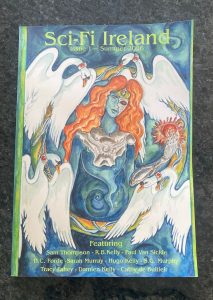
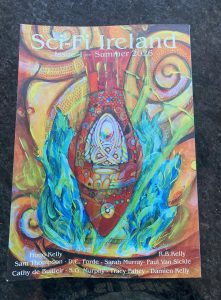
Ireland’s newly minted Science Fiction short story magazine is launching it’s inaugural issue!!!! The launch will feature an introduction to the magazine from Editor-in-Chief Mark Mullan, followed by readings from authors including R.B. Kelly and Sam Thompson.
Ash and I then repaired to the Lisburn room where a generous supply of wine and nibbles had been laid on to support the launch of a new science-fiction magazine.
Editor in chief Mark Mullan gave a welcome in a well-attended gathering, setting out the vision for the project of championing emerging authors and filling an empty niche in the Irish magazine landscape. The covers of the magazine – front and back – are quite stunning and we were then treated to some teasing readings by authors including Sam Thompson, R.B. Kelly and Tracey Fahey that made us eager to read on.
 |
 |
With dogs to get back to at home, that brought Ash and my engagement in Norncon to a close and we headed back on the trusty 6a bus. But all in all it was a fun event and – as other attendees noted – it was so great to have a speculative fiction convention that one didn’t have to fly to!