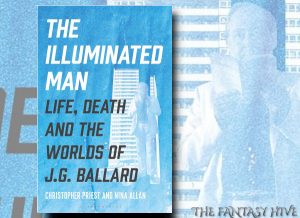
THE ILLUMINATED MAN: LIFE, DEATH AND THE WORLDS OF J. G. BALLARD by Christopher Priest and Nina Allan (BOOK REVIEW)
“But for Balalrd it held a deeper meaning, a sense that reality was itself a stage set that could be dismantled at any moment. No matter how magnificent anything appeared, it could in a few moments be swept aside into the debris of the past. He began to believe that the ruined casino, like the city and the world beyond it, was now more real and meaningful than it had been when it was thronged with gamblers and dancers.” (36)
I am a huge fan of J.G. Ballard, who remains one of the most exciting voices to emerge from 20th century speculative fiction. I never got to meet Ballard before his death in 2009, but I’ve always felt an intensely personal connection to his work. Ballard is one of the few writers to truly nail how it feels to live in the dissociated, media-saturated hyperreal landscape of the 21st century. Even as a young science fiction reader, I think I understood this on some level. Novels like High Rise (1975) and The Drowned World (1962) unearthed something more atavistically real than my other favourite post-apocalyptic novels. Reading Crash (1973) as a confused teenager probably did some damage to my developing sexuality. My childhood was in many ways idyllic, whereas Ballard’s was informed by the trauma of internment in a prisoner of war camp in Shanghai, but I recognised in Empire of the Sun (1984) a depiction of the dissociation that occurs when my similarly privileged expat perspective left me with a forever alienated perspective on returning to my deeply strange home country.
 So I was super excited to learn that Christopher Priest, another of my favourite authors and one of the few that I would consider an equal of Ballard’s in terms of how well his work dissects our current reality, was writing a biography of Ballard. Sadly, during the writing of this book, Priest was diagnosed with terminal cancer. Nina Allan, another favourite author who I consider the greatest writer of current speculative fiction, was also Priest’s partner and wife, and so the book evolved to become a collaborative process between the two of them as Priest’s health failed, with Allan eventually completing the book after Priest’s death. As well as being a huge fan of Priest and Allan’s writing, I have been lucky enough to meet them at various book events and conventions, and consider Chris and Nina to be friends of mine. So reading The Illuminated Man: Life, Death and the Worlds of J.G. Ballard has been an intensely moving experience on various levels. It stands as a remarkable chronicle of the life of one of speculative fiction’s most vital writers, as well as an inspiring and insightful reading of his work. But rather than trying to paper over the cracks of how their personal life and tragedies have shaped the book, Allan and Priest make that experience a part of the narrative. As well as an exploration of Ballard’s life, the book is also a profoundly moving exploration of how the vagaries of life and death intrude into any work of art, and a brave celebration of Priest and Allan’s love for each other during the final years of Priest’s life.
The biographer of Ballard has a number of challenges. Firstly, Ballard’s work is notoriously difficult to write about well. His incredibly concise style and his famous “lack of affect” means that his work is full of hidden depths and meanings that can be tricky to tease out without tying yourselves in knots. Secondly, Ballard’s life has been the subject of much mythologisation, not least by Ballard himself. Ballard was a writer who portrayed a very curated version of himself to the world in his interviews, which makes him incredibly quotable but difficult to trust. This is further complicated by both his own autobiography Miracles of Life (2008) which is very much the official curated version of Ballard’s story from his own perspective, and Empire of the Sun and The Kindness of Women (1991), which are novels and therefore fictional but very much draw on Ballard’s personal life experiences in relating the life of Jim Graham. Empire of the Sun became his most well-known work, especially following its Booker Prize novelisation and its film adaptation by Stephen Speilberg. With Ballard being dead for almost two decades, it’s impossible for the current biographer to speak with him to try and disentangle the fact from the myth.
Priest and Allan do a remarkable job of constructing the story of Ballard’s life, from his childhood internment in the prisoner of war camp through his return to England, his discovery of science fiction while in the RAF, and the development of his career as a writer of both novels and short stories. They have clearly done an incredible amount of research, reading extensively the material that currently exists on Ballard and also talking to his friends, family and colleagues, from his daughters Faye and Beatrice Ballard to writer and editor Michael Moorcock and science fiction critic and Ballard expert David Pringle. The book manages to get as close to the truth as anyone is likely to, whilst at the same time acknowledging that all of us inevitably have our own perspective on things, not least the biographer writing about their subject, and highlighting the people and the perspectives Priest and Allan were unable to include. Particularly important is Claire Walsh, Ballard’s partner after his wife’s death who stuck with him through the ups and downs of their relationship. She is dead and her close friends and family declined to be interviewed, so the book is as much shaped by the absence of her perspective as it is by anyone else’s presence, and is all the stronger for Allan’s frank acknowledgement of this.
Over the course of the biography, Priest and Allan enthusiastically examine all of Ballard’s major novels and a large number of his most significant short stories. As a science fiction academic, I found these parts to be incredibly informative and inspiring. Priest and Allan, as anyone familiar with their writing knows, are brilliant readers and critics as well as writers, and it is a joy to read their profound, lively and sometimes challenging takes on Ballard’s major works. There is enough great scholarship in here to fuel Ballard studies for the next decade. Priest and Allan’s readings of Ballard’s most controversial texts, Atrocity Exhibition (1970), High Rise and Crash, is particularly rewarding. Their argument that the fantastical element of Crash lies in the fact that its central conceit – the inherent eroticism of the car crash – is completely invented for the text provides a startling new key for understanding Ballard’s most challenging work:
the entire substructure of Crash is based on a fantasy – or worse, to quote a distinction made by the author Anthony Burgess, a fancy. The fact that it is persuasively and imaginatively argued, consistently explored and has helped create one of the greatest novels of Ballard’s career, does not diminish this. A fancy is unworkable and untestable, and when pursued ruthlessly to the end it becomes a presumption too far. (208)
This is just one of many aspects of Ballard’s writing that Priest and Allan have helped me see in a new light and that I will be thinking of for a long time to come. Another is an astute observation on the similarities between Ballard and Mervyn Peake, an artist whose style is so radically different from Ballard’s that I had never thought to compare them, and Allan’s expert reassessment of Ballard’s late-period novels Cocaine Nights (1996) through Kingdom Come (2006) which reclaims them as key parts of Ballard’s oeuvre. It’s impossible to read these sections and not want to immediately dive into an extensive reread of Ballard’s work.
But this is only half the book. The other half is the deeply personal story of two people whose lives together are disrupted by illness and death. The decision to include these aspects are part of what make the book so powerful. It would be easy to get distracted by the scholarship and the historicity, and forget that Ballard was a human being who suffered a traumatic childhood and later the traumatic death of his beloved first wife Mary. Just as the apparent serenity of the public persona Ballard expertly displayed at almost all times is brutally interrupted by these uncontrollable traumatic events, so the recounting of his life is disrupted by the trauma of Priest’s diagnosis, illness and death. This not only gives us insight into how the work was sculpted, it allows the humanity of both Ballard and of Priest and Allan to take centre stage at certain points. Allan writes incredibly movingly about love and loss. As someone who knew and cared for both Priest and Allan, reading these sections is emotionally devastating, and I found myself moved to tears multiple times. But knowledge of the subjects is not necessary for the effect – Allan emphasises how this struggle, the process of caring for a loved one and grieving for them after they are gone, is an essential part of the fabric of life that will come in time to almost everyone. Even as it is an intensely personal experience, there is a universality in it in that all of us, and everyone we love, is mortal. Ballard and his children would have undoubtedly gone through their own version of this when Mary died, and his children and his friends again when Ballard himself died. In this way, Priest and Allan’s remarkable courage and generosity with their experiences brings home the humanity present in every biography, on both sides of the page.
The Illuminated Man is a complex book, one I expect to revisit on multiple occasions and discover new things each time. As well as chronicling Ballard’s life and Priest’s final years, it also is an exploration of modernism in post-war British fiction. Priest and Allan link Ballard’s work not just to his science fiction contemporaries in the New Wave, but that wave of brilliant writers such as Anna Kavan and Ann Quin who radically challenged the boundaries of what fiction could do in the 50s, 60s and 70s. It’s also a celebration of the kind of science fiction that Ballard and Priest and Allan write, fiction that is not interested in all the “Buck Rogers stuff” as Ballard dismissively referred to it, but in new ways of exploring the human condition in the 20th and 21st centuries. It’s an impeccable resource of scholarship, an incredibly moving exploration of grief, and a guide for those who would seek to follow the spirit of Ballard, Priest and Allan in their own work. In the end, The Illuminated Man is a fitting tribute to Ballard, Priest and Allan, and what more could one ask for of this book.
The Illuminated Man: Life, Death and the World of J. G. Ballard is available now. You can order your copy on Bookshop.org