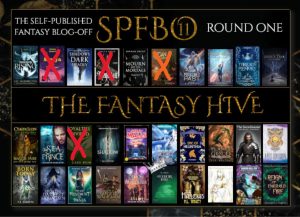
SPFBO 11 FIRST Elimination Post and FIRST Semifinalist Reveal
You can read a little bit about SPFBO 11, our judging blog process and our team here. But to summarise we have divided the process of picking our finalist from our batch of thirty books into two phases.
In Phase 1a the team have been working through the first 10% or so of our batch of 30 books, RAG (Red-Amber-Green) rating each book according to how much the opening drew us in to wanting to read on.
The most enticing six books will go forward into Phase 1b where we will give each book a full read, a full Fantasy Hive review and the chance of being our chosen SPFBO 11 Finalist.
The scores for Phase 1a are all in and we are ready to reveal our first set of eliminations and our first semi-finalist.
We know it’s a disappointing time for those authors whose books are cut, but reading is very much a subjective process and different readers will have different likes. Our judges may have found a semi-finalist that engaged their interest more than the four books whose SPFBO 11 journey ends here. However, there may be other readers out there who like the glimpse we are sharing of the eliminated books and might be tempted to pick them up and read on – and please do!
Eliminations
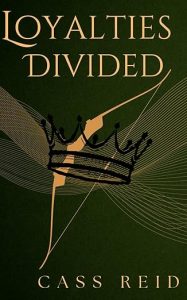 Loyalties Divided by Cass Reid
Reid has a well-developed origin story for her world and the races within it, which is set out in broad brush strokes through the opening prologue. The book then settles into the meat of character and events as we are brought into tense negotiations for an annual cessation of hostilities in a long running war. There are elements of mystery in the cause of the headaches that afflict King Andriel Cassander, and of conflict in the arguments between tempestuous army officer Tyra Carnell and her peers. There are some nice sensory pieces of description in the prose eg “The scent of spice and vanilla flooded the kitchen, and Cade breathed deeply” and “the fire sputtered and crackled, one of the logs giving way to nothing but embers.” However, I would have liked to see tighter dialogue that showed plot and character more economically and the team felt the prologue information would be more effective if folded into the main part of the book. – Theo
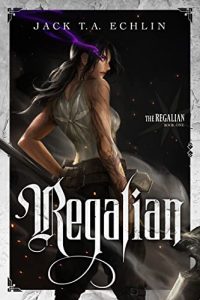 Regalian by Jack T. A. Echlin
Regalian has an interesting idea behind it – a bit of X-Men with a gritty street vibe going for it. The concept of people coming into their powers indicated by a change in their eye color sounded pretty intriguing. The idea of a strong police monitoring system to track and detain these people built up some of the initial tension for this dark dystopian novel. Where it ultimately didn’t land was in the execution. The lead character had a sense of desperation to her but the writing ultimately felt a little off and that took me away from the book far too many times than I expected. That ultimately resulted in a lower engagement with the story than what I would have liked – Vinay
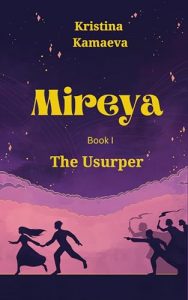 The Usurper by Kristina Kamaeva
I really liked the narrative voice here – it felt as if the story was being told by a bard (appropriately for a fantasy!). The humour is good fun, and I really liked the atmosphere, very Indian, almost like an Arabian Nights-style fairytale. The main issue I had was the amount of character names thrown in so fast, with only a word or two of descriptor to differentiate between them (eg Prankster). The prologue was especially confusing, and I had to reread it several times to really get a sense of the world. Perhaps fewer characters could be introduced more fully, rather than virtual crowds at once? Allow the story to breathe and the world to open up more steadily so we can enjoy, as the writing has tremendous potential. – Cat
This week’s Honourable mention
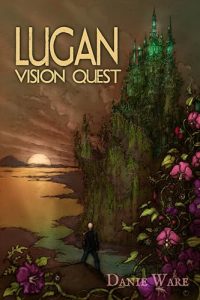 Lugan Vision Quest by Danie Ware
This actually proved to be one of the best written books in the entire competition so far. The characters have real depth, reflected in both their actions and their patterns of speech, the central mystery is intriguing and this would most likely have made it through to the semi-finals if not for the slight problem that it is a cyberpunk book, not a fantasy one. While fantasy elements may show up later in the story, they had entirely failed to do so by the cut-off point for our selections. – G D Penman
I did read on enough to find ‘fantasy’ elements creeping in and I do like an uploaded consciousness story. However, I did find myself asking how far virtual fantasy is really fantasy (see also is Ready Player One fantasy or sci-fi?). That point – in the end – is where Lugan Vision Quest narrowly lost out on a semi-finalist spot. – Theo
And Our First Semi-finalist
The Boddicker Letters
by AC Cross
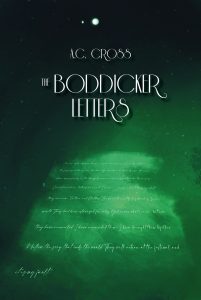 – I really liked the distinctive voice and epistolary nature of a story told through letters. It felt a bit retro/gothic with echoes of the epistolary openings to Frankenstein and aspects of Dracula. There are already a good smattering of nice lines and curios to keep me interested. For example, this line felt like the 1920s talking to the 2020:
“I believe the word of the press is sacrosanct and must be treated with due respect and humility. A lie, once printed, becomes inscribed as true and damns the rest of us.”
The narrative voice is really strong and distinctive with a touch of sardonic humour: “Innsmouth, to put it gently, is a town direly in need of extinction.”
The first 10% has definitely done its job of making me want to read on, but more from the moody writing and the hint of strife/conflict as the plot direction still feels a little obscured. So there is still work to do in developing the story. – Theo
– This book had you in the first chapter and in a way sets the atmosphere wonderfully well. Dark, moody with a side dose of creepy, I loved the narrative epistolary style of this book. I also like characters who are seemingly not aware of the stupidity of their actions but still chronicle them and you cant help but chuckle at some of it. The writing has that flourish to it and the pace keeps you engrossed throughout. It genuinely felt very strongly atmospheric (I keep coming back to it as that’s what really appealed to me) and induced a sense of engrossment and dread. – Vinay
– There can be no denying that this book’s boisterous prose is charming enough for it to get away with a lot, but I have some concerns about its ability to make it through the contest. Thus far it has been a retread of Lovecraft’s Shadow Over Innsmouth, a story which has seen literally hundreds of retellings and spins in mythos circles. It also manages to be a book set in 1920s America where the author seems to have forgotten that the Prohibition exists, though the character also forgets whether he travelled by boat or train to the aforementioned town, describing parts of both, so I’m holding out hope that these ‘errors’ actually turn out to be an unreliable narrator or some clever alternate history twist. – G D Penman
– This appealed to me right from the start, as it seems like a mix of Dracula and Lovecraft, which I am entirely here for! The beginning chapters also carried a similar gothic atmosphere to the recent ‘Nosferatu’ movie, and the (clearly fallible) narrator was likeable enough, with his occasional obliviousness raising a smile. The lady he’s writing to must have the patience of a saint! Prohibition-blindness aside, I thought the writing suited the period very well and have high hopes. – Cat
So congratulations to The Boddicker Letters and commiserations to Loyalties Divided, Regalian, The Usurper and Lugan Vision Quest.
We’ll be back next Wednesday with a second set of eliminations and our second semi-finalist announcement – see you all then 🙂 – Theo